Steel Weldment Camera Frames for Vision Stations

By Johnson on August 22, 2026

steel-weldment-camera-frames-vision-stations

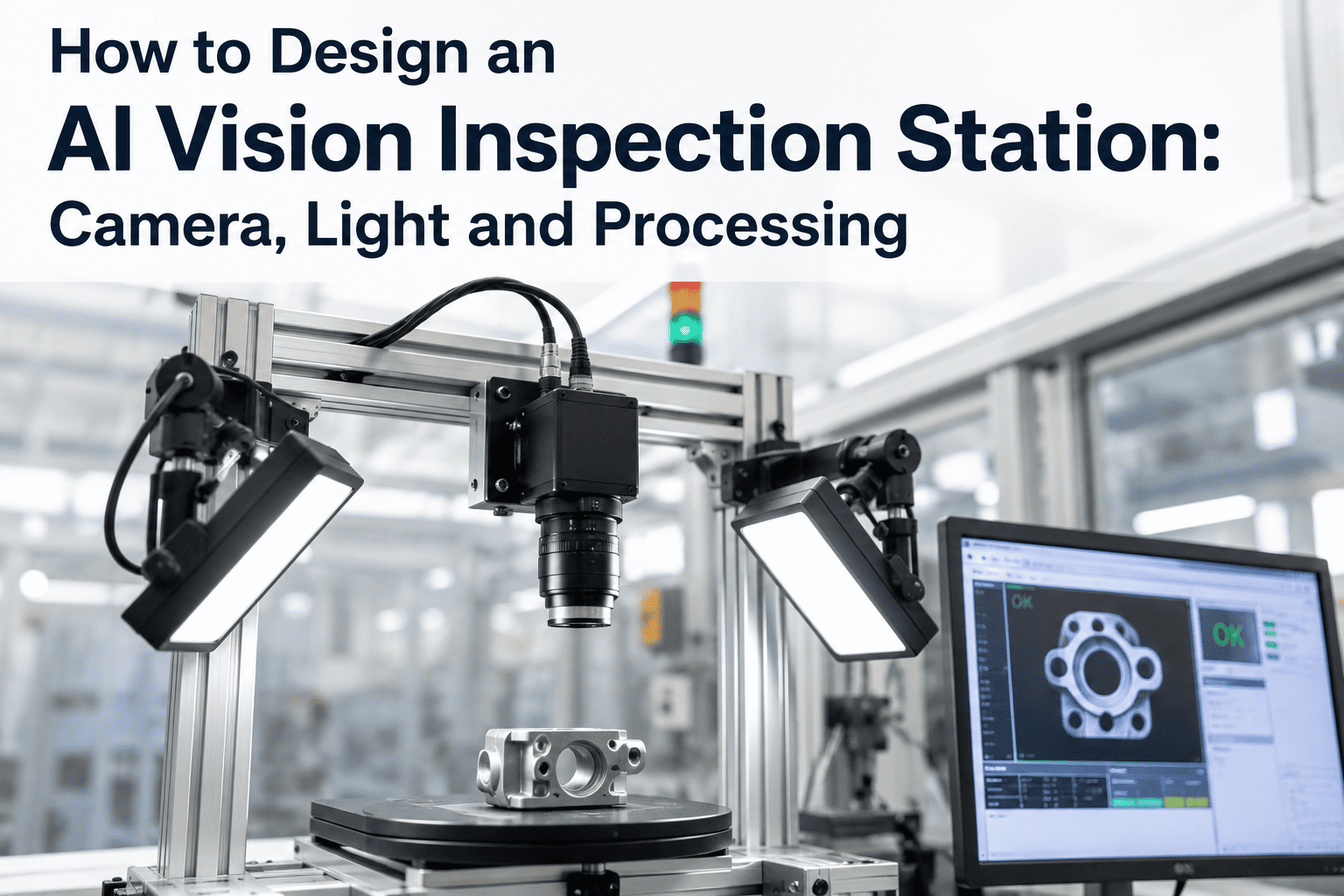
An AI vision model is only ever as accurate as the frame holding its camera steady. A camera bolted to a bracket that flexes even half a millimeter under normal line vibration doesn't produce an occasional blurry frame, it produces inconsistent pixel positioning on every single image, and that's exactly the kind of noise that erodes defect detection accuracy long before anyone thinks to suspect the mounting hardware. Most vision system troubleshooting starts with the camera, the lighting, or the model, and the frame underneath all of it rarely gets a second look until nothing else explains the drift. A properly engineered steel weldment frame is what keeps every other part of the system honest. See how a rigid vision station frame is engineered when you book a demo with iFactory.

STRUCTURAL DESIGN · VISION STATION ENGINEERING

The Camera Frame Most Vision Deployments Get Wrong

A steel weldment frame is the difference between a vision station that holds calibration for years and one that needs re-squaring every month. iFactory engineers the structure before the software ever sees a single frame.

THE INVISIBLE VARIABLE

Why Rigidity Is a Vision Metric, Not Just a Mechanical One

Every micron of flex in a camera frame translates directly into image noise, the same way flex in a machine tool's gantry translates into chatter and dimensional error. It can't be corrected in software after the fact, because the model has no way to know whether a pixel shifted because a defect moved or because the frame it's mounted to moved instead.

Vibration Transfer

A frame mounted directly to a vibrating conveyor or press passes that motion straight into the camera, blurring every frame captured during the vibration cycle.

Thermal Drift

Materials expand and contract with ambient temperature swings across a shift, and a frame without dimensional stability slowly shifts the camera's field of view over the course of a day.

Joint Loosening

Pinned or friction-based connections work loose under repeated dynamic load, and a frame that's slightly out of square today will be more out of square next month.

CHOOSING THE STRUCTURE

Steel Weldment or Aluminum Extrusion: What Actually Holds Calibration

Both materials show up in vision station builds, and both have a real place depending on the application. The comparison below is what actually separates them once dynamic load and long-term stability enter the picture, not just sticker price at purchase.

Factor Steel Weldment Aluminum Extrusion
Joint type Welded, fixed connection that resists rotation Pinned or bolted, leaves clearance at the joint
Rigidity under dynamic load High, holds calibration without added bracing Lower, often needs extra cross-bracing to match
Fatigue strength Roughly double that of aluminum on average About half the fatigue strength of steel
Maintenance pattern Minimal re-tightening once installed and squared May need periodic re-squaring and retightening
Reconfigurability Lower, changes require re-fabrication Higher, beams can be unbolted and repositioned
Best fit Fixed, high-precision, permanent inspection stations Stations expected to change layout frequently

Weight matters here too, in both directions. Steel's added mass is exactly what damps vibration on a demanding station, but it also means the structure needs proper anchoring and can't be repositioned as casually as a lighter extrusion frame. For a station that isn't moving once it's installed, that trade-off almost always favors steel.

Not Sure Which Structure Fits Your Station?

iFactory engineers the mounting structure alongside the camera, lighting, and edge compute, matching frame material to your line's vibration profile and precision requirements before anything gets fabricated.

ANATOMY OF THE FRAME

What a Properly Engineered Weldment Actually Includes

A camera mounting frame is more than a pole with a bracket on top. Every component below plays a specific role in keeping the camera's field of view fixed, frame after frame, cycle after cycle.

BASE

Base Plate

Anchors the entire structure to the floor or a fixed sub-frame, isolated from equipment that generates vibration nearby.

UPRIGHT

Square Steel Upright

Typically welded from square steel tubing, forming the vertical backbone that resists both bending and twisting loads.

BRACE

Diagonal Bracing

Added on taller frames specifically to prevent sway, converting what would be a flexible cantilever into a rigid triangulated structure.

PLATE

Camera Mounting Plate

The precision-machined surface the camera actually bolts to, required to hold tight tolerance so the lens stays exactly where it was calibrated.

GUSSET

Gusset Reinforcement

Triangular plates welded into corner joints, adding stiffness exactly where bending stress concentrates under dynamic load.

FINISH

Stress-Relief and Coating

Heat treatment to remove residual welding stress, followed by a corrosion-resistant finish suited to the plant's environment.

DESIGN REQUIREMENTS

What a Frame Has to Prove Before It Earns Trust on the Line

These aren't arbitrary specifications. Each one maps directly to a failure mode that shows up as a vision system problem long before anyone traces it back to the frame itself.

01
Zero measurable vibration at the camera mount during normal line operation, verified with the equipment actually running rather than tested at rest.
02
Stress relief performed after welding, since an unrelieved weldment continues to move slightly every time it's touched or machined afterward.
03
Dimensional stability across the plant's real temperature range, not just at the ambient temperature the frame happened to be built in.
04
A mounting plate flat and rigid enough that the camera's calibrated position doesn't shift when a cable is routed or a lens is swapped.
05
A finish rated for the plant's actual environment, including washdown, coolant exposure, or corrosive atmosphere where relevant.
THE WARNING SIGNS

Five Signs Your Frame Is Quietly Undermining Inspection Accuracy

These patterns tend to get blamed on the camera, the lighting, or the AI model first, when the actual root cause is sitting one layer beneath all three.

A
Detection accuracy drifts over the course of a shift without any change to the part, the lighting, or the model itself.
B
The station requires re-calibration more often than the vendor's documentation suggests it should, month after month.
C
Image sharpness varies depending on whether nearby equipment, like a press or conveyor motor, happens to be running.
D
The camera mount is a lightweight bracket originally sourced for a security or CCTV application, not engineered for inspection tolerances.
E
Maintenance regularly re-tightens fasteners on the mounting structure just to keep the field of view where it's supposed to be.
WHAT RIGIDITY ACTUALLY BUYS

The Numbers Behind a Frame That's Built Right

These figures aren't abstract engineering trivia. Each one maps directly to how much noise ends up baked into every image your vision model has to interpret.

0.1mm
Side-to-side flex enough to visibly degrade image sharpness on a precision inspection station
2x
Roughly the fatigue strength advantage steel holds over aluminum in dynamic, vibration-heavy applications
Monthly
Typical re-tightening cycle required to keep an under-braced frame within tolerance
Years
Expected service life of a properly stress-relieved, welded steel frame before structural rework is needed
FREQUENTLY ASKED QUESTIONS

Questions Engineers Ask Before Specifying a Vision Station Frame

Is a steel weldment frame really necessary, or is a standard camera mount enough?
For a lightweight indoor camera in a low-vibration environment, a standard bracket can genuinely be enough, and there's no reason to over-engineer a station that doesn't need it. The calculus changes fast the moment the line has real vibration, wide temperature swings, or a precision tolerance tied to the inspection result, since a bracket that flexes under those conditions introduces exactly the kind of inconsistent noise a defect detection model struggles to distinguish from an actual defect. A quick vibration and thermal assessment of the mounting location is usually enough to settle the question either way. Book a demo and bring details on your mounting location for a fast read on which structure fits.
Why does a weldment need stress relief after it's welded?
Welding introduces residual internal stress into the metal around every joint, and an unrelieved weldment continues to move slightly every time it's machined, drilled, or even just handled during installation. That movement is small, often a fraction of a millimeter, but it's precisely the scale that matters for a camera mounting plate that needs to hold its calibrated position indefinitely. Stress relief, typically done in a furnace, settles the structure into its final shape before precision machining or calibration ever happens, which is what keeps the frame true for years rather than months. Contact support to ask about the fabrication process behind a specific station.
Can an existing frame be retrofitted, or does it need to be rebuilt from scratch?
It depends on what's actually wrong with the current structure. If the base frame is fundamentally sound but the mounting plate or bracing is undersized for the application, targeted reinforcement can often solve the problem without a full rebuild. If the frame relies on pinned or friction connections that have already worked loose repeatedly, or if it was never engineered for the vibration profile it's now exposed to, a proper weldment replacement is usually the more reliable long-term fix. An on-site assessment is the fastest way to know which path applies to your station. Book a demo to have your current mounting structure assessed.
How much does frame rigidity actually affect AI defect detection accuracy?
More than most teams expect, because the model has no way to separate real defect signal from noise introduced by a shifting camera position. Even sub-millimeter flex can shift enough pixels between frames that a model trained on a stable mounting position starts producing inconsistent confidence scores, which shows up as accuracy drift that has nothing to do with the model itself. This is why frame engineering is treated as a core part of the vision system design rather than an afterthought handled by whoever happens to be free to weld a bracket together. Contact support to review whether frame stability could be contributing to accuracy issues you're seeing.
What environmental factors should be considered when specifying the frame's finish?
The finish needs to match the actual conditions the frame will live in, not a generic industrial coating chosen without that context. Washdown environments common in food and pharmaceutical plants call for a corrosion-resistant finish rated for repeated moisture exposure, while stations near coolant, cutting fluid, or corrosive process chemicals need a coating specifically compatible with those substances. Getting this wrong doesn't just shorten the frame's life, it can lead to corrosion-driven dimensional changes that quietly reintroduce the exact instability a rigid frame was built to eliminate. Book a demo to spec a finish matched to your plant's environment.

Get a Vision Station Engineered From the Frame Up

iFactory designs the structural frame, camera placement, lighting, and edge compute together as one system, so calibration holds and accuracy stays consistent shift after shift. Book a demo to see it engineered for your line.


Share This Story, Choose Your Platform!