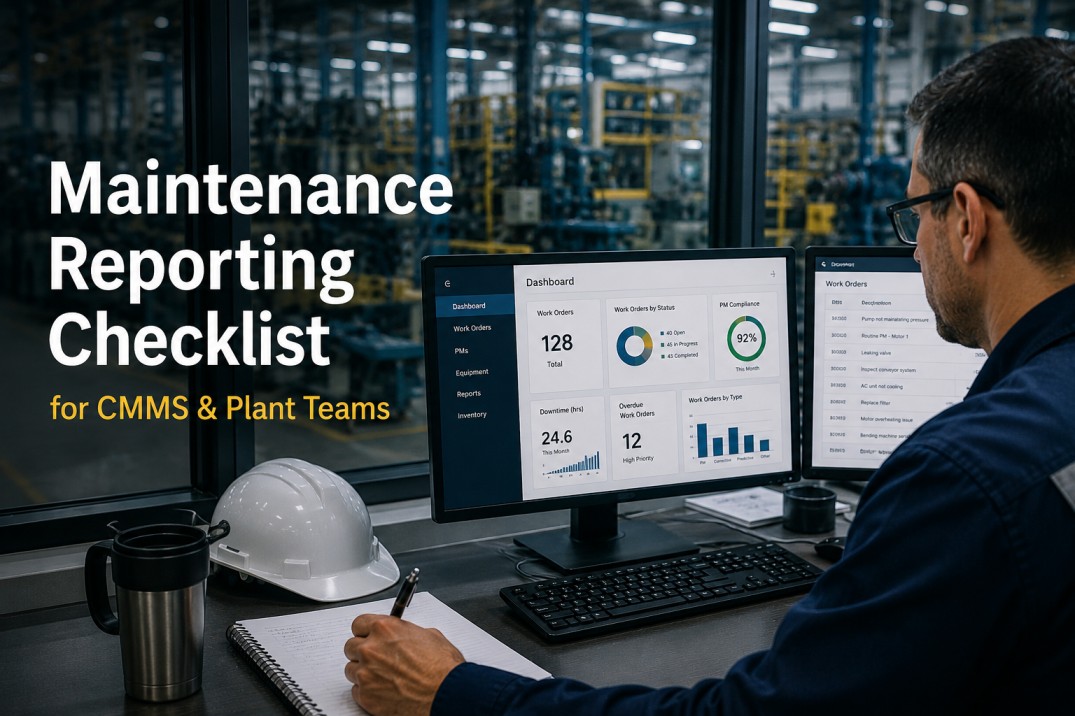
A predictive maintenance reporting checklist helps maintenance and operations teams ensure their PdM program captures the right data, delivers actionable insights, and demonstrates measurable ROI. Without a structured reporting framework, predictive maintenance initiatives generate data but not decisions — failure forecasts go unread, asset health scores are ignored, and the maintenance team cannot prove the value of the investment. This checklist covers the seven dimensions of a complete PdM reporting program, from data readiness through ROI tracking.
See Where Your PdM Reporting Stands
Get a 30-minute assessment of your predictive maintenance reporting readiness. An iFactory analytics specialist will map your current data sources, identify gaps in your PdM dashboard coverage, and show you a live demo using your plant's actual maintenance data.
PdM Data Source Readiness Checklist
Predictive maintenance reporting is only as good as the data feeding it. Before building dashboards or generating forecasts, confirm that each data source is connected, clean, and delivering at the required frequency.
Predictive Maintenance KPI Reporting Checklist
Every PdM dashboard should include a core set of KPIs that measure both the effectiveness of the prediction models and the business impact of the maintenance program. These KPIs fall into three categories: prediction accuracy, operational impact, and financial performance.
Percentage of predicted failures that actually occurred within the forecast window. Target: >85%. Tracked per asset class and per prediction model.
Percentage of predicted failures that did not occur. High false-positive rates erode trust in the system. Target: <15% for mature PdM programs.
How close the predicted failure date is to the actual failure date. Measured in days +/-. Target: within 30 days for long-lead assets, within 7 days for critical assets.
Year-over-year reduction in unplanned downtime attributed to PdM interventions. Tracked as hours saved per quarter. Target: 30-50% reduction in year one.
Composite health score per asset (0-100) tracked over time. A declining trend triggers a PdM review. Score combines vibration, temperature, oil analysis, and run-time data.
Cost avoided from unplanned failures minus the cost of the PdM program (sensors, software, labor). Tracked as a ratio. Target: 4:1 or higher within 12 months of deployment.
Total maintenance cost divided by production output. PdM programs should drive this metric down by replacing emergency repairs with planned, cost-effective interventions.
How many times spare parts inventory turns over per year. Better PdM forecasts enable leaner inventory with fewer emergency orders. Target: 20% improvement in year one.
PdM Reporting Frequency Checklist
Different PdM insights have different cadences. A daily asset health scan is not useful for quarterly ROI reviews, and a monthly prediction report is not actionable for operators. Match the reporting frequency to the decision cycle.
- Health score per critical asset (0-100)
- Threshold violations (vibration, temp, pressure)
- Active alerts requiring Human review
- Sensor connectivity status
- Failure predictions issued in the past week
- Prediction accuracy vs actual events
- Assets approaching critical health threshold
- Recommended inspection or intervention list
- Unplanned downtime trends (hours and events)
- PdM interventions completed and results
- False positive / false negative analysis
- Asset class health trend comparison
- PdM ROI calculation (cost avoidance vs cost)
- Model accuracy improvement trajectory
- Coverage expansion status (assets under PdM)
- Program roadmap and budget review
Out-of-the-Box PdM Reporting
iFactory Ships Predictive Maintenance Dashboards That Work on Day One
Pre-built PdM report templates, asset health scoring engine, and automated KPI calculation. Connects to your existing sensors, CMMS, and data historians in hours — no custom development required.
Asset Health Scorecard Template
Each critical asset should have a health scorecard that combines multiple data sources into a single 0-100 score. The scorecard enables maintenance teams to prioritize interventions based on objective criteria rather than intuition.
| Asset | Health Score | Trend | Next Predicted Failure | Recommended Action | Priority |
|---|---|---|---|---|---|
| Compressor #3 | 92 | Stable | Not expected <180 days | Routine PM | Low |
| Mixer #7 Drive Motor | 67 | Declining | 45-60 days | Vibration analysis & bearing inspection | Medium |
| Conveyor Line 2 Gearbox | 58 | Declining | 21-35 days | Oil change & alignment check | Medium |
| HVAC Unit #2 | 85 | Stable | Not expected <90 days | Filter replacement schedule | Low |
| Press #4 Hydraulic Pump | 34 | Critical | 5-10 days | Schedule replacement — order parts now | High |
| Robot Arm #2 Servo | 72 | Declining | 30-45 days | Calibration check & thermal scan | Medium |
PdM ROI & Value Tracking Checklist
Proving the ROI of predictive maintenance requires tracking both the costs avoided and the program costs. Without a structured ROI dashboard, the maintenance team cannot demonstrate the value of the PdM investment to plant leadership.
- Unplanned downtime cost avoided
- Emergency repair premium avoided (overtime, expedite fees)
- Secondary damage cost avoided (cascading failures)
- Production throughput preserved
- Scrap / rework cost avoided from failure-related quality events
- Sensor and IoT infrastructure (hardware + installation)
- PdM software platform subscription
- Data engineering and integration labor
- Maintenance team training and change management
- Model development and validation (internal or partner)
ROI = (Total Cost Avoided − Total Program Cost) / Total Program Cost × 100
Target: >300% ROI (4:1 benefit-to-cost ratio) within 12 months of full deployment
Frequently Asked Questions About PdM Reporting
What is the most important KPI for predictive maintenance reporting?
Failure prediction accuracy is the single most important KPI because it directly determines the credibility of the entire PdM program. If the model predicts failures that do not occur (false positives), the maintenance team stops trusting the system. If it misses actual failures (false negatives), the program fails to prevent downtime. Most PdM programs target >85% accuracy within the first six months of operation.
How often should PdM reports be generated?
PdM reports should follow the decision cycle of the audience. Asset health dashboards should update daily or in real time for operators and maintenance technicians. Prediction accuracy and failure forecast reports are typically weekly. Operational impact reviews are monthly. ROI and program reviews are quarterly. A good PdM reporting platform supports all four cadences with role-based views.
Do we need machine learning to generate PdM reports?
Basic PdM reports — asset health scores, threshold violations, and trend analysis — can be generated with rule-based algorithms that do not require machine learning. ML becomes valuable for failure prediction, anomaly detection, and lead-time forecasting. Many plants start with rule-based PdM reporting and add ML models as they accumulate enough historical data to train accurate predictors.
How long does it take to set up a PdM reporting dashboard?
With a pre-built PdM platform like iFactory, a basic asset health dashboard can be live in 2-4 days if sensor data is already streaming to a database. Full PdM reporting — including failure prediction, ROI tracking, and multi-cadence dashboards — typically takes 4-6 weeks. The timeline depends on data source complexity, the number of assets, and whether ML model training is required.
What data sources are required for PdM reporting?
The minimum viable data set for PdM reporting includes: sensor data (vibration, temperature, pressure) from critical assets, work order history from the CMMS with failure codes, and asset metadata (age, manufacturer, maintenance history). More advanced PdM programs add oil analysis data, thermal imaging, acoustic data, and production schedule data to correlate maintenance needs with production demand.
How do you measure PdM ROI?
PdM ROI is calculated as the total cost avoided from prevented failures divided by the total cost of the PdM program. Cost avoided includes unplanned downtime, emergency repair premiums, secondary damage, and production losses. Program costs include sensors, software, labor, and training. A healthy PdM program achieves a 4:1 benefit-to-cost ratio within the first year and improves as prediction models mature.
Your PdM reporting is ready to go.
Get iFactory's PdM Dashboards — Pre-Built and Connected
A 30-minute demo with a manufacturing analytics specialist. We'll connect to your existing sensor data and CMMS, show you live asset health dashboards, and deliver a prioritized PdM reporting roadmap for your plant.