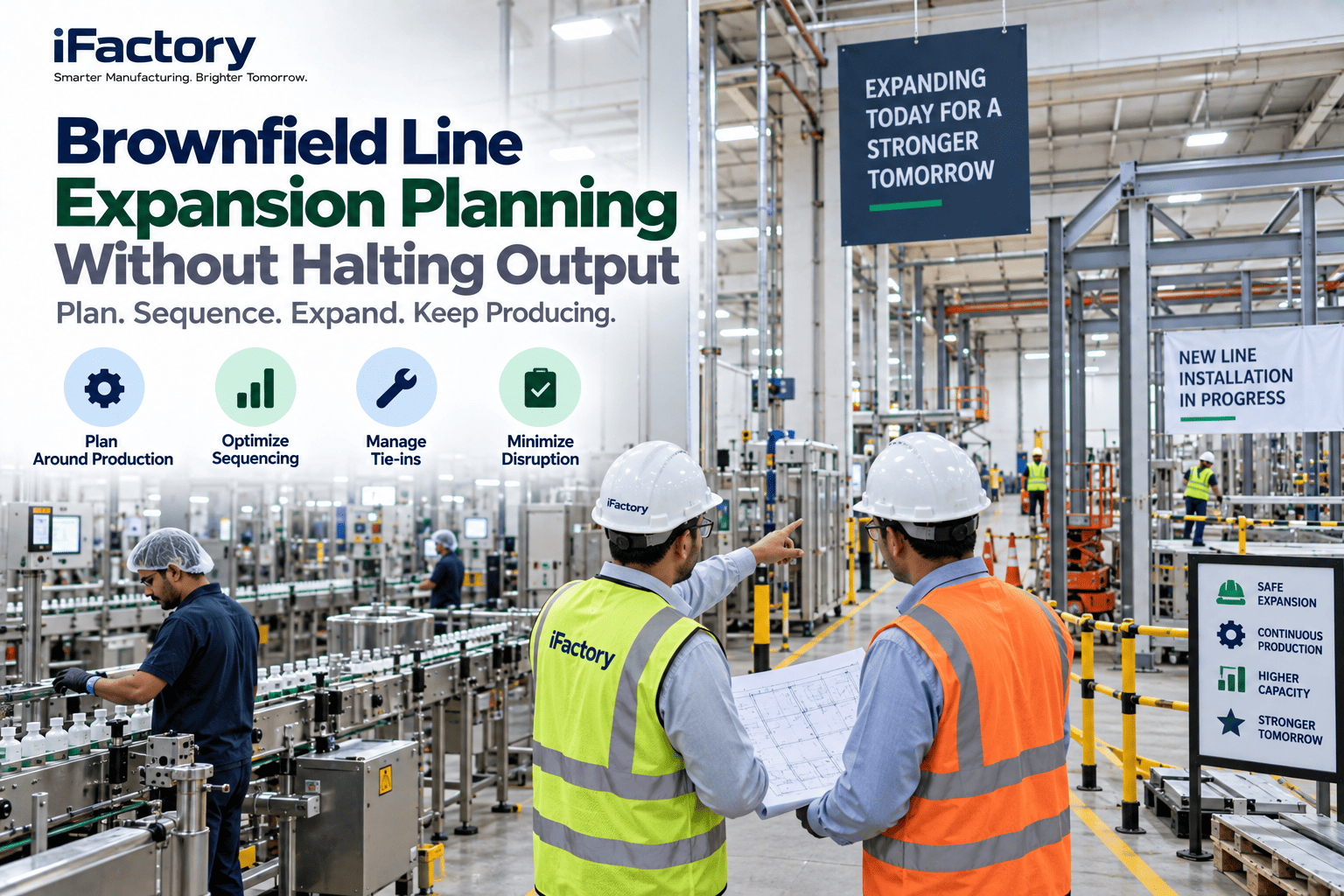
Adding a line inside a running plant means building around production — every foundation pour, every utility tie-in, every commissioning activity has to sequence against the plant's daily output. The economics that justify the expansion assume the running plant keeps running during construction; two weeks of unplanned shutdown erode the pro forma before the new line makes its first shipment. Brownfield expansion planning covers phased sequencing (foundation and utilities where production continues, equipment install with minimal disruption, tie-in windows scheduled during natural low-demand periods, commissioning and ramp-up in parallel with continued operation), and — because brownfield is where late-discovered constraints hide — a discovery discipline that surfaces existing-plant limitations early rather than at concrete-pour.
iFactory / Brownfield line expansion
Add a Line Inside a Running Plant Without the Two Weeks of Shutdown Nobody Budgeted
Brownfield expansion planning with phased sequencing, tie-in window scheduling against demand pattern, existing-plant constraint discovery, and commissioning-during-operation discipline — so the pro forma survives construction.
Ph 1 · Foundation + utilities
Ph 4 · Commissioning + ramp
4-phase
sequenced expansion
Tie-in windows
scheduled to demand
Constraint discovery
pre-concrete
The Problem in Brownfield Expansion Practice
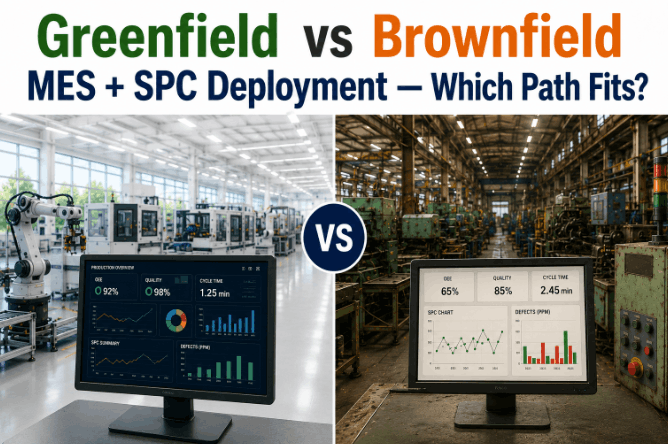
A typical brownfield expansion is planned as if the running plant were a greenfield site with an inconvenient obstacle in the way. Utility tie-ins are scheduled at times construction can execute them, not times production can absorb the outage. Foundation excavation runs near existing lines without vibration analysis. Existing-plant constraints — an under-sized transformer that cannot support the new line's load, a compressed air header that will not deliver the new demand, a wastewater treatment capacity already at operating limit — reveal themselves at commissioning rather than at design. Each late discovery forces a design change, a construction change, or absorbs production time. Meanwhile the pro forma assumed steady-state production throughout.
Where Brownfield Expansion Actually Fails
Brownfield expansion failure modes are consistent across process and discrete manufacturing. Each is a specific late-discovery pattern that pre-work discipline prevents.
Utility undersized
New line's electrical, compressed air, or steam demand exceeds existing infrastructure. Discovered at commissioning. Utility upgrade adds months and cost the pro forma did not carry.
Tie-in during peak
Utility tie-in scheduled at construction convenience rather than demand pattern. Two weeks of production halted during peak demand season. Customer allocation impact and revenue loss compounds.
Vibration to line
Foundation excavation near existing production line transmits vibration that exceeds equipment tolerance. Existing line requires temporary shutdown for construction protection. Cost never budgeted.
Environmental at limit
New line's wastewater or air emission adds load to a treatment system already at operating limit. Environmental permit revision required. Regulatory delay adds quarters to timeline.
What Good Looks Like in Brownfield Expansion
A working brownfield expansion practice holds four disciplines together — pre-construction constraint discovery, phased sequencing against production pattern, tie-in windows scheduled to demand, and commissioning-during-operation coordination.
Constraint Discovery
Existing-plant utility, environmental, and structural capacity assessed against new line demand before design commits. Every constraint that will affect design surfaced pre-concrete.
Discovered early, not late
Phased Sequencing
Construction phases sequenced against production pattern — foundation and utilities where continuous operation is possible, equipment install with minimal disruption, tie-ins concentrated in windows.
Sequenced to production
Tie-in Windows
Utility and process tie-ins scheduled during natural low-demand periods (annual maintenance shutdowns, seasonal low demand, planned inventory build). Construction adapts to production, not vice versa.
Windows serve production
Commissioning Coord
Commissioning of the new line coordinated with continued operation of existing lines. Shared resources (control room operators, maintenance staff, utility supply) protected from over-commitment.
Coordinated ramp-up
How iFactory AI Fits
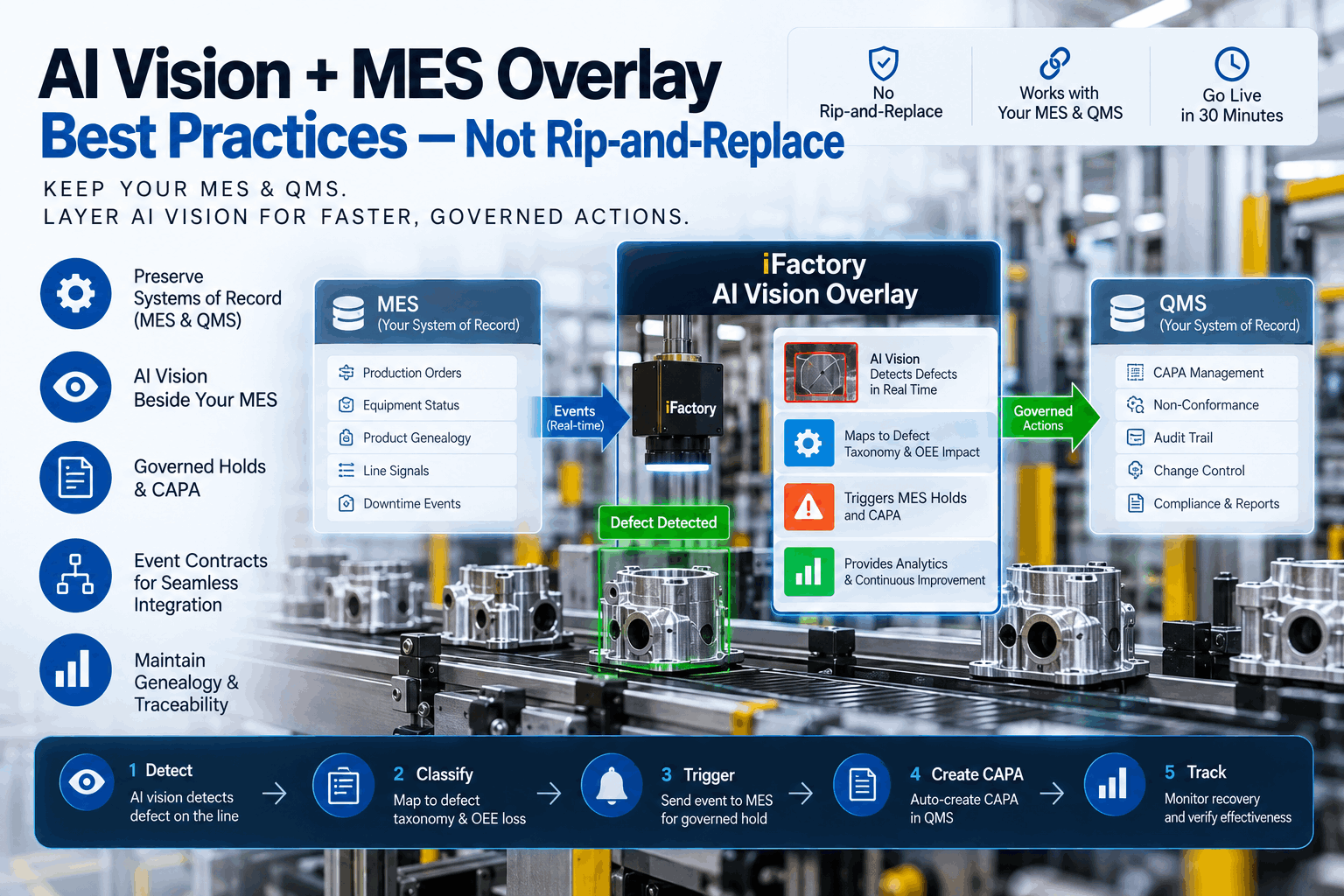
iFactory AI overlays your project management, existing MES/historian data, and utility monitoring — providing the constraint discovery and production-pattern analysis that brownfield planning needs but generic project management does not deliver.
Constraint Scan
Expansion Layer
Existing-plant utility load, environmental compliance headroom, and structural capacity assessed against new line demand. Constraints surfaced with quantified gap and required resolution.
Demand Windows
Expansion + Analytics
Historical demand pattern analysed to identify natural low-demand windows for tie-in scheduling. Window options priced against production impact for project team decision.
Phase Planner
Expansion + PM
Phased sequencing integrated with project management (MS Project, Primavera, Smartsheet). Each phase with production-impact assessment. Alternatives compared quantitatively.
Coord Dashboard
Expansion + MES
Real-time coordination view during construction — existing production metrics, construction milestones, tie-in countdown, shared resource utilisation. All stakeholders on one picture.
Ask your operations director how the last brownfield expansion's production loss compared to the pro forma assumption. If the answer is significantly worse — or unknown — the next expansion is queued to repeat the pattern. Book a brownfield expansion review.
16-Week Brownfield Expansion Planning Pilot
One planned brownfield expansion in early design, sixteen weeks. The pilot runs constraint discovery, produces the phased sequencing plan against demand pattern, and delivers the pre-construction risk register.
Weeks 1–4
Constraint Discovery
Existing-plant utility, environmental, and structural capacity assessed against new-line demand. Every gap quantified. Resolution options priced for design team.
Weeks 5–8
Demand Windows
Historical demand pattern analysed. Tie-in window options identified with production impact per option. Recommended windows aligned with demand valleys.
Weeks 9–12
Phased Sequence
Construction phases sequenced with production impact per phase. Alternatives compared. Recommended sequence with production-impact-adjusted schedule delivered.
Weeks 13–16
Risk Register
Pre-construction risk register with all late-discovery risks quantified and mitigated. Project team enters construction with realistic pro forma protected.
Who Owns the KPI
Brownfield expansion crosses operations, engineering, project management, and finance. Each function owns a specific KPI or the project reverts to greenfield-style planning inside a running plant.
Operations Director
Production loss vs pro forma
Owns the operational outcome — the delta between actual production loss during construction and pro forma assumption. Rising delta erodes project economics directly.
Plant Engineering Manager
Late-discovery constraint count
Owns the constraint discipline — the count of late-discovered constraints post-design commit. Zero is the target; every one costs schedule and dollars.
Project Manager
Tie-in windows aligned with demand
Owns the sequencing — the share of tie-in windows scheduled during demand valleys rather than construction convenience. Convenience-scheduled tie-ins destroy pro forma.
CFO / Finance
Actual vs pro forma capital ROI
Owns the capital outcome — actual ROI vs pro forma. Brownfield expansions frequently underperform pro forma; disciplined planning is what closes the gap.
FAQ
How is this different from generic capital project management?
Generic capital project management focuses on cost, schedule, and scope — the standard project triangle. Brownfield expansion adds a fourth dimension: existing-plant operational continuity. A greenfield project can absorb schedule slippage because there is no running plant to protect; a brownfield project cannot, because every day of construction interference is a day of production impact against the pro forma. The workflow adds the discovery, sequencing, and coordination discipline that greenfield project management does not require. Where the organisation already runs Primavera P6, MS Project, or Smartsheet for capital projects, the brownfield workflow integrates with them rather than replacing.
What if the pro forma is already committed with unrealistic production assumptions?
This is the situation most brownfield expansions actually face. The pro forma was approved on assumptions that construction would run around production without meaningful impact — an assumption that unravels the first time a utility tie-in is scheduled during peak demand. The workflow's discovery phase surfaces these unrealistic assumptions before construction commits, allowing the project team to either adjust the pro forma (protecting future accountability) or find sequencing that actually meets the original assumption. What the workflow doesn't do is protect a fundamentally unrealistic pro forma; what it does is prevent the specific late-discovery pattern that most commonly destroys projected ROI.
Book a demo to see the pre-construction discovery in action.
How does this handle regulated environments where tie-ins require validation?
Regulated environments (pharma, medical device, biotech, aerospace) add validation dimensions to brownfield expansion — new equipment requires IQ/OQ/PQ, changes to existing validated systems require change control, and utility tie-ins that affect classified spaces require environmental monitoring reassessment. The workflow supports regulated brownfield expansion with validation activities integrated into the phased sequencing — validation runs in parallel with construction where scope permits, in series where regulatory requirements demand, and never as a post-hoc retrofit. Where the site runs pharmaceutical or medical device regulated processes, integration with existing QMS and validation systems preserves regulatory posture through the expansion.
Stop letting brownfield expansions destroy their own pro forma.
Run Constraint Discovery on the Next Expansion — Live
Bring one planned brownfield expansion in early design, the current pro forma assumptions on production continuity, and demand pattern data from the last two years. We'll walk constraint discovery on utilities, environmental capacity, and tie-in windows against demand — and show what the disciplined phased sequencing looks like.
Constraint
discovery early