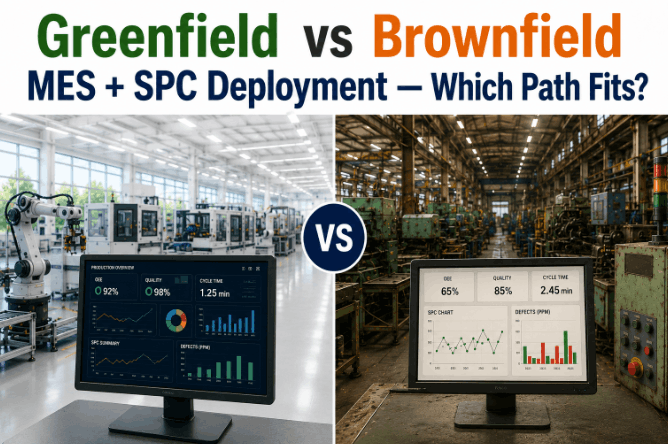
Greenfield vs Brownfield MES + SPC Deployment — Which Path Fits?

By Henry Green on June 3, 2026

greenfield-vs-brownfield-mes---spc-deployment-—-which-path-fits

Every plant modernization decision eventually arrives at the same fork: treat the facility as a greenfield build — start with a clean architecture, modern protocols, and a full digital stack — or work around what is already there, layering new capabilities onto legacy PLCs, proprietary historians, and aging MES platforms that the business cannot afford to replace. The greenfield path promises clean data, clean architecture, and fast time-to-value. The brownfield path promises no rip-and-replace, no production disruption, and no capital spend on infrastructure that is already paid for. Both promises are real. Both paths have failure modes that most MES vendors do not disclose before the contract is signed. iFactory is designed for both — a read-only MSMQ connector for brownfield plants that need intelligence layered onto existing infrastructure, and a native REST and OPC-UA integration path for greenfield builds that want a modern digital stack from day one — running the same SPC engine, the same AI analytics, and the same quality management workflows regardless of which deployment mode the plant requires. Book a Demo to map your plant's deployment path against iFactory's two-mode architecture.

2 Paths
Brownfield read-only MSMQ and greenfield native REST/OPC-UA — one platform supports both
Zero
Legacy systems replaced in brownfield mode — connector reads without modifying existing OT
5 Weeks
Deployment timeline for either path — brownfield or greenfield — to live SPC and AI analytics
Same SPC
Identical SPC engine, quality workflows, and AI Copilot in both deployment modes
Brownfield or greenfield — iFactory deploys in five weeks either way.
Two deployment modes, one platform. iFactory's read-only MSMQ connector serves brownfield plants; native REST and OPC-UA serves greenfield builds — both running the same SPC engine and AI analytics from day five.

Defining the Difference: Greenfield vs. Brownfield in Manufacturing Modernization

The terms greenfield and brownfield describe the infrastructure context a new system enters — not the age of the facility itself. A ten-year-old plant that recently installed a modern DCS and an OPC-UA-capable historian may be a greenfield integration context. A new facility built with legacy equipment from a recently closed plant may be a brownfield context. Getting the classification right is the first step in selecting the right deployment path — and the right questions to ask any MES or SPC vendor before signing.

Brownfield Plant Characteristics
  • PLCs from multiple vendors, multiple generations, communicating via Modbus RTU, EtherNet/IP, or proprietary protocols
  • Historian platform in production (OSIsoft PI, GE Proficy, Honeywell PHD) with years of process data already archived
  • MES or SCADA system that the business depends on — not available for replacement without a capital project
  • OT network segregated from IT network with strict change control on anything touching PLC programs or historian configuration
  • Quality data distributed across multiple systems — LIMS, paper records, spreadsheets, and the MES — with no single normalized source
Greenfield Plant Characteristics
  • New control infrastructure — modern PLCs with native OPC-UA server capability and no legacy protocol dependencies
  • No existing historian — the data architecture is being designed from scratch alongside the plant build
  • No incumbent MES that requires integration — opportunity to define the data contract between PLC and analytics layer without backward compatibility constraints
  • IT/OT convergence designed in — network segmentation planned with analytics data flows in mind, not retrofitted afterward
  • Opportunity to define quality KPI structure and SPC calculation methodology consistently from day one — no legacy calculation methods to reconcile

Brownfield Deployment: MSMQ Connector for Legacy Infrastructure

iFactory's brownfield deployment path is built on a single architectural principle: get intelligence out of legacy systems without touching them. The MSMQ connector reads from existing historians and control systems using the protocols they already speak, normalizes the data without requiring schema changes or new data exports, and delivers SPC and AI analytics through a layer that is entirely separate from the OT infrastructure the plant depends on.

01
Read-Only MSMQ Connector Installation
The iFactory MSMQ connector installs on a dedicated server in the plant DMZ — network adjacent to the OT historian but logically isolated from both the OT control network and the corporate IT network. Historian connection is read-only at the protocol level using OPC-UA, OPC-DA, or the historian's native API. No PLC programs, no historian configurations, and no existing MES workflows are modified.
Compatible: OSIsoft PI · Aspentech IP21 · GE Proficy · Honeywell PHD · Wonderware
02
Tag Mapping and Data Schema Normalization
iFactory's implementation team maps existing historian tags to ISA-95 canonical objects — equipment units, process variables, production orders — using the plant's existing tag naming conventions. No new tags are created in the historian. The mapping layer translates legacy nomenclature into the iFactory data model without requiring changes to the source system.
Typical scope: 200–2,000 tags per plant · Tag mapping completed in Week 1–2
03
SPC Model Training on Historical Data
iFactory ingests the plant's historical process data from the connected historian to train SPC baselines — control limits, process capability indices, and normal operating envelopes — that reflect actual plant performance history rather than theoretical specification limits. Plants with 12–36 months of historian data achieve the highest initial SPC model accuracy.
Data requirement: Minimum 12 months historian archive · Optimal: 24–36 months
04
Live SPC and AI Analytics — No Legacy System Changes
With the connector live and SPC baselines trained, iFactory delivers real-time SPC monitoring, AI anomaly detection, automated CAPA generation, and the AI Copilot quality interface — all without any modification to the plant's OT infrastructure. The legacy historian continues operating identically. The existing MES continues operating identically. iFactory adds a new analytical intelligence layer on top of the infrastructure that is already there.
Deliverable: Live SPC + AI by Week 5 · Zero production disruption during deployment

Greenfield Deployment: Native REST and OPC-UA Integration

For facilities being built or rebuilt with modern control infrastructure, iFactory's greenfield deployment path eliminates the middleware layer entirely. Native OPC-UA connections from modern PLCs deliver process data directly to the iFactory platform, and REST APIs handle bidirectional communication with ERP, quality management, and scheduling systems — establishing a clean, maintainable architecture from the first production run.

Native OPC-UA from PLC
Modern Allen-Bradley, Siemens S7-1500, Mitsubishi iQ-R, and Omron NJ/NX controllers expose native OPC-UA server capability. iFactory subscribes directly — no historian required, no additional middleware, sub-second tag data delivery to the analytics platform with built-in security at the OPC-UA session level.
REST API for ERP Bidirectional
Production orders from ERP arrive at iFactory via REST webhook, triggering automatic recipe validation and SPC baseline selection for the new order. Production actuals — yield, cycle time, Cpk, and quality disposition — publish back to ERP through the same REST interface at job close, closing the planning-vs-actuals loop without manual data entry.
ISA-95 Data Model from Day One
In a greenfield deployment, iFactory configures the ISA-95 data model before production begins — equipment unit definitions, process segment definitions, and production schedule structures are set up against the new plant's actual equipment topology. There is no legacy data model to reconcile and no tag mapping exercise required.
SPC Baselines Set Pre-Production
For greenfield facilities without historical data, iFactory uses transfer learning from analogous plant processes to establish initial SPC baselines — applying cross-plant process knowledge to generate starting control limits that tighten as the new plant accumulates production data in its first operating months.

Side-by-Side: Brownfield vs. Greenfield Deployment Comparison

Dimension Brownfield (MSMQ Connector) Greenfield (Native REST/OPC-UA)
Primary Integration Path MSMQ connector reads from existing historian via OPC-UA, OPC-DA, or native historian API — no new tags or configurations in source systems Direct OPC-UA subscription from PLC + REST webhooks from ERP — no historian layer required
OT Infrastructure Changes Zero — existing PLCs, historian, and MES continue unchanged Minimal — OPC-UA server enabled on modern PLCs (typically a configuration change, not a program change)
Historical Data for SPC Training Available — historian archive used to train SPC baselines before go-live; 24–36 months recommended Not available — SPC baselines initialized via transfer learning and tighten as production data accumulates
Tag Mapping Effort Moderate — existing historian tags mapped to ISA-95 canonical objects in Weeks 1–2 Low — ISA-95 model built from scratch aligned to new plant equipment topology before first production run
Data Latency to SPC Platform Historian polling interval + MSMQ delivery: typically 1–30 seconds depending on historian configuration OPC-UA subscription event: typically 100–500ms from PLC tag change to SPC platform
Deployment Timeline to Live SPC 5 weeks: Week 1–2 connector + mapping, Week 3–4 SPC training + validation, Week 5 full production rollout 5 weeks: Week 1–2 OPC-UA config + ISA-95 model, Week 3–4 ERP REST integration + SPC setup, Week 5 go-live
Best Fit Plant Profile Operating facilities with incumbent historian and MES that cannot be replaced or modified; strict OT change control environments New construction, post-major retrofit, or facilities with modern PLC infrastructure and no incumbent MES dependency

Expert Review: The Deployment Path Decision Most Plant CIOs Get Wrong

The mistake I see plant CIOs make most consistently in MES modernization projects is treating brownfield as a temporary state to be tolerated until the next capital budget cycle funds a full greenfield replacement. That framing creates two problems: it delays value realization by two to four years while the business waits for the capital project, and it typically results in a greenfield replacement that replicates the data architecture problems of the legacy system because nobody did the ISA-95 design work during the brownfield period. The better framing is: deploy the analytics intelligence layer on top of what you have today via a read-only connector, capture value immediately, and use the insights from that brownfield deployment to design the greenfield data architecture correctly when the capital is available.
Plant CIO, Discrete Manufacturing
Automotive Components and Industrial Equipment, 21 Years — CGEIT, ISA Member
On the greenfield side, the failure mode I see most often is over-engineering the data architecture during construction and under-delivering on the analytics capabilities by go-live. Teams spend six months designing the perfect ISA-95 model and arrive at commissioning with a beautiful data structure and no SPC logic, no quality workflows, and no AI capabilities. iFactory's greenfield deployment path is designed to prevent that: the ISA-95 model is configured in parallel with construction, SPC baselines are seeded with transfer learning before the first part runs, and the ERP integration is tested against the production order schema before the plant opens. You arrive at commissioning with a live analytics platform, not a data architecture diagram.
Manufacturing IT Director
Greenfield Plant Commissioning, Medical Device and Aerospace, 16 Years

Frequently Asked Questions

Yes. Because both deployment modes run the same SPC engine and data model, brownfield plants can migrate to direct OPC-UA connections incrementally — by equipment line or by plant area — without disrupting existing MSMQ-connected data flows or retraining SPC models.
SPC models are stored in iFactory's platform, not in the historian — a historian replacement only requires reconfiguring the connector's data source, not retraining models; existing control limits and baselines are preserved and continue operating against the new data stream.
Yes — the corporate quality roll-up aggregates data from MSMQ-connected brownfield plants and native OPC-UA greenfield plants into the same corporate dashboard; both paths deliver normalized Cpk, OEE, and quality data to the same analytical layer.
For legacy PLCs without OPC-UA capability, iFactory's connector uses OPC-DA, Modbus TCP/RTU, or EtherNet/IP — in most cases connecting through the plant's existing SCADA or historian which already aggregates data from legacy controllers.
Partial retrofit plants use both paths simultaneously — native OPC-UA for new equipment lines and MSMQ connector for legacy lines — with iFactory normalizing both data streams into a unified plant view under the same SPC and analytics framework.

Conclusion: Both Paths Lead to the Same Platform

The greenfield vs. brownfield decision is a deployment architecture decision, not a capability decision. Both paths lead to the same iFactory SPC engine, the same AI analytics, the same quality workflows, and the same corporate roll-up capability. Brownfield plants do not need to wait for a capital project to get intelligence out of the infrastructure they already have — the read-only MSMQ connector delivers live SPC and AI analytics in five weeks without touching a single PLC program or historian configuration. Greenfield plants do not need to wait for six months of data architecture design to deploy a production-ready analytics platform — the ISA-95 model is configured during construction, and transfer learning seeds SPC baselines before the first production run. The right deployment path is the one that matches your plant's current infrastructure reality. iFactory supports both, and plants that start in one mode can evolve to the other incrementally as their infrastructure changes — because the platform, the data model, and the analytics are the same regardless of which path brought the data in.


Brownfield or Greenfield — Deploy iFactory in Five Weeks Either Way
iFactory's two deployment modes — read-only MSMQ for brownfield, native REST/OPC-UA for greenfield — run the same SPC engine, AI analytics, and quality workflows regardless of your plant's infrastructure maturity. No rip-and-replace. No six-month wait. Live SPC in five weeks.
Brownfield MSMQ Connector Greenfield OPC-UA Native Same SPC Engine 5-Week Deployment Zero OT Modification

Share This Story, Choose Your Platform!