A cement plant runs on several hundred electric motors, and a handful of them can stop the kiln on their own. They work in dust and heat, start against heavy loads, and often sit where nobody can easily reach them. Most are checked a few times a year, which leaves long gaps in which a bearing, a winding or a drive can go from fine to failed. iFactory's Predictive Maintenance and MCSA AI listens to each motor through its own electrical supply, around the clock, and turns what it hears into a planned job instead of a breakdown. To see it on your own motor list, book a motor review.
AI Motor and Electrical Health Monitoring for Cement Plants
Catch bearing wear, insulation ageing and MV drive faults early — on LT and HT motors across kilns, mills, fans and conveyors, mostly without fitting a sensor to the motor.
- Listens from the MCC, not the hot end of the plant
- One view for LT motors, HT motors and drives
- Each alert comes with a cause and a repair window
- Most motor failures start in the bearings or the windings, and both give warning.
- A motor's own current carries that warning, so it can be read from the MCC.
- Covering the whole fleet matters: a small conveyor motor can stop a kiln too.
Why Motors Fail — and Why Cement Is Hard on Them
Three out of four failures begin in two places: the bearings and the stator winding.
Surveys of large motors have said the same thing for decades. That is good news, because both kinds of damage build slowly and leave signs long before the motor stops. Our support team can go through your own failure history with you.
The catch is timing. A quarterly inspection route gives four snapshots a year, and a bearing can go from first damage to failure inside one gap. Continuous monitoring takes a reading every few minutes instead. It is a fast-growing field: one analyst puts the motor monitoring market at US$3.1 billion in 2026, rising about 10% a year.
A later IEEE survey of industrial motors gave a similar picture: bearings 44%, stator 26%, rotor 8%.
What cement adds
- Dust. It blocks cooling fins and filters, and works its way into bearings and windings.
- Heat. Motors near the kiln and cooler run hot. A common rule of thumb says every 10°C over rating halves insulation life.
- Heavy starts. Mills, crushers and loaded conveyors start hard. Each start strains rotor bars and windings.
- Hard-to-reach places. Preheater towers and conveyor galleries are not walked every day.
Three Ways to Listen to a Motor
No single method hears everything. Used together, they cover the bearing, the winding, the rotor and the drive.
iFactory brings the three into one health score for each motor, and adds any vibration data you already collect. To see which of these fit your motors, book a working session.
Current signature
Listens from the MCC or switchgear.
Good at: broken rotor bars, an off-centre rotor, supply imbalance and problems in the driven machine.
Weaker at: early bearing wear, lightly loaded motors, and drive-fed motors unless the analysis allows for the drive.
Partial discharge
Listens at the HT motor terminals.
Good at: ageing, loose or contaminated insulation in HT stator windings, often long before failure.
Weaker at: anything on LT motors. It shows a trend, not a countdown, and drive-fed machines need extra care.
Drive and temperature data
Listens to the MV drive and winding sensors.
Good at: failing capacitors and power cells, blocked cooling, overloads and hot windings or bearings.
Weaker at: faults the drive does not report. What is available depends on the drive and how it is connected.
Current analysis can see bearing damage, but usually later than a vibration sensor does. Where bearings are the main risk, iFactory uses your vibration and temperature readings alongside the electrical ones.
What Each Fault Looks Like
Each fault leaves its own fingerprint, and each gives a different amount of warning.
The AI learns what is normal for each motor at each load, then watches for change. When something shifts, it names the likely fault and how fast it is moving. Ask our reliability specialists how thresholds are set for a motor like yours.
Warning times are typical ranges from field experience, not guarantees. They vary with the motor, the load and how early monitoring begins.
MV drives deserve their own watch
Capacitors and cells
In one published cement-plant case, a faulty capacitor cell caused repeated start-up trips on a 4,160 V drive. Monitoring found the cell, and it was changed at a planned stop.
Cooling
Cement dust clogs filters and slows fans. Cabinet and heat-sink temperatures climb for weeks before the drive finally trips on over-temperature.
Supply quality
Voltage dips and harmonics stress the drive and the motor together. Logging them shows whether a trip began inside the drive or outside it.
What One Avoided HT Motor Failure Is Worth
A preheater fan motor that fails without warning stops the kiln until it is repaired or replaced. The same job, planned into a stop, costs a fraction of that.
LT and HT: Cover the Whole Fleet, Not Just the Big Six
The largest motors get the attention. The small ones cause many of the stops.
A belt conveyor motor or a cooler fan can halt production as surely as a mill motor. Because current analysis is read at the MCC, it is practical to cover hundreds of LT motors, not only the few HT ones. To sort your own list into tiers, book a fleet review.
LT motors run at low voltage, typically 415 V, and there are hundreds of them. HT motors run at 3.3, 6.6 or 11 kV. There are only a few, but each one can stop the kiln.
Where they are, and what tends to go wrong
Kiln
Main drive and its converter. Slow speed, high torque and heat. Watch the drive, the winding temperature and load swings.
Mills
Raw, coal and cement mill motors. Heavy starts and shock loads. Watch rotor bars and HT insulation.
Fans
Preheater, cooler and filter fans, often on MV drives. Watch bearings, imbalance from build-up, and drive cooling.
Conveyors
Belts, elevators and crushers. Many small motors in dusty galleries. Watch bearings and overloads from jams.
From Signal to Work Order
An alert that nobody acts on is just noise. Each finding ends as a job with a date.
Most of the sensing happens in clean, cool electrical rooms. Current and voltage are taken at the MCC or switchgear; only HT motors need couplers at the terminals. Our integration team can confirm what your panels and drives already provide.
Sense
Current and voltage at the MCC, partial discharge on HT motors, drive data and temperatures.
Learn
Each motor's normal pattern is learned across its real range of loads.
Detect
A change from normal is matched to a fault type, with its rate of growth.
Plan
A work order is drafted with the likely cause, the urgency and the next planned stop.
A cracked rotor bar, unwatched
- Week 0. A bar cracks during a heavy start.
- Week 6. More bars crack. Nobody knows.
- Week 9. The motor trips on a Saturday night.
- After. Days of lost production and an emergency repair.
The same fault, watched
- Week 0. A bar cracks during a heavy start.
- Week 2. Sidebands appear. The motor goes on watch.
- Week 6. Alert raised; work order and spare arranged.
- Week 7. Repaired at a planned mill stop.
Who sees what
- Electrical engineer. Every motor's health, with the evidence behind each alert.
- Maintenance planner. Jobs ranked by urgency and matched to planned stops.
- Stores. Early notice of spares and rewinds that will be needed.
- Plant manager. Critical drives at risk this month, on one page.
iFactory advises. Protection relays and trips stay exactly as they are.
Turnkey AI: Delivered, Connected and Live in 6–12 Weeks
You do not build this. It arrives ready.
iFactory ships as a pre-configured NVIDIA AI server, racked and ready, with the software pre-loaded. Rack it, plug in power and Ethernet, and the AI is live on your network.
Our team handles cabling, network setup, PLC and SCADA integration, operator training and 24×7 remote monitoring. The server sits inside your own network, and your plant data stays on it. For a scope matched to your motor fleet, request a turnkey quote.
Ship, network and data
Server installed. Motor list sorted into tiers. Current sensors fitted at the MCCs; drive and temperature data connected.
Model training and pilot
Normal patterns learned for each motor. First findings checked on site with your electrical team before any alert goes live.
Go-live and training
Health scores and work orders go live. HT couplers fitted at the next planned stop. Training by role; 24×7 remote monitoring begins.
Frequently Asked Questions
What is MCSA, in simple terms?
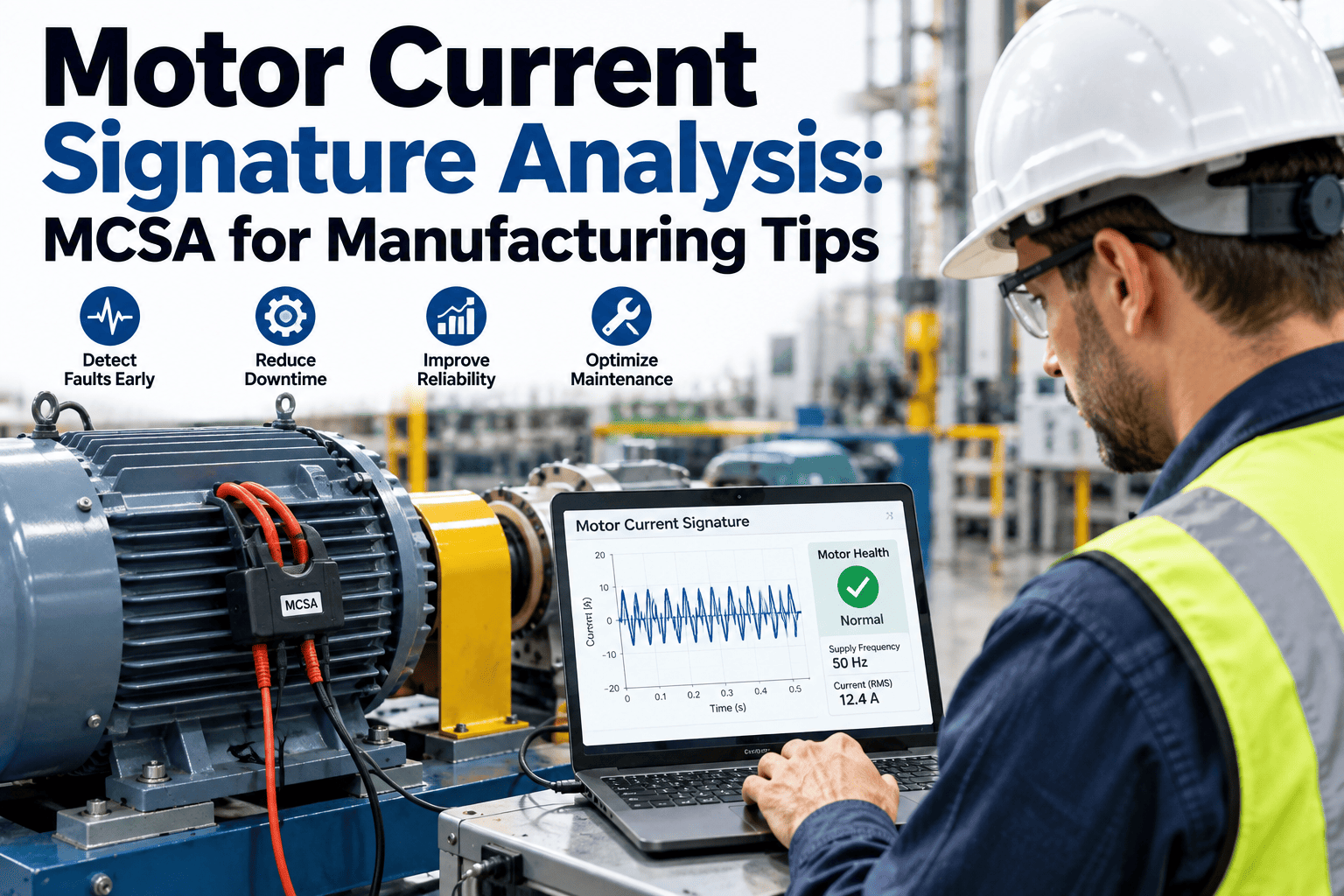
Motor current signature analysis. A healthy motor draws a smooth, regular current. A fault in the rotor, the air gap or the driven machine adds small, repeating ripples to it. MCSA measures the current at the MCC and looks for those ripples, so nothing has to be fixed to the motor itself.
Can MCSA detect bearing wear?
Yes, but usually later than vibration monitoring does. It is strongest on rotor and air-gap faults. For motors where bearings are the main worry, we combine the electrical readings with vibration and temperature so the earliest sign is not missed.
How is HT motor monitoring different from LT?
HT motors add one important risk: the high-voltage winding insulation. That is watched with online partial discharge measurement, which applies from about 3 kV upward. LT motors do not need it; current analysis and temperature cover them well.
Does it work on motors fed by VFDs and MV drives?
Yes, with care. A drive adds its own ripple to the current, so the analysis has to allow for it. The drive's own data, such as cell voltages and temperatures, becomes an extra source. Partial discharge on drive-fed machines is harder and is assessed case by case.
Do we have to stop the plant to install it?
Mostly no. Clamp-on current sensors can usually be fitted in the MCC while the plant runs, under your own electrical safety rules. Partial discharge couplers on HT motors need the motor isolated, so they are fitted at a planned stop.
Will it tell us how long a motor has left?
Not to the day, and nobody honestly can. It tells you what is wrong, how fast it is changing and how that compares with similar faults. That is enough to choose between the next planned stop and an earlier one. The decision itself stays with your engineers.
How long does it take to go live?
Six to twelve weeks from delivery. We need a place for the server with power and Ethernet, access to the MCCs and switchgear, your motor list and any failure history. A pilot normally covers one production line. To check your set-up first, contact our team.
Bring Your Motor List and Last Year's Failures
In thirty minutes we sort your motors into tiers, mark which methods fit each one and show where past failures would have given warning. You keep the list whether or not you go further with iFactory.
- 1Motor list with ratings and voltages
- 2Single-line diagram of MCCs and switchgear
- 3Motor and drive failures from the last two years
- 4Recent vibration or thermography reports
- 5Your planned shutdown calendar