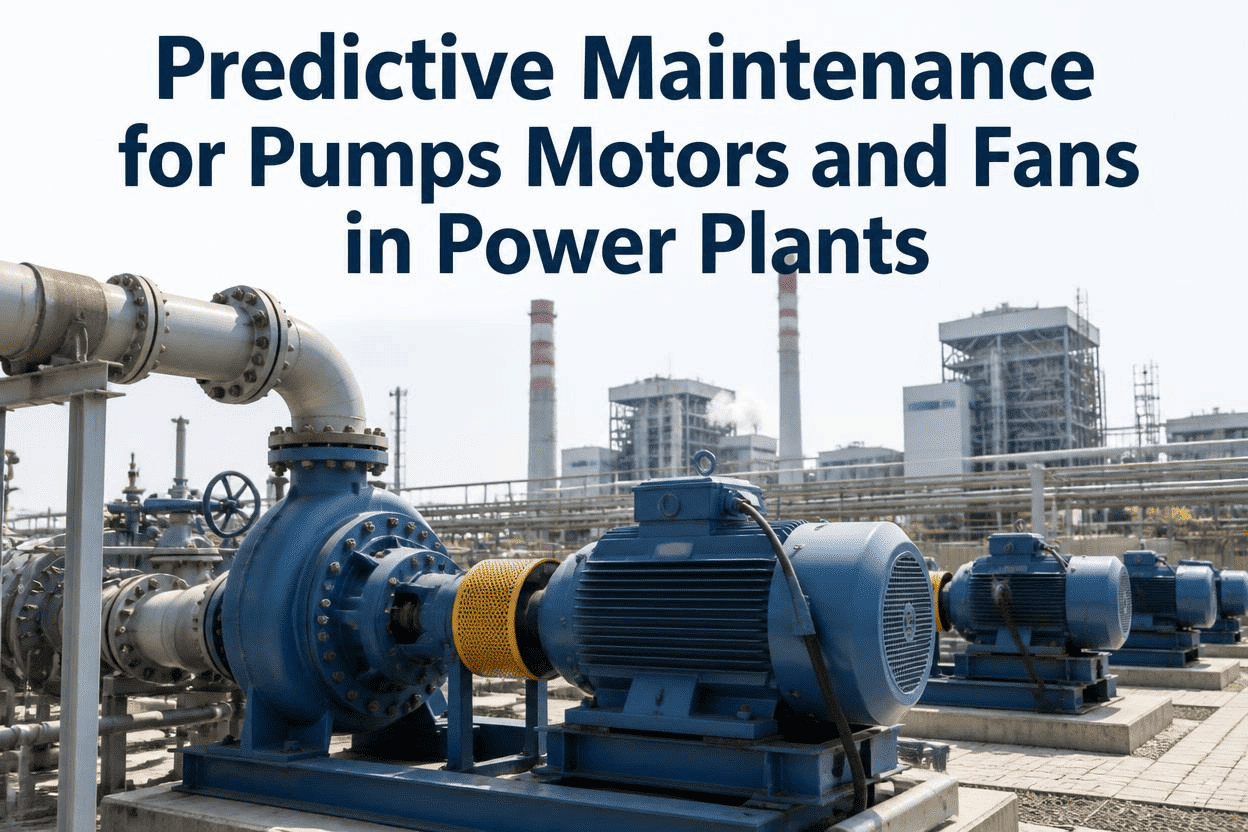
Pumps, motors, and fans rarely fail without warning — a bearing runs hotter for weeks, a shaft develops a slight imbalance, current draw drifts a few percent off baseline — but most maintenance teams only see these signs once a technician happens to walk past with a handheld vibration meter. By then the asset is often days from a trip, and the plant is scheduling an emergency repair instead of a planned one. iFactory's predictive maintenance platform reads the signals these rotating assets are already producing and turns them into an early warning your team can act on weeks in advance. You can book a demo to see it running against your own fleet of rotating equipment.
Your Pumps and Motors Are Already Telling You They're About to Fail. Nobody's Listening Continuously.
iFactory's AI monitors vibration, temperature, and current signatures across every pump, motor, and fan in your plant, flagging developing failures weeks before they become an unplanned trip.
What Reactive Maintenance on Rotating Equipment Actually Costs a Power Plant
Rotating equipment failures rarely stay isolated. A failed cooling water pump can force a load reduction, and a failed induced-draft fan can trip an entire boiler. The figures below reflect industry benchmarks for the cost gap between reactive and predictive maintenance approaches on this equipment class.
How Failure Signatures Differ Across Pumps, Motors, and Fans
Each rotating asset class fails in characteristic ways, and a useful predictive model needs to track the signal that actually matters for that equipment type rather than one generic vibration threshold. The health bars below represent typical early-warning indicators iFactory tracks for each asset class.
Every Unplanned Pump or Motor Failure Was Detectable Weeks Before It Actually Happened
iFactory's AI reads vibration, temperature, and current data from your existing sensors to flag developing failures on pumps, motors, and fans before they become an outage. Book a demo and see it analyzing your own fleet's data.
Five Failure Modes iFactory Detects Before They Become an Outage
Rotating equipment fails through a limited set of well-understood mechanisms, and each one leaves a distinct signature in vibration, temperature, or electrical data long before the asset actually trips. Expand each mode below to see how the AI isolates it.
Bearing wear produces characteristic high-frequency vibration signatures long before audible noise or visible heat appears at the housing. iFactory tracks these frequency bands continuously against the bearing's expected life curve, flagging degradation stages well before a catastrophic seizure.
Misalignment introduces a distinct vibration pattern at specific harmonics of running speed, distinguishable from normal operating vibration. The AI flags a developing misalignment before it accelerates bearing and seal wear across the coupled equipment.
Cavitation produces a recognizable noise and vibration signature caused by vapor bubble collapse inside the pump casing, often long before it visibly erodes the impeller. Early detection lets operators adjust suction conditions before impeller damage requires a full replacement.
Insulation degradation shows up as subtle shifts in current signature and power factor well before an actual winding fault occurs. iFactory tracks these electrical signatures against the motor's baseline to catch insulation risk before an unplanned motor failure takes down the driven equipment.
Ash and particulate buildup on induced draft fan blades gradually changes the vibration and airflow signature, often mistaken for normal wear until performance drops sharply. The AI trends this drift against the fan's clean-blade baseline to time cleaning before efficiency loss becomes severe.
The Four-Stage Path From Raw Sensor Data to a Scheduled Repair
Predictive maintenance only creates value when a detected anomaly turns into a scheduled action, not just another dashboard reading. iFactory's pipeline is built to close that loop automatically.
Sensor and Signal Ingestion
Vibration, temperature, current, and flow data from existing sensors and condition monitoring systems stream continuously into iFactory's platform.
Baseline and Anomaly Modeling
Each asset gets a health baseline built from its own operating history, so the AI flags genuine degradation rather than normal load-driven variation.
Remaining Useful Life Estimation
Once a failure mode is detected, the AI estimates a remaining useful life window so maintenance planners know how much runway they actually have.
Work Order Generation
A prioritized, dollar-quantified work order is generated automatically and can route directly into your existing CMMS for scheduling.
Reactive Maintenance vs iFactory's Predictive Maintenance Platform
The table below compares how maintenance teams typically operate under a reactive or calendar-based model against a continuously monitored predictive model.
| Capability | Reactive / Calendar-Based Maintenance | iFactory Predictive Maintenance |
|---|---|---|
| Failure Detection Timing | After the asset trips or fails | 2 to 6 weeks before failure |
| Maintenance Trigger | Fixed calendar interval or breakdown | Actual asset condition and RUL estimate |
| Repair Cost | Emergency parts and labor premiums | Planned procurement and scheduling |
| Spare Parts Planning | Reactive ordering after failure | Ordered ahead of the RUL window |
| Unplanned Downtime | Higher, driven by surprise failures | Reduced 25 to 35 percent typically |
Questions Maintenance Teams Ask Before Adopting Predictive Maintenance
Your Rotating Equipment Is Already Broadcasting Its Own Failure Warnings
Every pump, motor, and fan in your plant generates vibration, temperature, and current data continuously, and a meaningful share of that data already contains the early signature of a developing failure. The gap is not a lack of signal; it is the absence of a system watching that signal closely enough to act on it before the asset trips.
iFactory's predictive maintenance platform closes that gap by monitoring every rotating asset continuously and converting developing failures into a scheduled, prioritized work order weeks ahead of an unplanned trip. Book a demo to see it running against your own fleet of pumps, motors, and fans.
Stop Waiting for the Trip Alarm to Tell You Something Was Wrong
iFactory continuously monitors every pump, motor, and fan for the earliest signs of bearing wear, misalignment, and insulation breakdown. Book a demo and see the AI flagging developing failures on your own equipment.