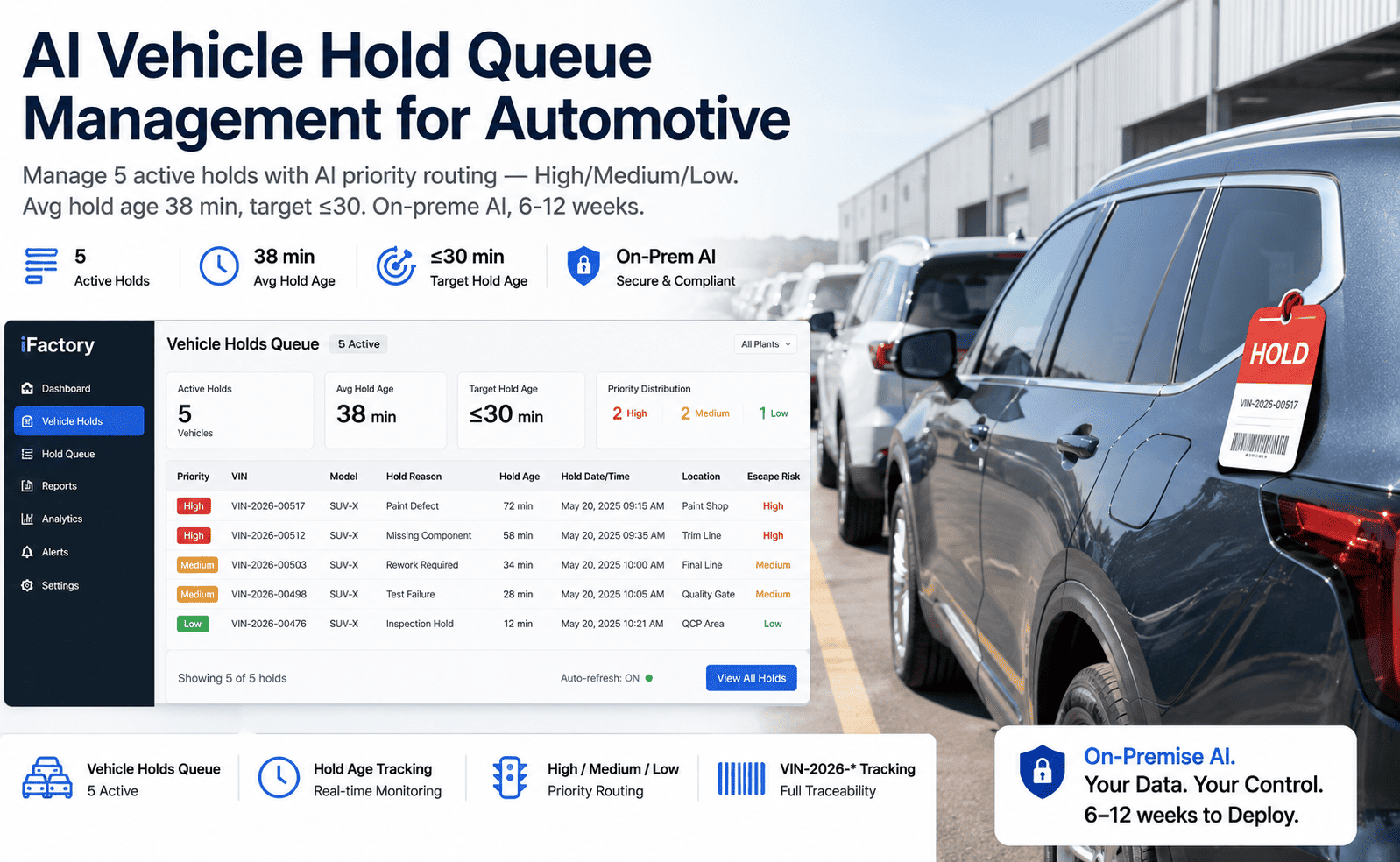
Every assembly plant has a yard full of vehicles that are finished but not free — held back for a suspect weld, a paint rework, a missing-component check, a supplier campaign. The danger isn't the hold itself; it's the queue behind it. When five vehicles sit on hold and the disposition order is a whiteboard, a clipboard, or whoever shouts loudest, two bad things happen at once: a low-risk car blocks a trailer it should be on, and a real escape risk quietly ages past its ship window. A defect that costs a dollar at the source costs ten in the plant and a hundred once it leaves the gate — and the hold queue is the last place to stop that escalation. iFactory's Vehicle Holds Queue with AI priority routing ranks every held VIN by escape risk against its ship deadline, tracks hold age live, and tells the floor exactly which car to disposition next.
iFactory · Vehicle Holds Queue
Five Cars on Hold. Which One Do You Release First?
AI priority routing ranks every held vehicle High, Medium, or Low by escape risk against its ship deadline, tracks hold age against a 30-minute target, and surfaces the next VIN to disposition — so nothing ages out and nothing risky slips through.
5
active holds, ranked in real time
38 min
avg hold age now — target 30 min
100×
cost of a defect that escapes the gate
3 tiers
High / Medium / Low priority routing
The Live Hold Board
This is the queue as the floor sees it — every held VIN, its reason, how long it has waited, when its trailer leaves, and the priority the AI assigned. The rows reorder themselves as deadlines tighten and risk scores change. The car at the top is always the one to work next; you never have to ask.
Vehicle Holds Queue · Live
5 active · avg age 38 min · target ≤30
VIN-2026-4471
Structural weld expulsion
52 min
Ships 14:10
High
VIN-2026-4458
Missing airbag fastener
41 min
Ships 14:25
High
VIN-2026-4490
Paint rework — Class-A panel
36 min
Ships 16:40
Medium
VIN-2026-4503
Torque re-verify, seat rail
28 min
Ships 17:15
Medium
VIN-2026-4512
Cosmetic scratch, hidden trim
19 min
Ships next day
Low
VIN-2026-4471 tops the queue: a structural defect, 52 minutes held, and the earliest trailer. The cosmetic scratch on 4512 is real, but it ships tomorrow and carries no escape risk — so it waits. That ordering is the whole job, done automatically.
How the Priority Gets Decided
Priority isn't age alone, and it isn't severity alone. A critical defect with a next-day trailer can wait; a medium defect leaving in twenty minutes cannot. The AI scores every hold on two axes at once — how costly an escape would be against how little time is left — and the intersection sets the tier.
Escape risk × Time to ship
Ships <1 hr
Ships 1-4 hr
Ships >4 hr
Safety / structural
High
High
Medium
Functional / fit
High
Medium
Low
Cosmetic / hidden
Medium
Low
Low
Bring your own hold reasons and ship schedule. Get a turnkey AI quote and we'll tune the matrix to your plant in the pilot.
Hold Age Is the Number That Bites
Hold age is where money leaks quietly. A vehicle parked too long misses its trailer, triggers expedited freight, or worse — gets released under deadline pressure without a real disposition. The queue runs a live clock against a 30-minute target and color-codes every car, so an aging hold becomes impossible to miss instead of easy to forget.
≤30 min
On Target
Within the disposition window. Trailer and rework slot are both safe.
30-45 min
Watch
Aging. The queue pushes it up and pings the line lead before the window closes.
>45 min
At Risk
Trailer or escape risk now in play. Escalated to the quality manager automatically.
What Changes on the Floor
The shift from a manual hold list to AI routing isn't subtle. It removes the two failure modes that cost the most: risky cars aging out, and the team burning time deciding what to touch next instead of touching it.
Manual Hold List
Order set by clipboard or memory
Age tracked, if at all, by hand
Ship deadline lives in another system
Risky cars released under pressure
No audit trail on disposition order
AI Priority Routing
Queue self-orders by risk × deadline
Live age clock, color-coded
Ship time scored into every rank
Escalation before the window closes
Every release logged with its reason
The Escape-Cost Case
The whole point of a hold is to stop a defect before the gate. The 1-10-100 rule sets the stakes: a problem caught at the source is a dollar, ten in the plant, a hundred once it reaches the customer — and field escapes drive recalls, warranty, and the external-failure costs that dominate cost of quality. AI routing makes sure the holds that matter most are dispositioned first, while they're still cheap to fix.
$1
At the source
caught and fixed in-station
$10
In the plant
caught on hold before ship — the queue's job
$100
In the field
escaped the gate: warranty, recall, reputation
How many vehicles are on hold in your yard right now, and how old is the oldest? Start a 6-week pilot and watch the queue rank itself.
Ask the Copilot
The queue answers plain language too — for the line lead checking status from a tablet, or the quality manager deciding what to escalate.
Plant Copilot — Holds
Line Lead
What should the team work next, and is anything about to miss a trailer?
Copilot
Work VIN-2026-4471 first — structural weld expulsion, held 52 minutes, on the 14:10 trailer. That's the only one at risk of missing its slot; it's 8 minutes from the at-risk threshold. Next is 4458, missing airbag fastener, 14:25 trailer. Everything below those ships after 16:00, so 4490, 4503, and 4512 can follow once the two High cars clear. I've already flagged 4471 to the quality manager.
Line Lead
4471 rework is done and it passed re-inspection. Release it.
Copilot
Logged. 4471 released to the 14:10 trailer with the re-inspection pass attached, your name on the disposition, and a timestamp. Queue is now 4 active, average age dropped to 31 minutes. 4458 is now top priority.
Turnkey: Hardware, Software, Live in 6-12 Weeks
iFactory ships a pre-configured NVIDIA AI server — racked, software pre-loaded. Rack it, plug in power and Ethernet, and the AI is live inside your firewall. The engagement covers cabling, network, PLC/SCADA and quality-system integration, operator training, and 24×7 remote monitoring. The hold queue connects to the data you already have — VIN tracking, defect detections, and your ship schedule.
Phase 1 · Weeks 1-4
Ship & Connect
Edge server on-prem; VIN tracking, hold reasons, defect feeds, and ship schedule connected read-only.
Phase 2 · Weeks 5-8
Tune & Pilot
Priority matrix tuned to your hold reasons and ship windows; the queue ranks in shadow while your team grades it.
Phase 3 · Weeks 9-12
Go Live
Live routing on the floor with age alerts and escalation, operator training, and 24×7 monitoring at 99.9% uptime.
1000+
clients running iFactory
6-12 wks
to live operation
On-prem
inside your firewall
What the Quality Team Gets Back
Routing holds by risk and deadline turns a reactive scramble into a controlled queue — fewer missed trailers, fewer pressured releases, and a clean record of every disposition decision.
≤30 min
Hold age target, enforced
live clock and escalation keep the average down
Zero
Risky cars aged out
High-tier holds surface before the window closes
Fewer
Missed trailers
ship deadline scored into every priority rank
Full
Disposition audit trail
every release logged with reason, name, timestamp
Frequently Asked Questions
Does the AI release vehicles on its own?
No. It ranks, tracks age, and escalates — it never releases a hold. A person dispositions every vehicle, and each release is logged with the reason, the name, and a timestamp. The AI decides order of work, not whether a car is fit to ship.
How is priority calculated?
Two axes: escape risk — how costly the defect would be if it reached the customer — and time to ship. A safety defect on an early trailer is High; a cosmetic flaw on a next-day car is Low. Hold age then pushes any car up its tier as it ages toward the 30-minute target.
Can it use our existing VIN tracking and ship schedule?
Yes. The queue reads your VIN tracking, hold reasons, defect detections, and trailer schedule as read-only inputs. Hold reasons and ship windows are tuned to your plant during the pilot so the ranking reflects your real constraints, not a generic model.
What happens when a car is about to miss its trailer?
It moves to the top of its tier and the line lead is pinged before the window closes. If it crosses the at-risk threshold, it escalates to the quality manager automatically. The point is to force a decision early — fix and ship, or re-slot — rather than discover the miss after the trailer leaves.
Where does our data live?
Everything runs on-premise inside your firewall on the pre-configured NVIDIA server — read-only and inbound-only. VIN data, hold records, and ship schedules never leave the plant, with 24×7 remote monitoring and 99.9% uptime.
Ranked by Risk. Clocked by Age. Released by You.
See Your Hold Queue Rank Itself
Bring a snapshot of your current holds — VINs, reasons, ages, and ship times. We'll run the priority routing live, show the age clock and escalation in action, and scope the 6-to-12-week turnkey deployment, on-prem, inside your firewall.
1000+
clients · 99.9% uptime