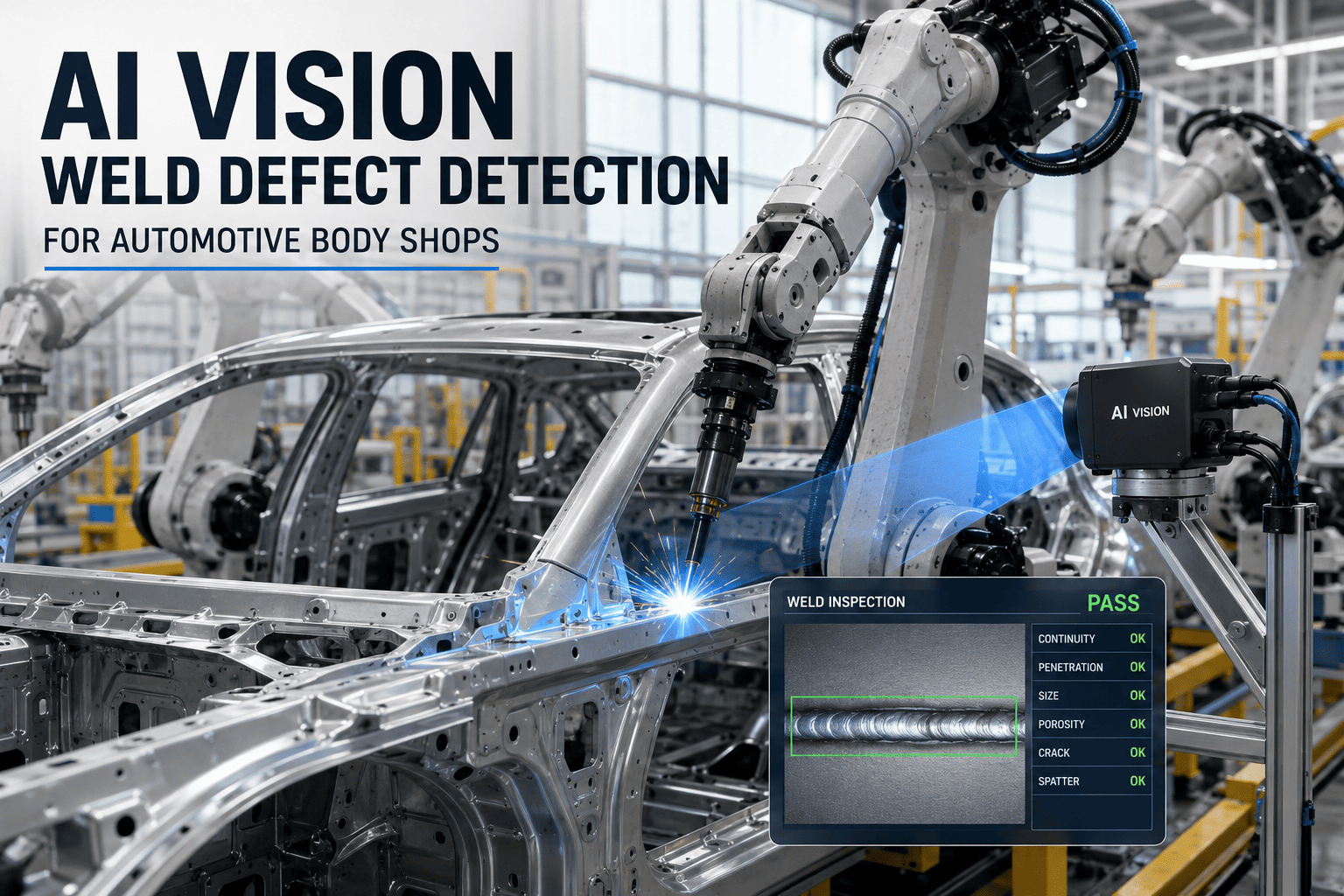
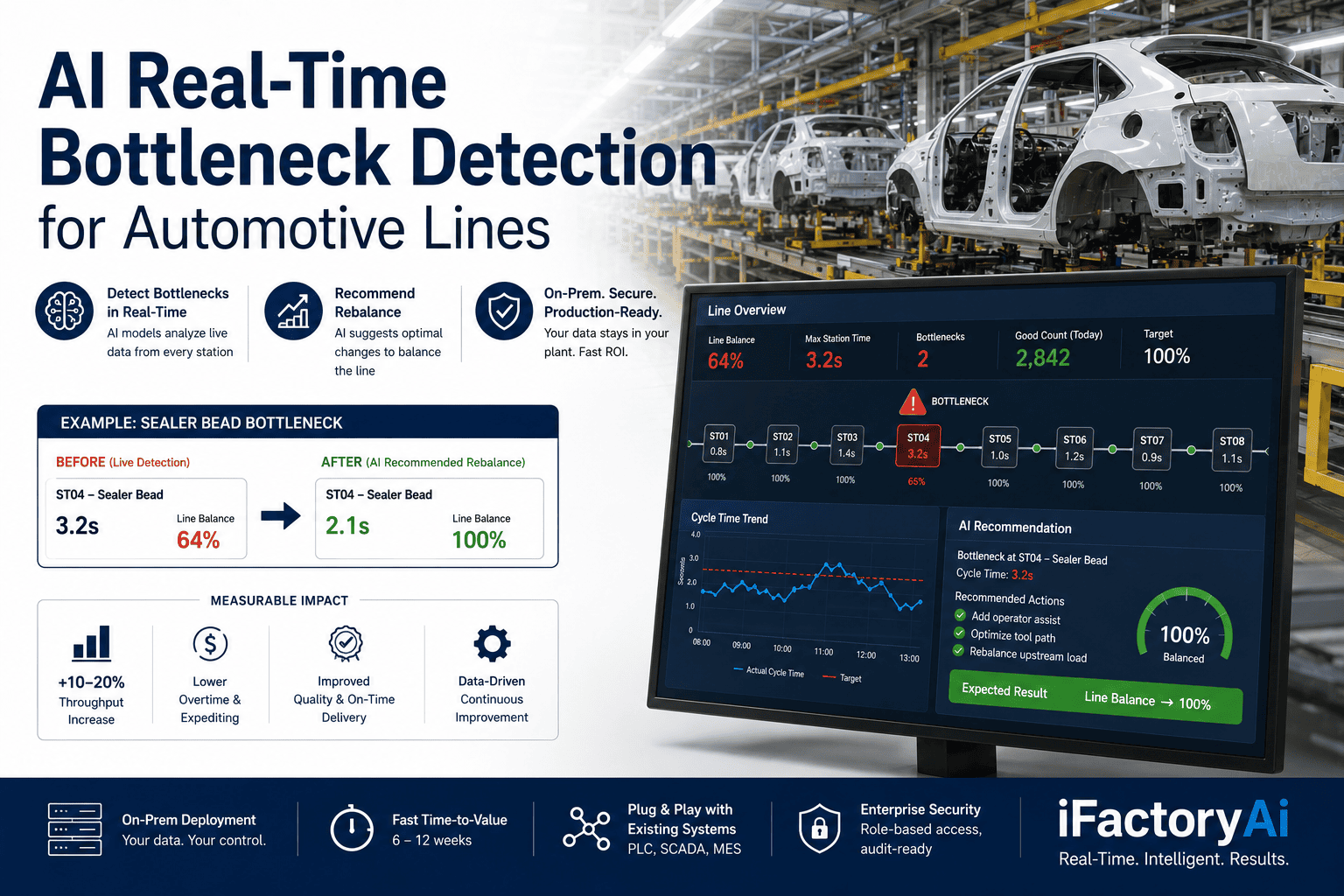
A modern vehicle accrues thousands of defect opportunities before it ever leaves the line — 3,000 to 5,000 spot welds, 500-plus installed components, formed panels, painted surfaces, and sealed battery packs. Each can fail in a dozen distinct ways, and most quality systems still funnel them all into one blunt bucket: "reject." That is the expensive mistake. A scratch, a weld expulsion, a missing fastener, and an orange-peel paint finish have nothing in common except the word defect — they have different causes, different costs, and different fixes. iFactory's Defect Detection & Classification engine sorts every detection into a structured, multi-class taxonomy at line rate, scores it on a severity-by-area heatmap, codes it against 43 root causes, and builds the Pareto automatically — so the vital few defects draining 10 to 30% of your revenue stop hiding inside a single number.
iFactory · Defect Detection & Classification
Every Defect Has a Name. Your AI Should Use It.
Multi-class AI vision classifies each detection into a structured taxonomy — splits, wrinkles, orange peel, weld expulsion, missing parts — scores severity by area, codes it to one of 43 root causes, and auto-builds the Pareto that tells you exactly what to fix first.
10-30%
of revenue lost to poor quality, typical plant
43
root causes coded to defect classes
99.5%+
classification accuracy, every shift
<200ms
to classify, not just flag
"Reject" Is Not a Defect Type
A single pass/fail flag tells you a part is bad. It does not tell you why, where, how badly, or whether the same cause is quietly producing four other failures across the line. When every defect collapses into one number, the data is useless for improvement — you can count rejects, but you cannot attack them. Classification is the difference between a tally and a map.
Pass / Fail Flag
One bucket: "reject"
No cause, no location, no severity
Pareto built by hand, weeks later
Recurring defects stay invisible
Rework scoped to whole lots
Multi-Class Taxonomy
Named class, subtype, and severity
Area-tagged, root-cause coded
Pareto auto-built, live
The vital few surface on their own
Containment scoped to the real cause
The Taxonomy: Five Families, Many Names
Automotive defects originate in five distinct production zones, and each zone speaks its own dialect of failure. The model is trained on the full vocabulary — not a generic "anomaly" detector, but a classifier that knows a split from a wrinkle and an expulsion from a cold lap. Below is the working taxonomy across the line.
Stamping & Forming
SplitsWrinklesSpringbackEdge burrsSurface scratchesDimensional deviation
Body-in-White Welding
ExpulsionUndersized nuggetMissing weldPorositySeam gapSpatter
Paint & Coating
Orange peelRuns / sagsCratersPinholesDirt inclusionColor mismatch
Powertrain & Battery
Hairpin windingBusbar weldCell misalignmentMachining burrForeign particleTab weld geometry
Final Assembly
Missing componentWrong partReversed orientationGap & flushLabel / barcodeTorque verify
Bring your own defect dictionary. Get a turnkey AI quote and we'll map it to a trained classifier in the pilot.
Severity by Area: One Heatmap, Every Class
A scratch on a hidden bracket and a scratch on a Class-A visible panel are the same defect type with wildly different consequences. The engine scores every detection on two axes at once — defect class against the zone it landed in — so triage is automatic. The hot cells are where rework dollars and warranty risk concentrate.
Minor
Low
Medium
High
Critical
The Pareto Builds Itself
Once defects are classified instead of counted, the 80/20 pattern emerges with no spreadsheet work. Roughly 20% of defect classes drive 80% of the cost — and quality teams that focus on that vital few report 60% faster improvement cycles. Here is a representative week, ranked and cumulative, the way the engine renders it live.
31%
Weld expulsion
cum 31%
18%
Surface scratch
cum 73%
Two classes — weld expulsion and orange peel — account for 55% of the cost this week. That is where the next corrective action goes, and the engine flags it without anyone building a chart.
From Class to Cause: 43 Codes
Classification is only half the value. Each defect class is wired to a curated set of likely root causes, so a named defect immediately narrows the investigation instead of opening a blank one. The mapping is what turns detection data into corrective action.
Detect
Vision captures the part at line rate, every unit, no sampling.
Classify
Multi-class model assigns family, subtype, and confidence score.
Score
Severity weighted by the zone — Class-A, structural, or hidden.
Code
Mapped to its likely root causes from the 43-code library.
Rank
Rolled into the live Pareto and cost-of-quality view.
See your own line's Pareto in the pilot. Start a 6-week pilot and watch the vital few surface in week one.
What It's Worth: The Cost-of-Quality Math
The case for classification is financial, not technical. Poor quality consumes 10 to 30% of revenue at a typical manufacturer, while world-class plants hold it under 5% — and the gap is closed by shifting spend from failure toward prevention. Classified, ranked defect data is the lever that makes that shift targeted instead of guesswork.
10-30%
Revenue lost to poor quality
typical manufacturer, most of it in failure cost
<5%
World-class benchmark
reached by prevention-led quality programs
100×
Cost escalation
a forming flaw caught early vs. at end of line
60%
Faster improvement
when teams attack the Pareto's vital few
Turnkey: Hardware, Software, Live in 6-12 Weeks
iFactory ships a pre-configured NVIDIA AI server — racked, software pre-loaded. Rack it, plug in power and Ethernet, and the AI is live inside your firewall. The engagement covers cabling, network, PLC/SCADA and vision integration, operator training, and 24×7 remote monitoring. The taxonomy is tuned to your parts, not a generic catalog.
Phase 1 · Weeks 1-4
Ship & Connect
Edge server on-prem; cameras, vision feeds, and process data connected. Your defect dictionary collected.
Phase 2 · Weeks 5-8
Train & Pilot
Multi-class model trained on your parts; classifications graded by your quality team against ground truth.
Phase 3 · Weeks 9-12
Go Live
Live classification, heatmap, and auto-Pareto, with operator training and 24×7 remote monitoring at 99.9% uptime.
1000+
clients running iFactory
6-12 wks
to live operation
On-prem
inside your firewall
Ask the Copilot
The taxonomy answers plain language too — for the quality engineer who wants the week's pattern without opening a dashboard.
Plant Copilot — Quality
Quality Engineer
What's driving rejects on Line 3 this week, and is it new?
Copilot
Two classes dominate. Weld expulsion is 31% of cost — up from 19% last week, concentrated at station 3B, structural zone, so it's scored critical. Orange peel is 24%, flat, all Class-A panels. The expulsion jump correlates with electrode wear past its change interval; that's root-cause code 17. Everything else is within normal range. I've drafted a containment hold on 3B parts since the trend break — your sign-off is the only gate.
Frequently Asked Questions
How is multi-class classification different from anomaly detection?
Anomaly detection only tells you a part looks wrong. Multi-class classification names the defect — split, expulsion, orange peel — assigns a subtype and confidence, and scores severity by area. A name lets you route to the right root cause and build a Pareto; an anomaly flag does not.
Can the taxonomy match our existing defect codes?
Yes. The classes are tuned to your parts and your defect dictionary during the pilot, so the output speaks your quality team's existing vocabulary and maps cleanly into your CAPA and MES systems rather than forcing a new naming scheme.
Does it work with our current cameras, or only iFactory hardware?
Both. Existing vision feeds are first-class inputs and trigger the same classification pipeline. Where lines lack inspection, iFactory deploys AI vision as part of the engagement, with documented accuracy of 95 to 99% across shifts.
How fast does it classify, and does it slow the line?
Classification runs in well under 200 milliseconds per unit on the edge server, fast enough for 100% inspection at line rate. Nothing is sampled and nothing slows down — every part is classified before it reaches the next station.
Where does our data live?
Everything runs on-premise inside your firewall on the pre-configured NVIDIA server — read-only and inbound-only. Frames, classifications, and quality records never leave the plant, with 24×7 remote monitoring and 99.9% uptime.
Named. Scored. Coded. Ranked.
See Your Defects Sorted, Not Counted
Bring your defect dictionary and a week of reject data. We'll show the multi-class taxonomy, the severity heatmap, and the auto-built Pareto running on your own parts — and scope the 6-to-12-week turnkey deployment, on-prem, inside your firewall.
5 families
across the line
43 causes
coded to classes
1000+
clients · 99.9% uptime