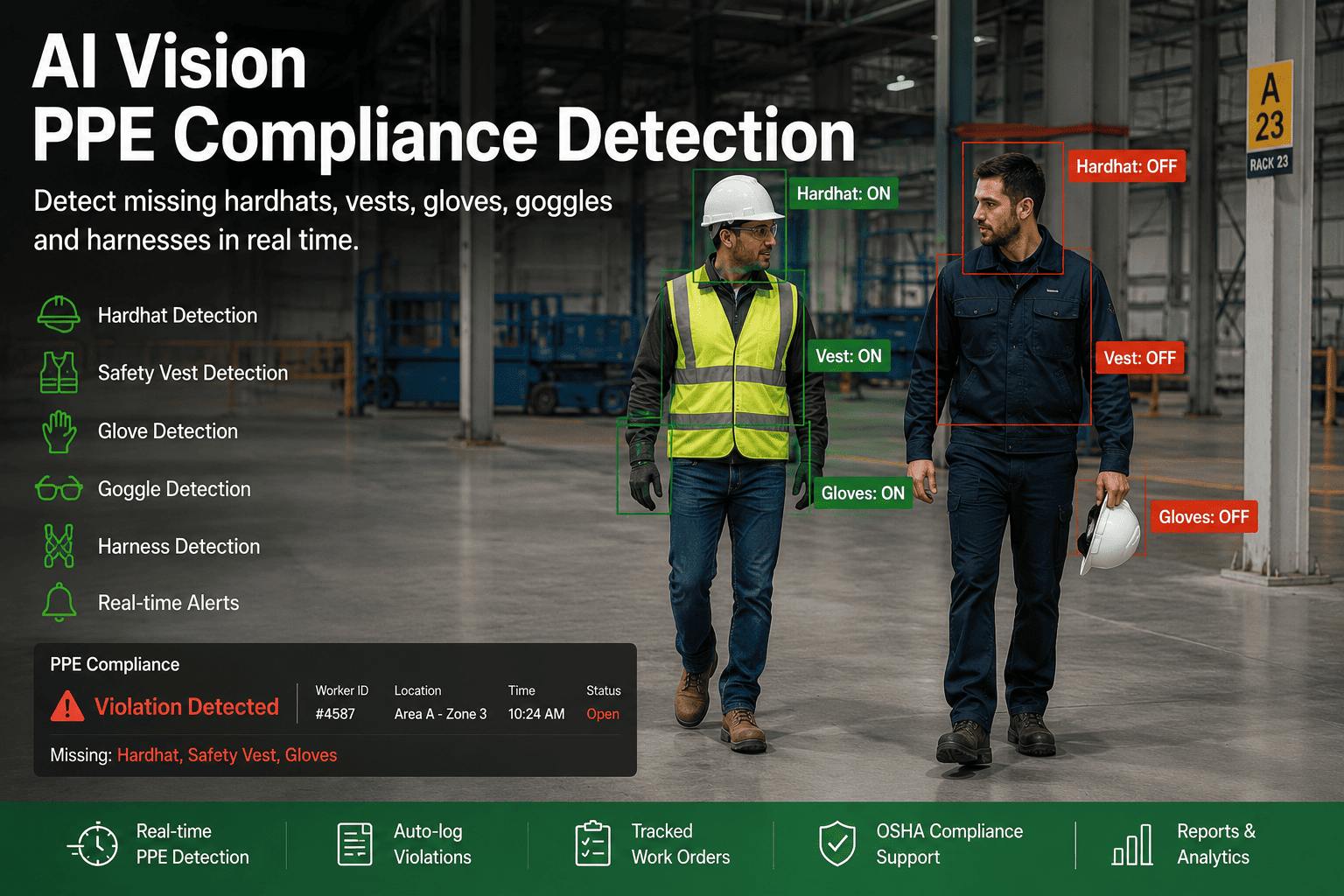
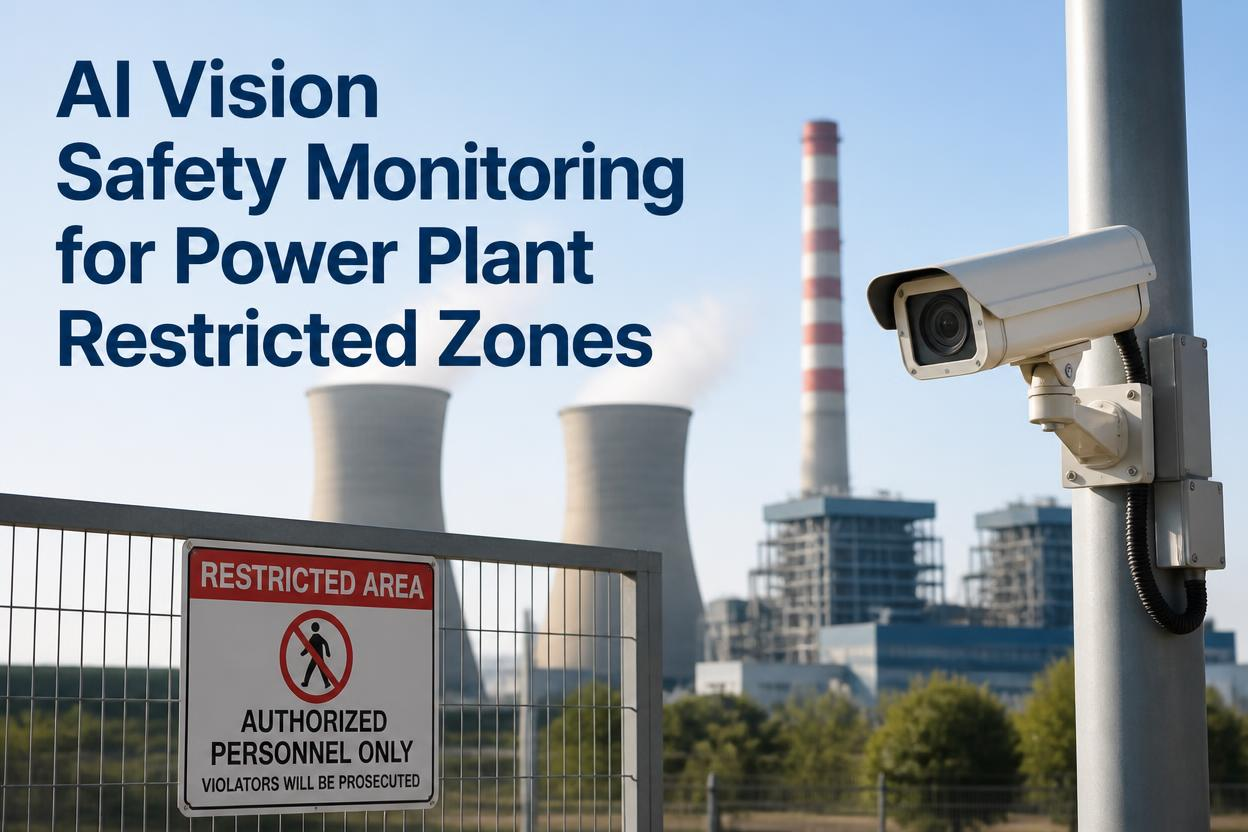
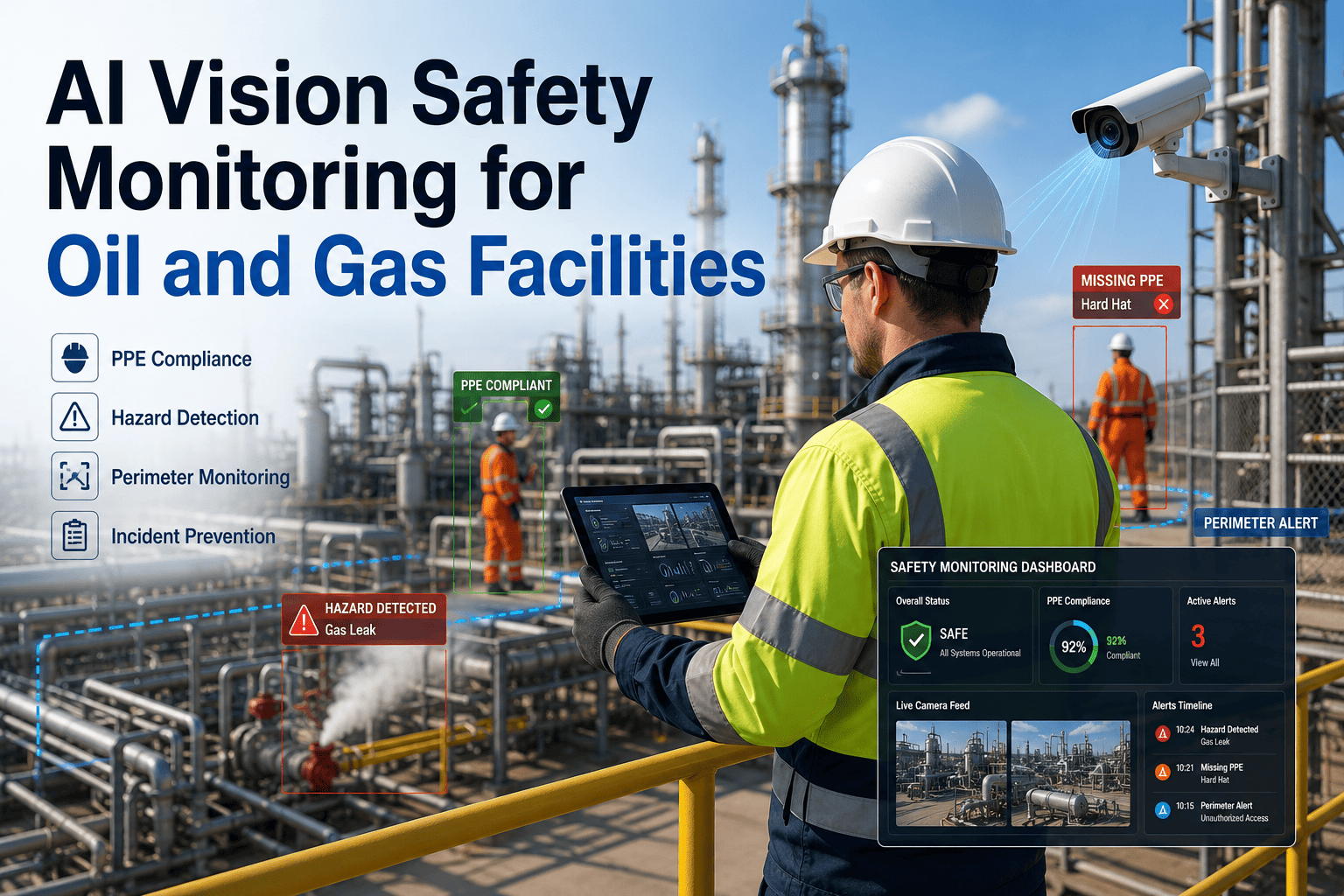
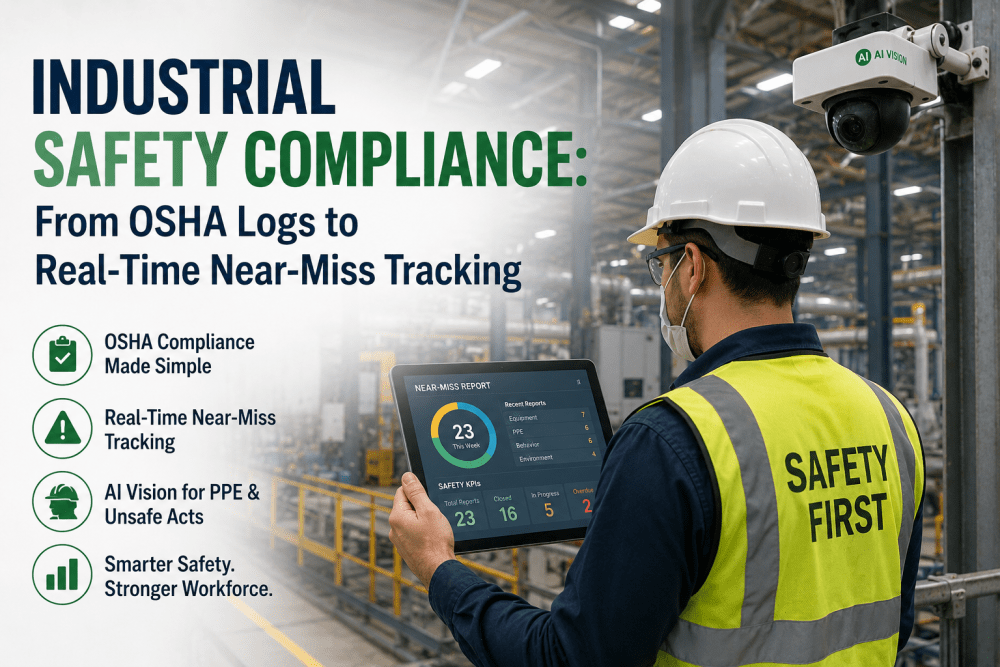
Every plant has the rule. Hardhats past the yellow line, goggles in the welding bay, harnesses on the scaffold. What no plant has is a supervisor who can watch every worker, in every zone, on every shift — which is why PPE violations stay on OSHA's most-cited list year after year: fall protection alone drew 5,914 citations in fiscal 2025, eye and face protection another 1,665, with penalties running as high as $145,000 per violation and eye injuries alone costing an estimated $300 million a year. The rules are not the problem; enforcement at human scale is. AI vision PPE detection watches every camera-covered zone continuously, spots the missing hardhat, vest, gloves, goggles, or harness in real time, and logs the violation as a tracked work order — so every detection leads to a resolution, not just a notification.
iFactory Vision Safety Monitoring
AI Vision PPE Compliance, Logged and Tracked
Detect missing hardhats, vests, gloves, goggles and harnesses in real time — and auto-log every violation as a documented, tracked work order with visual evidence.
96-97%
PPE detection precision
<10ms
per frame, true real time
5,914
fall-protection citations FY25
$145K
max penalty per violation
The Rule Exists. The Eyes Don't.
Manual PPE enforcement fails for predictable reasons: people can't watch everywhere at once, attention fades, and a quiet word on the floor leaves no record. The violation that hurts is rarely the flagrant one — it is the routine slip nobody happened to see, repeated until the day it meets a hazard.
Coverage Gaps
A supervisor sees one corner of one zone at a time, while violations happen across every shift and every area at once.
No Record
Verbal corrections leave nothing behind — no timestamp, no evidence, no trend, and nothing to show an auditor.
Human Error
An estimated 80 to 90% of serious injuries trace to human error — exactly the kind constant, neutral monitoring catches.
Repeat Citations
PPE standards sit on OSHA's top-10 list year after year because enforcement, not awareness, is the weak link.
Every PPE Item, Every Zone, Live
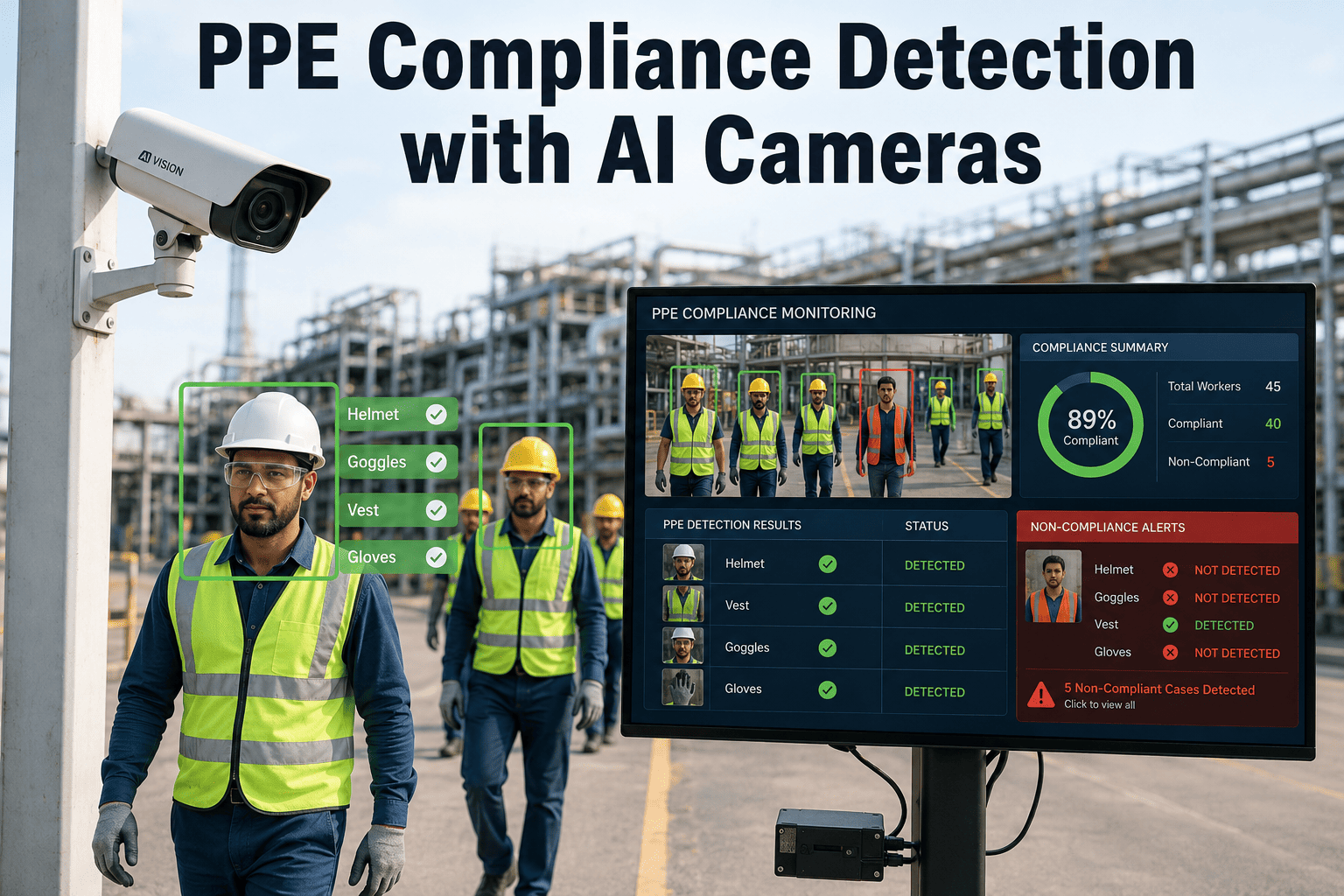
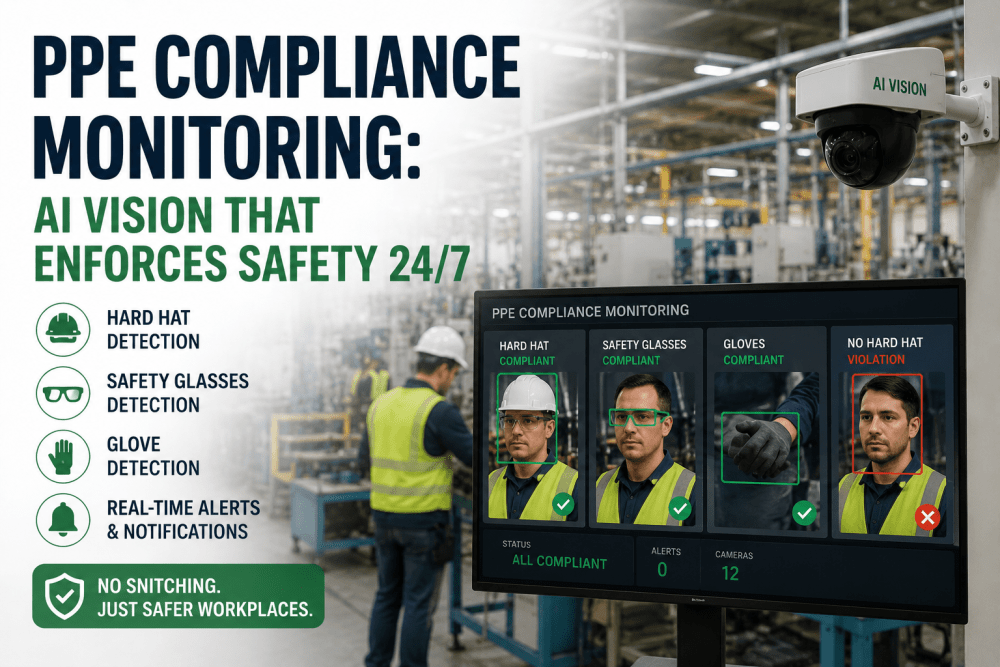
Deep-learning vision processes each camera frame in real time, detecting people and classifying what they are — and are not — wearing. The models are trained on both compliant and missing classes, so a worker without a hardhat is detected as positively as one with it.
Hardhats
Head protection verified in designated zones — the classic rule, finally enforced on every frame instead of every glance.
Safety Vests
High-visibility compliance checked in docks, aisles, and vehicle zones where worker-forklift proximity is the hazard.
Gloves
Hand protection monitored for chemical handling, assembly, and hot-work areas where bare hands meet the risk.
Goggles
Eye protection enforced in welding, grinding, and chemical zones — the violation class that just re-entered OSHA's top 10.
Harnesses
Fall protection detected for elevated work and scaffolding — the single most-cited OSHA standard, fifteen years running.
Zone-Specific Rules
Detected PPE is compared against each zone's requirements, so a welding bay and a crane zone each enforce their own list.
Want detection running on your own zones and PPE rules? Start a turnkey pilot and see it live on your cameras.
From Violation to Tracked Work Order
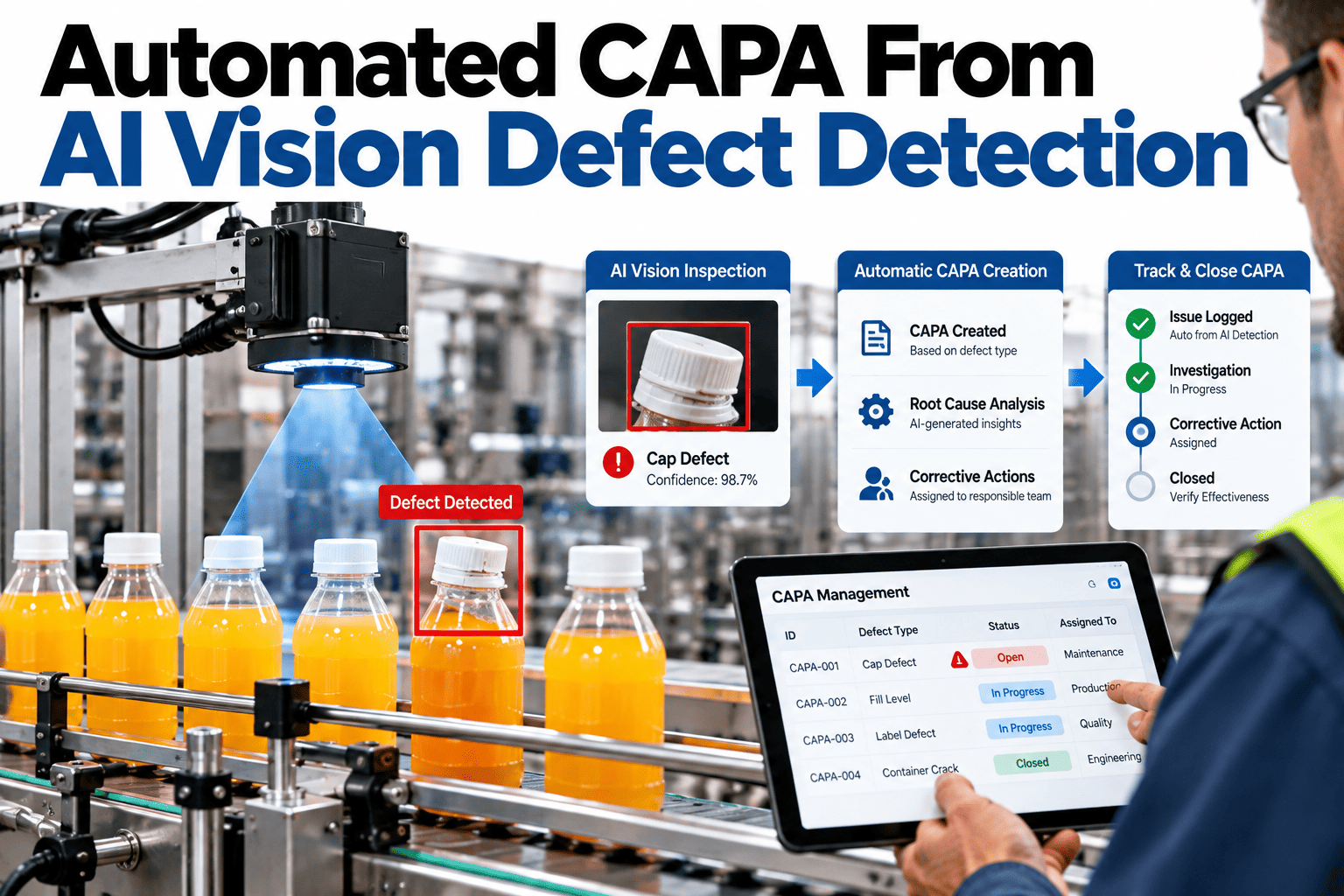
Most safety cameras stop at an alert — a ping that scrolls past and is forgotten. iFactory closes the loop: the violation is captured with evidence, the supervisor is alerted instantly, and a documented safety work order is generated automatically and tracked to resolution. The audit trail builds itself.
1
Detect in Real Time
The AI spots the missing item the moment a worker enters a zone out of compliance with its rules.
2
Capture the Evidence
Timestamp, location, and visual evidence are recorded automatically — a violation with proof, not an anecdote.
3
Alert Instantly
Supervisors are notified via dashboard, mobile, or on-site alarm while the situation can still be corrected.
4
Log a Tracked Work Order
A documented safety work order is auto-generated and tracked to resolution — a compliance audit trail with zero manual entry.
Accurate Enough to Trust
A safety system that cries wolf gets ignored. Modern PPE detection holds 96 to 97% precision on hardhats, vests, goggles, and harnesses, runs in under 10 milliseconds per frame, and is engineered to suppress the false alarms that erode a crew's trust in the system.
96-97% Precision
YOLO-based architectures hit 96 to 97% mean average precision on common PPE, improving further when tuned on site footage.
Occlusion Avoidance
If a body part isn't visible in frame, the system doesn't guess — cutting the false positives that train crews to ignore alerts.
Hard Conditions
Models hold accuracy across variable lighting, dust, distance, and worker postures, trained on real site footage.
PPE Status, Not Identity
The system monitors what is worn, not who is wearing it — safety enforcement designed around worker privacy.
Curious how it performs on your lighting and layouts? Talk to our safety team and we'll test it on your footage.
Turnkey on Your Existing Cameras
Deployment is a pilot, not a project. The system connects to the CCTV you already have, runs inference on an on-prem edge server inside your firewall, and applies your zone rules from day one — purpose-built for construction, manufacturing, oil and gas, and logistics environments.
Works With Your CCTV
Existing camera infrastructure connects directly, so the pilot starts with the coverage you already paid for.
Edge AI, On-Prem
Inference runs on an edge server inside your firewall — footage and violation data stay in the building.
Zone Rules, Your Way
Each area's PPE requirements are configured to your safety program, not a generic one-size-fits-all rule set.
Cross-Industry
The same vision safety layer protects construction sites, plants, terminals, and warehouses alike.
What Vision Safety Monitoring Delivers
Constant, evidence-backed PPE enforcement converts directly into fewer injuries, fewer citations, and a compliance record that defends itself. These reflect outcomes safety teams pursue when they move from spot checks to continuous AI monitoring.
24/7
Enforcement coverage
every camera-covered zone watched on every shift
Evidence
On every violation
timestamp, location, and image captured automatically
Tracked
To resolution
violations become work orders, not forgotten alerts
Audit
Trail built in
the compliance record assembles itself, no manual entry
Curious what your violation rate actually is right now? Start a turnkey pilot and find out with evidence, not estimates.
Frequently Asked Questions
What PPE can the system detect?
Hardhats, safety vests, gloves, goggles, and harnesses, along with their absence — the models are trained on both compliant and missing classes, so a worker without a hardhat is detected as positively as one wearing it. Detection is matched against zone-specific rules, so a welding bay enforces goggles, a crane zone enforces hardhats, and elevated work enforces harnesses, each according to your safety program.
How accurate is it, and what about false alarms?
Modern YOLO-based systems achieve 96 to 97% mean average precision on common PPE items, with accuracy improving further when models are fine-tuned on your site's footage, lighting, and PPE colors. False alarms are engineered down with occlusion avoidance — if a body part isn't visible in frame, the system doesn't guess — because a system that cries wolf is a system crews learn to ignore.
What happens when a violation is detected?
The full loop runs automatically: the violation is captured with timestamp, location, and visual evidence; supervisors get an instant alert via dashboard, mobile, or on-site alarm; and a documented safety work order is generated and tracked to resolution. That converts a fleeting alert into a compliance audit trail with zero manual data entry — every detection leads to a resolution, not just a notification.
Does it identify individual workers?
The system is built to monitor PPE status, not identity — it checks what is being worn in which zone, which is what safety enforcement requires. Footage and violation data stay on an on-prem edge server inside your firewall, supporting both worker privacy expectations and your data-governance requirements.
Do we need new cameras, and how fast can a pilot start?
Usually no new cameras — the system connects to existing CCTV infrastructure and runs inference on an on-prem edge server, processing frames in under 10 milliseconds for true real-time monitoring. A turnkey pilot starts with your highest-risk zones and your rules. Tell us your site and the PPE policies you most struggle to enforce, and we'll scope cameras, zones, and timeline.
Every Zone Watched. Every Violation Logged.
Start a Turnkey PPE Vision Pilot
Bring your highest-risk zones and the PPE rules you struggle to enforce. We'll connect your existing cameras, configure zone-specific detection for hardhats, vests, gloves, goggles, and harnesses, and show violations becoming tracked work orders with evidence — on-prem, on your footage.