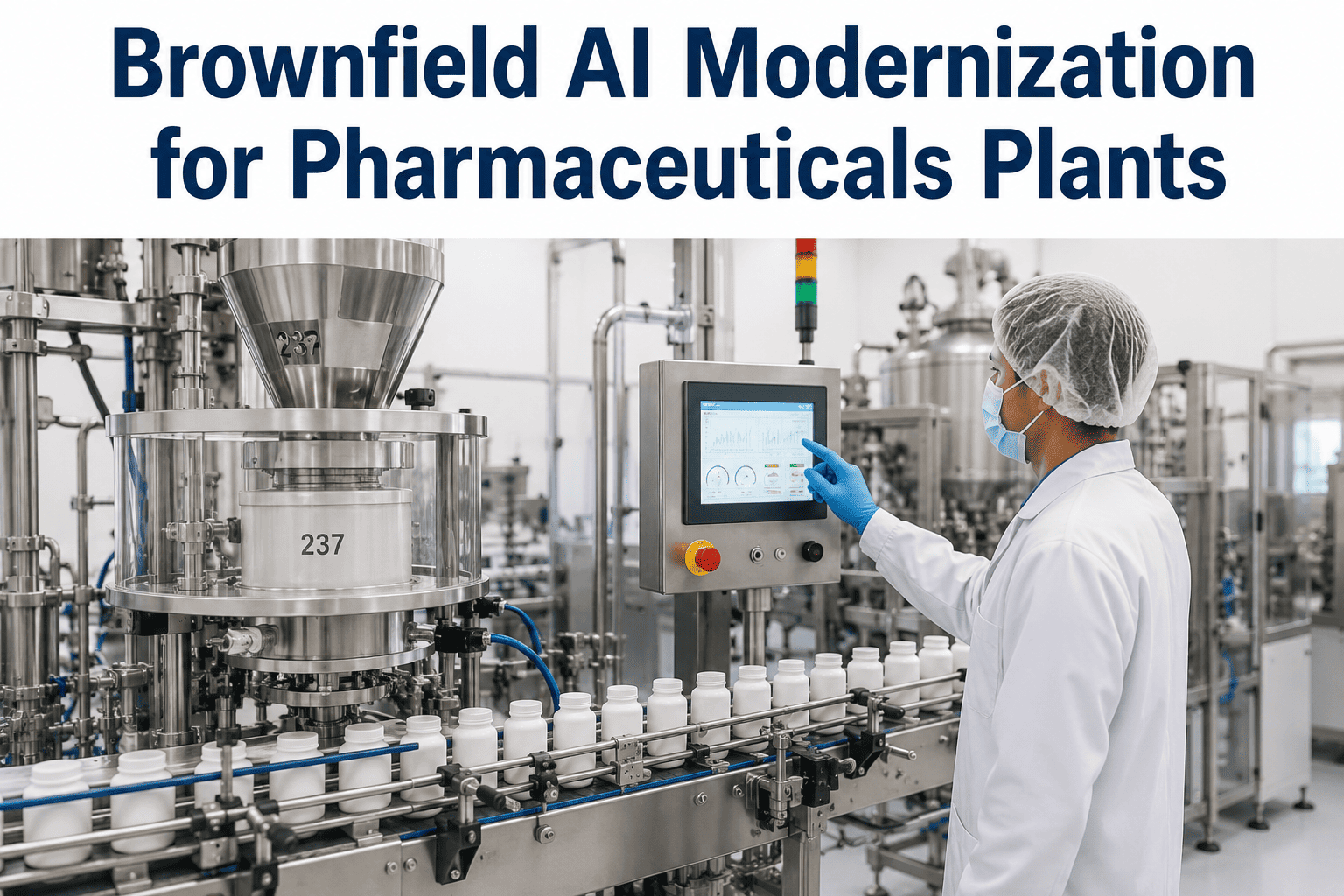
Most pharmaceutical plants running today were not built for an AI-driven operation — they were built around PLCs, SCADA historians, and MES systems installed over a decade or more, each validated, each documented, and each representing an investment nobody wants to rip out just to modernize. Plant managers evaluating AI adoption face a real tension: the productivity and quality gains are well understood, but the idea of replacing validated legacy control systems to get there sounds like a multi-year, high-risk undertaking that could put current production and compliance status at risk. Brownfield AI modernization resolves that tension by connecting to what's already running — lifting data from existing MES, SCADA, and PLC systems into an AI layer without requiring rip-and-replace of validated infrastructure. You can book a demo to see how this connectivity layer works against a live legacy filling and packaging suite.
Why Pharmaceutical Plants Can't Just Start From Scratch
A pharmaceutical facility's control and information systems represent years of validation work, regulatory documentation, and operational tuning that can't simply be discarded in favor of a clean-slate digital deployment. Every PLC program, every SCADA historian tag, every MES workflow has been through change control, qualification, and often regulatory review. Ripping that out to install a modern AI-native platform isn't just expensive — it reintroduces validation risk that most quality units and regulatory affairs teams would rightly resist.
There's also a practical operational reality underneath the compliance concern: these legacy systems generally work. A PLC installed fifteen years ago controlling a filling pump doesn't need to be replaced to make the pump run correctly — it's already doing that job reliably, and has been for years. What's missing isn't reliable control, it's the ability to extract intelligence from the data these systems have been generating all along. Framing modernization as an intelligence layer added on top, rather than a wholesale replacement of working control infrastructure, changes the entire risk and cost equation for a plant manager evaluating the investment.
This is precisely why brownfield modernization has become the dominant path for pharmaceutical AI adoption, in contrast to the greenfield deployments common in newer manufacturing sectors. Rather than replacing the systems that already work, brownfield modernization adds a connectivity and intelligence layer on top — one that reads data from existing infrastructure and applies AI analysis without altering the validated systems generating that data in the first place.
What's Actually Running in a Typical Pharmaceutical Plant Today
Understanding what a brownfield modernization actually connects to starts with an honest picture of the legacy technology stack most pharmaceutical plants operate. These systems were rarely designed to talk to each other seamlessly, let alone to an external AI platform — they were each procured, validated, and configured independently over years of separate capital projects, which is exactly why bringing them into a unified data model is the real technical work of brownfield modernization, more so than the AI analysis layered on top of it. Book a demo to see how this connectivity maps to your specific system vendors and versions.
Most facilities have all six of these system layers in place, but very few have them meaningfully connected to each other for analytical purposes. A historian holding years of process data and a LIMS holding the corresponding quality results typically exist as separate silos, queried independently by different teams for different purposes — which means the correlation between process conditions and quality outcomes that would actually power a useful AI model has usually never been assembled, even though every piece of underlying data needed to build it has existed in the plant for years.
Rip-and-Replace vs. Lift-and-Connect — A Direct Comparison
Plant managers evaluating AI modernization are usually presented with two fundamentally different paths, and understanding the tradeoffs between them is essential before committing budget and validation resources to either one. The rip-and-replace path is sometimes framed by vendors as the "proper" way to modernize — a clean, fully integrated new system built from the ground up. In practice, for an operating pharmaceutical facility, that framing understates the disruption and revalidation cost involved, and overstates how much of that disruption is actually necessary to capture the AI-driven gains a plant manager is after.
| Factor | Rip-and-Replace | Lift-and-Connect (Brownfield) |
|---|---|---|
| Validation impact | Full requalification of replaced systems | Minimal — existing systems remain validated |
| Typical deployment timeline | 12–24+ months | 8–16 weeks for initial connectivity |
| Production disruption risk | Significant — extended commissioning periods | Minimal — non-invasive data connection |
| Capital investment required | High — new hardware and software licensing | Moderate — connectivity infrastructure and AI layer |
| Historical data continuity | Often lost or requires complex migration | Preserved — existing historian data remains usable |
The historical data continuity point deserves particular emphasis, since it's often underweighted in the initial evaluation. Years of historian data represent exactly the kind of labeled, real-world operating history that makes AI models genuinely useful rather than theoretical — a rip-and-replace approach that discards or poorly migrates that history effectively resets the AI model's learning clock to zero, while a brownfield approach that preserves and connects to that same history can begin producing meaningful correlation insight almost immediately, since the training data already exists and simply needed to be made accessible.
How the AI Layer Actually Connects to Legacy Systems
The technical mechanism behind brownfield modernization matters to plant managers and IT/OT teams evaluating feasibility. Connectivity is built around reading existing data outputs rather than modifying the systems that produce them. This read-only architecture is the single most important design decision in the entire approach, because it's what allows the connectivity layer to sit alongside validated control systems without becoming part of the validated boundary itself — a distinction that matters enormously to how quickly a change control evaluation can move through your quality system. Book a demo to see how this connectivity architecture applies to your specific vendor mix.
How Brownfield Connectivity Interacts With Change Control
Connecting an AI layer to existing systems still requires a formal change control evaluation — brownfield modernization reduces validation burden, it doesn't eliminate it. Understanding what typically requires review, and what typically doesn't, helps plant managers scope the compliance conversation accurately from the outset, rather than either underestimating the review needed or assuming a level of scrutiny more appropriate to a system replacement than a connectivity addition.
Working through these considerations early, ideally in direct conversation with your quality unit before technical implementation begins, tends to produce a much smoother rollout than treating validation as a hurdle to clear after the connectivity work is already done. Most quality teams are receptive to a well-documented, read-only connectivity proposal precisely because it's a fundamentally different risk profile than the system modifications they're accustomed to reviewing — but that receptiveness depends on the proposal being framed and documented clearly from the start.
A Phased Path From Legacy Systems to Live AI Insight
Brownfield modernization works best as a phased rollout rather than a single big-bang deployment across the entire facility. Starting with a defined scope builds confidence and demonstrates value before expanding to additional lines or suites.
The reason this phased structure accelerates so noticeably after the pilot is that the hardest work — establishing the change control pattern, validating the data model approach, and building organizational trust in the platform's recommendations — happens once, during the pilot phase. Subsequent lines and suites benefit from that established pattern rather than starting the evaluation from scratch, which is why many facilities find that a pilot taking twelve to sixteen weeks is followed by additional line rollouts completing in a fraction of that time each.