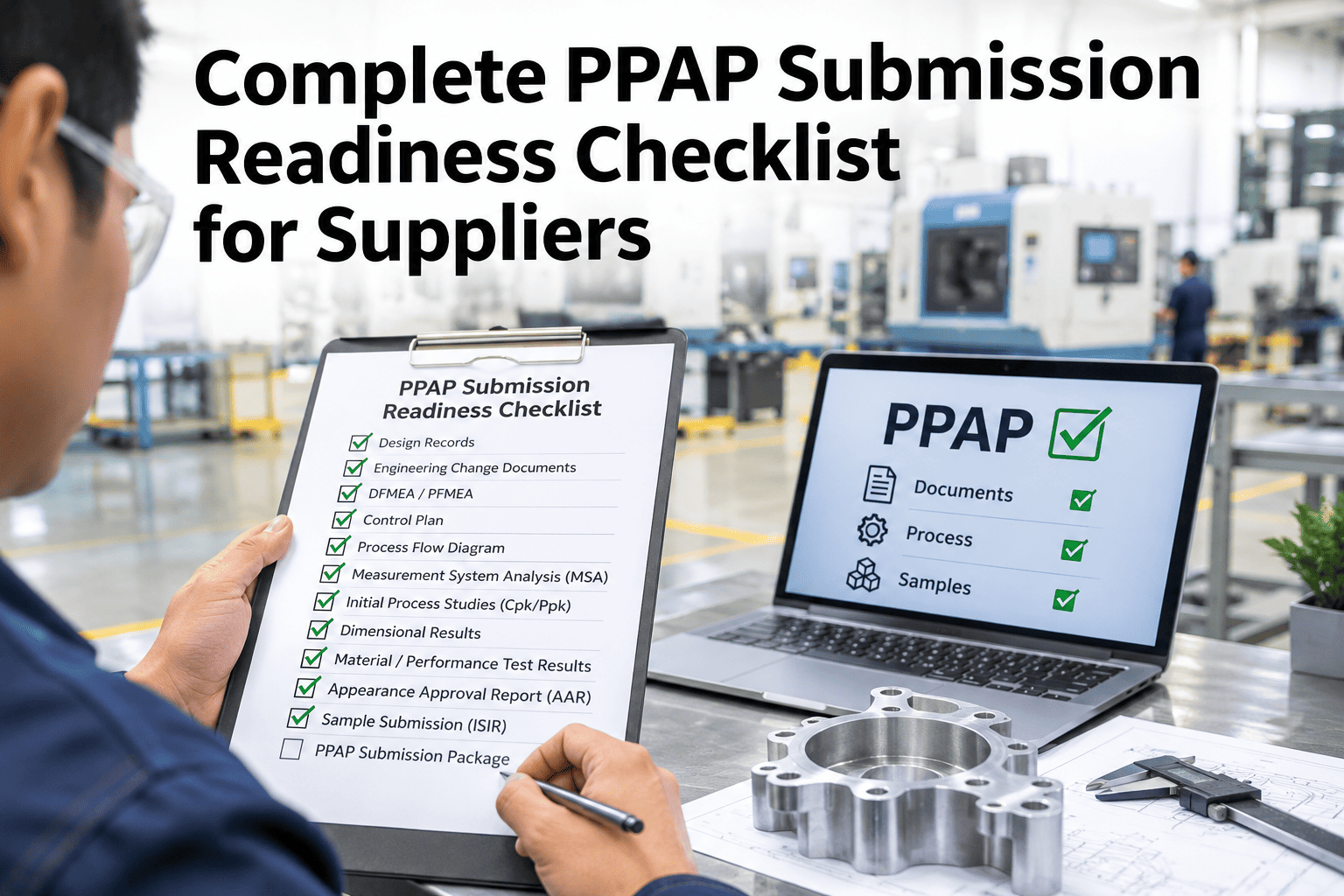
A rejected PPAP delays launch for everyone in the chain — the supplier resubmits, the OEM quality engineer re-reviews, and the production start date slips while both sides wait. Most rejections trace back to the same handful of causes: a Control Plan that does not match the PFMEA, dimensional results older than a year, or a capability study that was never actually demonstrated at rate. A Level 3 submission — the default for new parts and new suppliers — requires 18 AIAG-defined elements, and this checklist covers exactly what customers reject on and how to close each gap before you submit. You can review your PPAP package against this checklist with our team before your next submission.
Supplier Launch Readiness, 2026
Catch the Rejection Reasons Before Your Customer Does
iFactory, an on-premise AI platform for quality control and inspection management, keeps every PPAP element — DFMEA through sample parts — linked, current and audit-ready, so a submission goes out complete the first time.
18 AIAG Elements
Level 3 Default
IATF 16949 Linked
What it is
What Does PPAP Submission Readiness Actually Mean?
PPAP, the Production Part Approval Process, is the formal method a supplier uses to prove to a customer that their process can consistently produce conforming parts at the intended production rate, using the intended production tooling and workforce — not a prototype run.
Readiness means every one of the 18 elements tells the same consistent story, cross-checked against each other, before the package ever reaches the customer's desk. A package assembled element by element without cross-checking is exactly where mismatches hide.
The checklist
PPAP Level 3 Readiness Checklist
Design records and engineering change documents current to the latest revision
DFMEA and PFMEA consistent with each other and with the Control Plan
Process flow diagram matching the PFMEA step for step
Dimensional results current — not older than the customer's stated validity window
Material and performance test results matching the specified grade
Initial process studies demonstrating capability at production rate
A complete, current Measurement System Analysis for each control plan characteristic
Part Submission Warrant signed, with the correct reason for submission checked
Why packages come back
The Rejection Reasons Customers Actually Cite
| Rejection reason | Why it happens | Check before sending |
|---|
| Control Plan vs PFMEA mismatch | Documents updated separately, not cross-checked | Review both side by side before packaging |
| Dimensional results too old | Measurements pulled from an earlier program phase | Confirm every result is inside the validity window |
| Capability not demonstrated | Study run on prototype tooling, not production rate | Re-run on the actual production process |
| Wrong revision or part number | Package built from an older drawing than the current PO | Match PSW, drawing and PO revisions exactly |
| Missing or weak MSA | A control plan characteristic has no current study behind it | Confirm every characteristic has a passing MSA |
Timeline
What a Realistic PPAP Timeline Looks Like
Typical approval timelines run two to six weeks depending on part complexity, but that window assumes a complete, internally consistent package on first submission. Every rejection cycle adds the full review time back onto the launch schedule.
Building in an internal cross-check — comparing DFMEA, PFMEA, Control Plan and MSA against each other before the customer ever sees the package — is consistently the fastest way to avoid losing a full review cycle to an avoidable mismatch.
Expert review
What a Supplier Quality Manager Would Check First
Holds up
Cross-checking the DFMEA, PFMEA and Control Plan against each other before submission is standard AIAG Core Tools discipline, not an extra step — it is the step most teams skip under deadline pressure.
Watch for
A capability study run on prototype tooling and presented as production-rate data — customer quality engineers check this specifically and it is an easy rejection to trigger.
Do next
Run the internal cross-check on your next scheduled submission first, before a new program forces the discipline under worse time pressure.
FAQ
What Supplier Quality Teams Ask About PPAP Readiness
What is the most common reason PPAP packages get rejected?
A mismatch between the Control Plan and the PFMEA is one of the most consistently cited reasons, since customer quality engineers review the two side by side as a fundamental consistency check. Outdated dimensional results and unproven capability are close behind.
Check your package for this mismatch with our team.
How many elements does a Level 3 PPAP submission require?
Level 3 requires all 18 AIAG-defined elements, and it is the default submission level for new parts and new suppliers. Lower levels submit a subset, but most OEMs expect Level 3 unless told otherwise.
Ask about your specific OEM's requirement.
How long does PPAP approval typically take?
Typical approval timelines run two to six weeks depending on part complexity, assuming a complete package on first submission. A rejection and resubmission cycle adds that full review window back onto the schedule.
Discuss your launch timeline with our team.
What happens if a required element cannot be met in time for launch?
A deviation document can allow interim production with a documented improvement plan and deadline, though repeated deviations tend to erode customer trust over time and should be the exception, not a recurring workaround.
Does a PPAP need to be resubmitted after a process change?
Yes — significant changes to design, tooling, process, plant location or material must be evaluated for risk, communicated to the customer, and typically require a new or revised PPAP submission before implementation.
Review your change management process with our team.