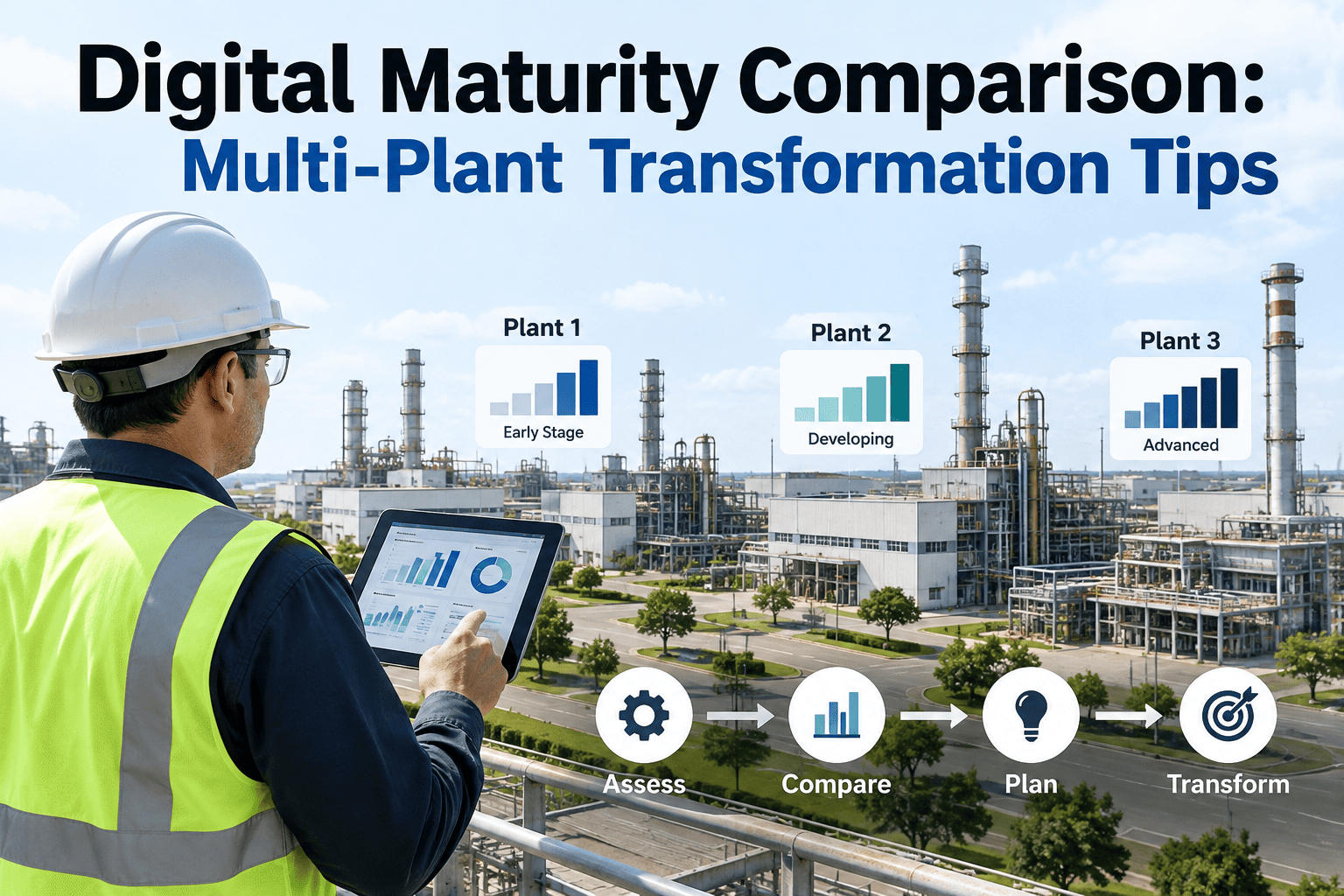
Ask three plant managers in the same manufacturing group how digitally mature their facility is and you'll usually get three confident, completely incomparable answers, each measured against a different informal sense of what "advanced" means. Digital maturity comparison replaces that guesswork with a shared scoring model applied consistently across every plant, so a transformation budget gets allocated based on actual gaps rather than whichever site made the loudest case in the last capital planning meeting. Once maturity is scored the same way everywhere, a coordinated rollout sequence becomes possible instead of five separate, uncoordinated digital projects competing for the same investment. Manufacturing groups ready to score their plants on a shared maturity model can start that process with iFactory's support team.
Five Plants, Five Different Ideas of What "Digitally Mature" Even Means
iFactory scores every plant against the same five-stage maturity model, so transformation investment goes to the sites and gaps that actually need it, not the loudest voice in the capital planning meeting.
Why Uncoordinated Plant-by-Plant Digital Projects Waste Budget
Without a shared maturity model, digital investment tends to flow toward whichever plant has the most persuasive local champion rather than the site with the largest actual gap, and that misallocation compounds every budget cycle it goes unaddressed.
Every Plant Claims to Be "Ahead"
Without a shared scoring model, self-reported maturity assessments tend to converge suspiciously close to "doing fine," which tells leadership nothing useful.
Advanced Plants Get More Investment, Not Less
Sites already comfortable with digital tools often make the strongest case for further investment, while genuinely lagging plants stay under-resourced.
Duplicate Tools Get Purchased Independently
Two plants at similar maturity levels frequently evaluate and buy overlapping software separately, simply because nobody had visibility into what the other was already doing.
Sequencing Gets Decided by Politics, Not Readiness
Which plant gets the next transformation investment often depends more on internal influence than on which site's foundational gaps most urgently need closing.
The Five Stages of Digital Maturity
A shared maturity model gives every plant a comparable position on the same scale, from manual, paper-based tracking through to a fully predictive operation that anticipates problems before they occur.
| Stage | Typical Characteristics | Common Gap |
|---|---|---|
| Ad Hoc | Paper logs, verbal handoffs, no consistent data capture | No baseline data to measure improvement against |
| Developing | Spreadsheets, some digital tracking, inconsistent adoption | Data exists but isn't standardized or trusted |
| Standardized | Unified CMMS or MES, consistent data entry across shifts | Data captured well but rarely used for prediction |
| Predictive | Condition monitoring, predictive alerts, integrated systems | Predictions exist but don't always drive scheduled action |
| Optimized | Prescriptive analytics, closed-loop automated response | Sustaining the practice as staff and processes change |
Turning a Maturity Score Into an Investment Sequence
A completed maturity assessment across every plant only creates value once it drives an actual, prioritized investment plan rather than sitting in a strategy deck.
Score Every Plant Against the Same Model
A consistent assessment framework applied identically across sites, resisting the temptation to adjust scoring for context.
Identify the Foundational Gaps First
A plant stuck at ad hoc needs standardized data capture before predictive tools would deliver any real value, regardless of budget available.
Sequence Investment by Readiness, Not Advocacy
The plant with the clearest foundational gap and the readiness to close it, not the loudest request, gets prioritized first.
Reassess on a Fixed Cadence
A maturity score calculated once during a strategy exercise stops reflecting reality within a year, so periodic rescoring keeps the sequencing plan current.
Stop Funding the Loudest Plant. Fund the Biggest Gap.
iFactory scores every plant on a shared digital maturity model, so your transformation budget follows readiness and gaps, not internal advocacy.
A Composite Scenario: The Plant Everyone Assumed Was Behind
A five-plant manufacturing group had informally assumed its newest facility, opened only three years earlier, was automatically the most digitally mature site in the network, while its oldest plant, running equipment original to the 1990s, was assumed to be the furthest behind. A structured maturity assessment applied the same five-stage model across all five sites and found the opposite was closer to true.
The newer plant had strong equipment but had never standardized its data capture practices beyond what came pre-installed with its machines, landing it at the developing stage. The older facility, by contrast, had spent several years building disciplined manual data logging and had recently layered a CMMS on top of that foundation, landing it solidly at the standardized stage and genuinely ready for predictive tools. The group redirected its next transformation investment to the older plant's predictive maintenance pilot instead of the newer facility's originally planned dashboard refresh, a sequencing decision the maturity data made obvious in a way informal assumption never would have.
Common Mistakes in Multi-Plant Maturity Assessment
Assuming Newer Equipment Means Higher Maturity
Modern machinery doesn't automatically translate into disciplined data practices, and the two get conflated more often than leadership expects.
Letting Plants Self-Score Without Verification
Self-reported maturity assessments tend to cluster optimistically, undermining the comparison's value for actual investment decisions.
Skipping Foundational Stages to Chase Advanced Tools
A predictive analytics investment at a plant still lacking standardized data capture tends to underperform badly, regardless of the tool's quality.
Scoring Once and Never Revisiting It
Maturity shifts as staff, processes, and equipment change, and a score left stale for several years stops reflecting the plant's real current state.
Is Your Group Ready to Build a Shared Maturity Model
Leadership agrees on one shared scoring framework
A single model applied consistently is worth more than five plants each using their own informal sense of maturity.
Someone independent can verify each site's self-assessment
A brief verification step keeps the comparison honest and prevents optimistic self-scoring from skewing investment decisions.
Investment sequencing is open to challenging past assumptions
The exercise only pays off if leadership is willing to redirect budget away from the plant that expected it.
A rescoring cadence is already planned
Revisiting the assessment on a fixed schedule keeps the sequencing plan aligned with how each plant is actually evolving.
Frequently Asked Questions
How long does a multi-plant digital maturity assessment usually take?
A structured assessment across a five-plant group typically takes a few weeks from initial data gathering to a completed scoring report, depending on how much documentation already exists at each site versus how much needs to be gathered fresh through interviews and system audits. Plants further along in their digital journey tend to have more existing documentation, which speeds up their portion of the assessment, while less mature sites often need more direct observation to score accurately. Groups wanting help scoping this timeline can talk to iFactory support.
Can a plant skip stages, like moving straight to predictive maintenance without standardizing data first?
Technically a plant can purchase predictive tools at any maturity stage, but the practical result is usually disappointing, since predictive models depend on clean, consistent historical data that an ad hoc or developing-stage plant typically doesn't have yet. Most successful transformations follow the stages roughly in order, even if some steps move quickly, because each stage builds the data foundation the next one depends on.
Who should actually score each plant's maturity level?
The most reliable assessments combine a site's own self-reported input with independent verification from someone outside that plant's immediate leadership, since local pride and unfamiliarity with what "advanced" really looks like elsewhere both tend to skew self-scoring toward the optimistic side. A shared, documented framework with specific criteria for each stage reduces this bias significantly compared to an open-ended subjective rating.
How often should the maturity comparison be updated across the group?
An annual rescoring cycle is common and generally sufficient for most manufacturing groups, since meaningful maturity shifts, driven by new systems, staff changes, or process discipline, usually take at least several months to show up clearly. Rescoring too frequently risks measuring noise rather than genuine progress, while going multiple years without revisiting the assessment risks basing investment decisions on an outdated picture. Book a demo to see how a maturity model gets built for your specific plant network.
Does a lower maturity score mean a plant is being managed poorly?
Not necessarily. Maturity often reflects history and prior investment more than current management quality, and an older facility with a lean IT budget can be excellently managed while still sitting at an earlier maturity stage than a newer, better-resourced sister site. The value of the comparison is in identifying where investment would have the most impact, not in assigning blame for where a plant currently stands.
Score Every Plant on the Same Scale Before Your Next Transformation Budget
iFactory builds a shared digital maturity model across your whole plant network, so investment goes where the gap actually is.