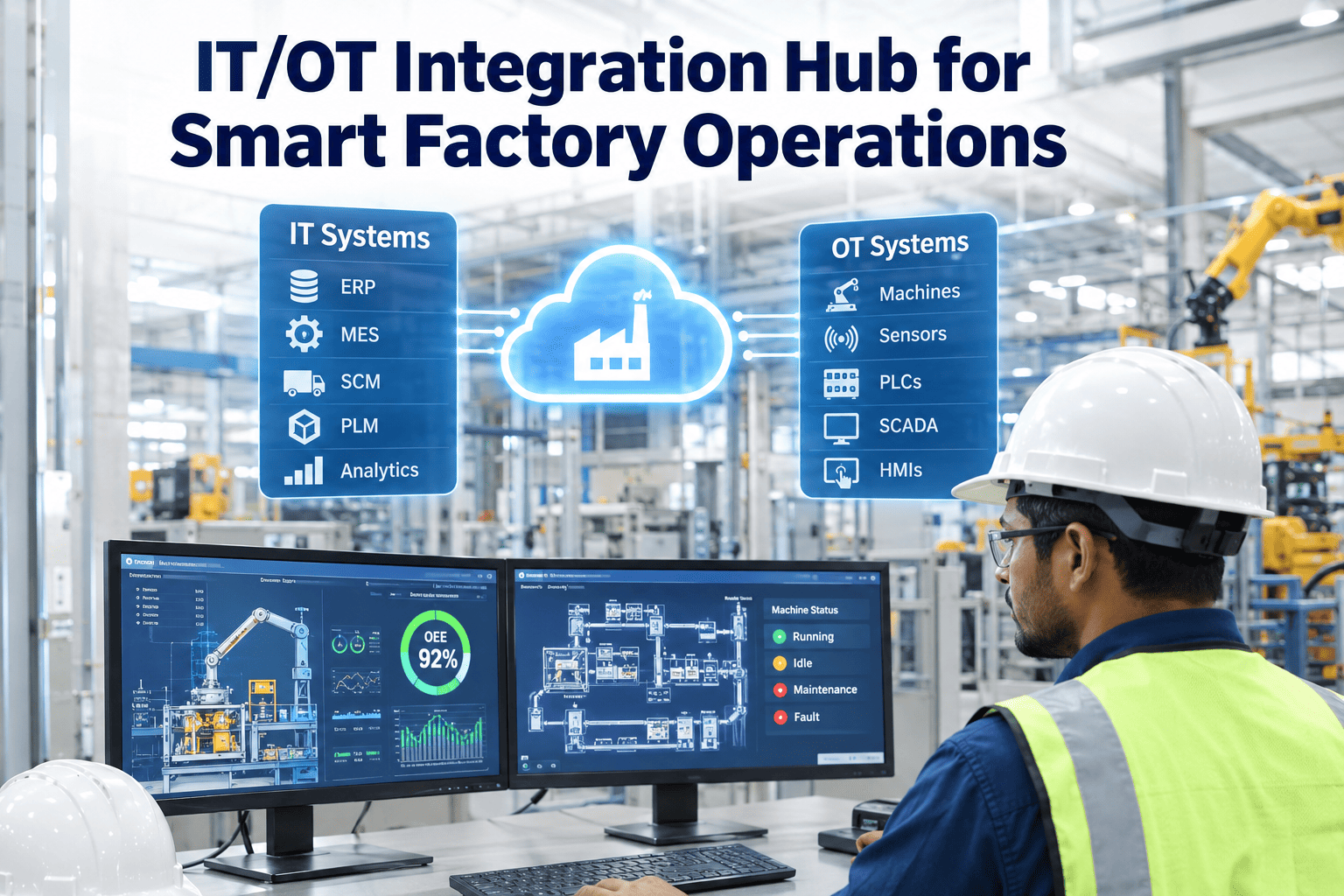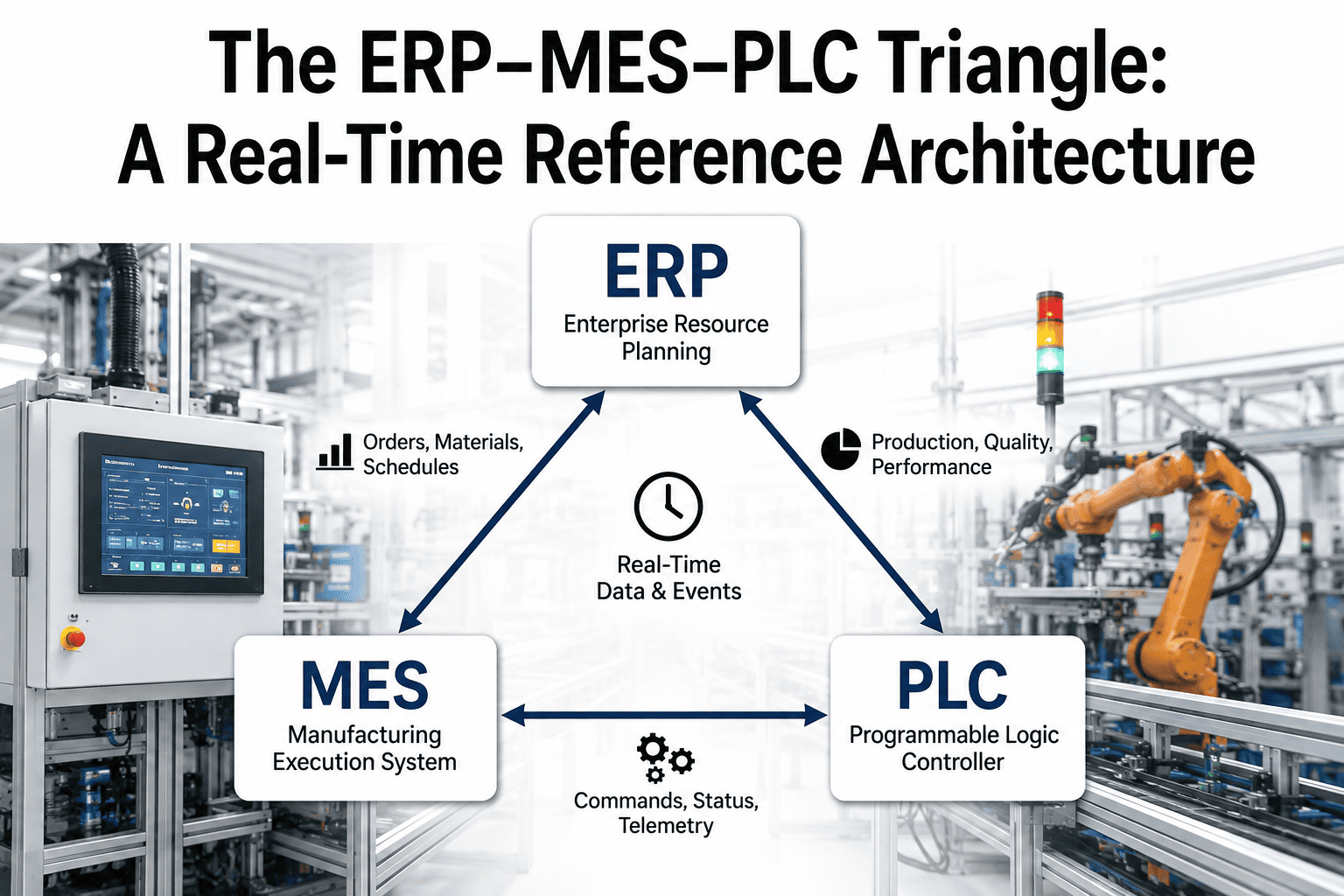
Every smart factory architect eventually draws the same triangle on a whiteboard: ERP at the top, MES in the middle, PLCs at the bottom, with arrows connecting them that look cleaner than the actual integration ever is. In practice the three layers rarely talk well enough, and the gaps between them are where visibility, not hardware, breaks down. iFactory closes the triangle with an industrial bus, a connector, and an AI layer on top — see the full ISA-95-aligned architecture and where each layer connects.
The ERP–MES–PLC Triangle Never Closes on Its Own
Three layers, three owners, and almost always three separate integration efforts that never quite meet in the middle. Here is the reference architecture that closes the triangle with a real-time bus and a connector, not another point-to-point patch.
Where ISA-95 Diagrams Meet Reality
The reference model looks like a clean pyramid. Most plants are actually running three separately-built layers stitched together with whatever integration was available at the time.
From Legacy OT to AI, in One Aligned Path
Each layer keeps doing the job it already does well. The stack below is what actually connects them, level by level.
Legacy OT and ERP
PLCs, sensors, MES workflows, and the ERP order and finance layer — the systems already running the plant today, unchanged.
MSMQ Message Queue
A continuous, low-latency industrial bus that carries events between OT and IT without waiting on a scheduled batch job.
Connector
Translates between PLC protocols, MES data models, and ERP formats, so no single system needs to natively understand the others.
REST + Webhooks
Standard, documented interfaces that let any system — internal or third-party — subscribe to plant events without custom code.
AI Platform
Recipe master, live SPC, Plant Copilot, and CAPA sit on top of the connected stack, reasoning over the full triangle at once.
Close the Triangle Without Rebuilding a Single Layer
iFactory's ISA-95-aligned architecture connects legacy OT and ERP through an MSMQ bus, a protocol connector, and REST plus webhook exchange — with an AI platform reasoning over the whole stack.
Why the Whiteboard Triangle Keeps Breaking
Most plants don't lack integration — they have too much of the wrong kind, built one urgent request at a time.
| Capability | Point-to-Point Patches | ISA-95 Reference Architecture |
|---|---|---|
| Number of custom interfaces | Grows with every new system | One connector, many consumers |
| Data latency | Varies by which patch is involved | Consistent across the whole stack |
| Adding a new system | Requires a new custom build | Connects via standard REST/webhooks |
| AI readiness | Blocked by fragmented data | Built to sit on top of the stack |
Four Capabilities That Only Work Once the Triangle Closes
None of these are possible without a connected stack underneath them — they depend on ERP, MES, and PLC data arriving in the same place, in real time.
Recipe Master
A single source of truth for recipes that stays consistent across MES execution and ERP order data.
Live SPC
Statistical process control that updates continuously because it's fed directly from the connected bus, not a batch export.
Plant Copilot
An AI assistant that can answer questions spanning ERP order context and PLC-level process data in a single response.
CAPA
Corrective action records linked automatically to the ERP order, MES batch, and PLC parameters involved in a defect.
How the Stack Gets Built Without Downtime
The architecture is layered specifically so each piece can be added without interrupting what's already running.
Inventory Levels 1 Through 4
Document the existing PLCs, sensors, MES workflows, and ERP configuration exactly as they run today.
Stand Up the MSMQ Bus
Introduce the message queue as a continuous event bus between OT and IT without modifying either layer's core logic.
Deploy the Connector
Translate protocols and data models between PLC, MES, and ERP so each system keeps speaking its native language.
Layer On the AI Platform
Bring recipe master, live SPC, Plant Copilot, and CAPA online once the connected stack is validated end to end.
ERP–MES–PLC Architecture — Questions Answered
What smart factory architects typically ask before committing to a reference architecture across all three layers.
Q: Does this architecture require replacing our current ERP or MES?
No, the reference architecture is built to connect to your existing ERP and MES exactly as they're configured today, using the connector and message bus as the translation layer between them rather than requiring either system to change. This is the core design principle behind the whole stack: every layer keeps doing the job it already does, and the connective tissue is what's new. You can book a demo to see how it maps onto your specific ERP and MES versions.
Q: Why use a message queue instead of direct API calls between systems?
A message queue like MSMQ decouples the systems from each other's availability, so a temporary outage or slowdown in one layer doesn't stall the others waiting on a direct synchronous call. Events queue up and flow through once the connection is available again, which is a more resilient pattern for a plant floor where network conditions and system uptime vary. Direct API calls remain part of the architecture at the REST and webhook layer, but the bus underneath is what keeps the whole system resilient.
Q: How does this align with the ISA-95 standard specifically?
The architecture maps directly onto ISA-95's levels, with legacy OT and ERP systems occupying Levels 1 through 4 and the connector, bus, and AI platform forming the integration and intelligence layer that ISA-95 leaves largely undefined. This alignment is deliberate, since ISA-95 is the shared vocabulary most controls, IT, and operations teams already use to talk about plant architecture, which makes the reference design easier to socialize internally.
Q: Can new third-party systems connect without custom integration work?
Yes, once the REST and webhook exchange layer is in place, a new system can subscribe to plant events or push data into the stack using standard, documented interfaces rather than a bespoke point-to-point build. This is the specific advantage over patch-by-patch integration, where every new system historically meant a new custom project. Our support team can review what a new system connection would look like for your environment.
Q: What's the typical sequence for rolling this out across multiple plants?
Most multi-site rollouts validate the full stack at one reference plant first, then replicate the connector and bus configuration at additional sites where the underlying OT and ERP setups are similar. Sites with more unusual configurations typically need additional mapping time during the inventory phase, but the AI platform layer on top stays consistent across all sites once each one's connection is validated.
Close the Triangle, Then Put AI on Top of It
ERP, MES, and PLC don't need three separate integration projects to finally talk to each other. iFactory's ISA-95-aligned architecture connects all three through one bus, one connector, and a standard exchange layer.