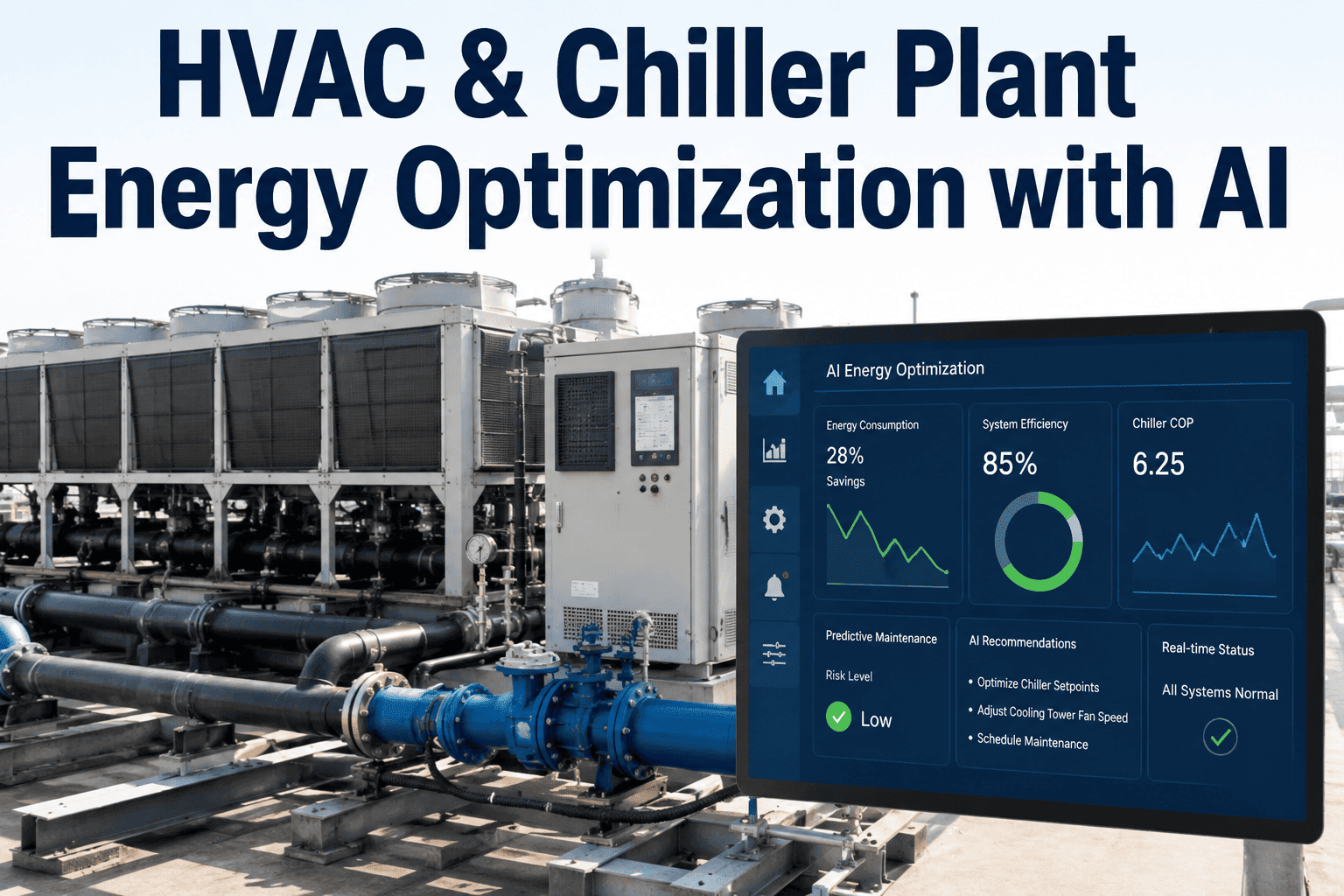
Most chiller plants run on setpoints that were reasonable the day they were commissioned and haven't been meaningfully revisited since, even as outdoor conditions, occupancy patterns, and production loads shifted year after year. A chilled water temperature set a few degrees colder than the current load actually requires, a condenser water setpoint that ignores a mild morning, or sequencing logic that runs three chillers when two would cover the load quietly consumes energy that never shows up as a fault, only as a bill. AI-based optimization doesn't replace the mechanical equipment; it replaces static setpoints with continuously adjusted ones that track the load the plant actually has right now. This guide covers where chiller plant energy actually goes, how setpoint optimization and free cooling recover it, and how a demo can show live chiller plant performance data from your own BMS.
Energy Monitoring
HVAC and Chiller Plant Energy Optimization With AI
Cut cooling energy 20-35% with AI-adjusted setpoints, free cooling, and variable flow pumping, without a capex-heavy retrofit.
Why Static Setpoints Waste Energy Even in a Well-Maintained Plant
A chiller plant designed to handle a summer design-day peak load spends the vast majority of its operating hours running well below that peak, often at partial load for entire seasons. Fixed setpoints tuned to handle the worst case don't automatically relax when the load drops, which means the plant frequently runs colder chilled water, higher static pressure, or more chillers online than the actual conditions call for on a mild day.
The inefficiency compounds because a chiller plant has several interacting variables — chilled water temperature, condenser water temperature, chiller sequencing, and pump and fan speed — and each one is often tuned independently by different technicians at different times, rather than optimized together as a system. AI-based optimization treats the plant as one connected system, continuously adjusting all of those variables together against the load the plant actually has at that moment.
The Levers That Actually Move Chiller Plant Energy
Chilled Water Reset
Raising supply temperature when load allows reduces compressor lift and energy per ton of cooling delivered.
Condenser Water Reset
Lowering condenser water temperature on cooler days improves chiller efficiency without any equipment change.
Chiller Sequencing
Running the right number of chillers at their most efficient loading point instead of a fixed staging order.
Variable Flow Pumping
Matching pump speed to actual demand instead of running constant flow with bypass valves absorbing the excess.
Free Cooling: Using Outdoor Conditions Instead of Fighting Them
On cool or mild days, outdoor air or a cooling tower can meet some or all of a facility's cooling load without running the mechanical chiller compressor at all, a strategy generally called free cooling or economizer operation. The opportunity is larger than most facilities capture, because free cooling logic is often left disabled or poorly tuned after commissioning, either due to a control sequence error or because nobody revisited it after the original installer moved on to the next project.
A waterside economizer, which uses the cooling tower to directly cool chilled water during cold weather, and an airside economizer, which brings in outdoor air to offset mechanical cooling, both depend on control logic that correctly compares outdoor conditions to the load requirement in real time. Getting that comparison wrong in either direction either wastes a free cooling opportunity or risks bringing in air that's actually warmer or more humid than what the space needs.
See the Load, Not Just the Setpoint
Watch AI-Adjusted Setpoints Track Your Real Cooling Load
A demo shows live chiller plant data and where setpoint drift is currently costing energy.
Building Management System Data: The Input AI Optimization Actually Needs
1
Pull existing BMS trend data on chiller load, setpoints, and outdoor conditions before assuming new sensors are required.
2
Establish a baseline of current energy use per ton-hour across a full seasonal cycle, not just a single week.
3
Layer AI-driven setpoint recommendations on top of existing controls rather than replacing the BMS outright.
4
Track actual energy per ton-hour against the baseline to confirm optimization is delivering measured, not modeled, savings.
Why This Doesn't Require a Capex-Heavy Retrofit
A common misconception is that meaningful chiller plant savings require replacing chillers, pumps, or the entire building automation system. In practice, a large share of chiller plant waste comes from how existing equipment is being controlled, not from the equipment itself being inefficient or undersized. Optimizing setpoints and sequencing against real-time conditions typically requires connecting to data the BMS is already collecting, not new mechanical hardware.
That distinction matters for budget approval as much as for engineering, since a controls-focused optimization project moves through capital planning far faster than an equipment replacement project, and it can often start delivering measurable savings within the first cooling season rather than waiting on a multi-year capital cycle.
20-35%
typical cooling energy reduction from AI-driven setpoint and sequencing optimization
No Capex
most gains come from optimizing existing equipment control, not replacing hardware
One Season
controls-based optimization can often show measurable results within a single cooling season
Frequently Asked Questions
Does AI-based chiller optimization work with our existing building automation system?
In most cases, yes. AI optimization platforms typically layer on top of an existing BMS through standard protocols like BACnet or Modbus, reading trend data and writing setpoint adjustments back rather than replacing the underlying control system entirely.
Support can review your current BMS platform to confirm integration compatibility before any project begins.
How quickly can we expect to see energy savings after implementation?
Since a large share of savings comes from setpoint and sequencing adjustments rather than hardware installation, measurable results often appear within the first few weeks, though a full seasonal comparison is needed to confirm savings across both mild and peak-load conditions.
A demo can walk through a realistic savings timeline based on your specific plant configuration.
Will optimizing setpoints for energy compromise occupant comfort or process cooling requirements?
A properly configured optimization system operates within comfort and process constraints defined upfront, not independently of them. Chilled water reset, for example, only raises supply temperature as far as the actual load allows while still meeting space temperature and humidity requirements, so comfort and process needs remain the boundary the optimization works within.
What's the difference between free cooling and chiller sequencing optimization?
Free cooling reduces or eliminates the need to run mechanical chiller compressors at all during favorable outdoor conditions, while sequencing optimization determines which chillers run and at what load when mechanical cooling is required. Both strategies work together in a fully optimized plant, but they address different parts of the cooling load curve throughout the year.
Do smaller facilities with a single chiller benefit from this type of optimization?
Yes, though the specific levers shift somewhat. A single-chiller plant won't benefit from sequencing optimization the way a multi-chiller plant does, but chilled water reset, condenser water reset, and variable flow pumping still apply and often deliver meaningful savings on their own.
Optimize What You Already Have
Turn Static Setpoints Into a Continuously Optimized Chiller Plant
See how AI-driven optimization tracks your real cooling load without a capex-heavy retrofit.