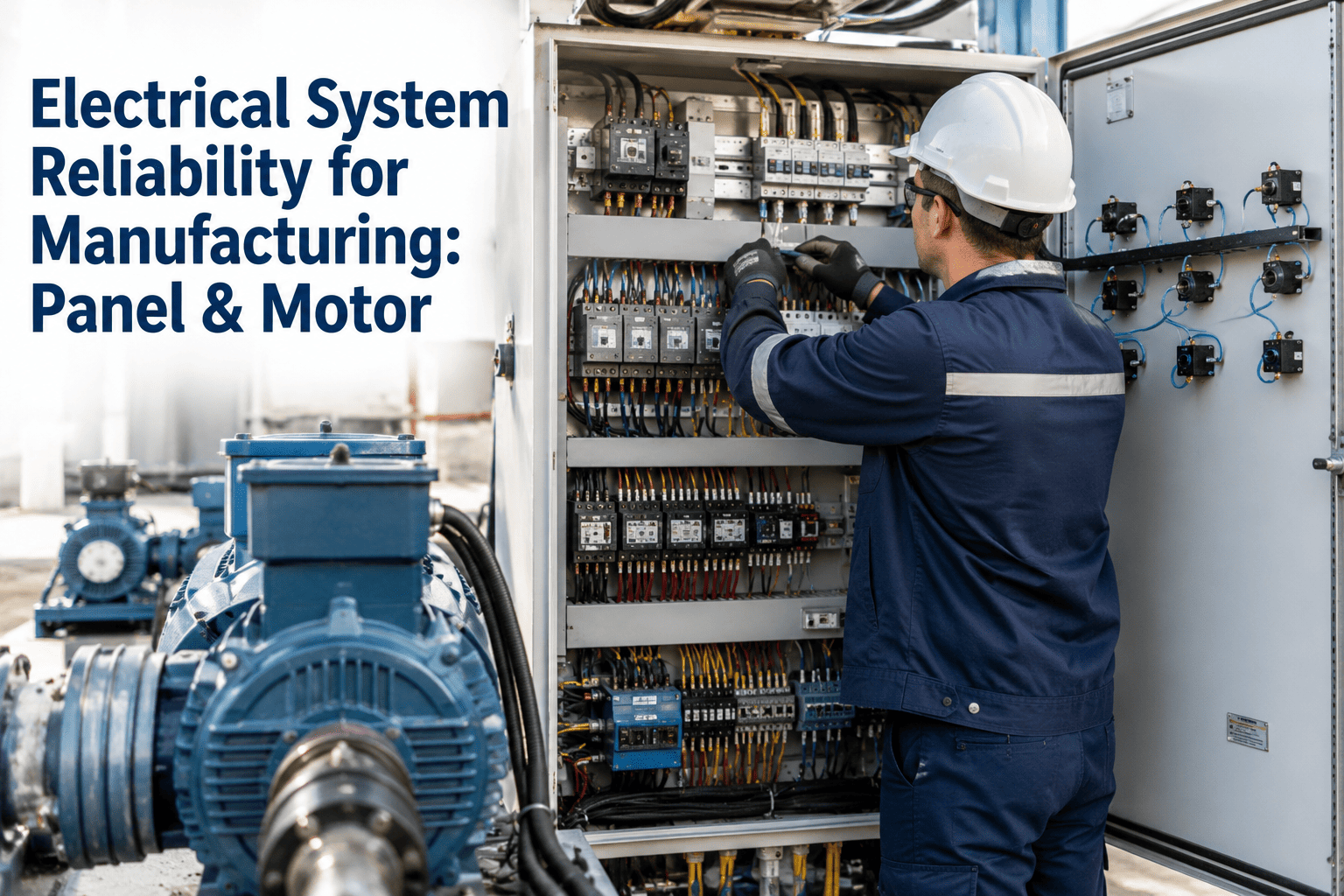
Motors are the least glamorous piece of equipment in most plants, which is exactly why they get overlooked as an energy target even though they typically account for 65-70% of a manufacturing facility's total electricity use. A motor running at the wrong speed against a throttled valve, or oversized for the load it actually drives, burns that excess energy as heat and noise every single hour it operates, with no alarm and no obvious sign anything is wrong. Because motors run continuously and rarely fail outright while wasting energy, the losses compound for years before anyone investigates. This guide covers where motor systems actually lose energy, how VFDs and right-sizing recover it, and how a demo can show real-time motor load data across your plant.
Why Motors Are the Highest-Leverage Energy Target in Most Plants
The purchase price of an industrial motor is a small fraction of what it actually costs over its working life. Studies of motor life-cycle economics consistently find that the electricity a motor consumes makes up the overwhelming majority of its total cost, which means even a small efficiency improvement, compounded over years of continuous operation, delivers far more value than most capital projects of similar upfront cost.
That math is exactly why motor systems reward a systematic look even when nothing is visibly wrong. A motor that runs fine, never trips, and hits its production targets can still be quietly oversized for its load or fighting a throttled valve every hour it operates, and neither of those conditions shows up as a maintenance issue. They only show up as an unusually flat electricity bill relative to what the process actually requires.
VFDs: Matching Motor Speed to Actual Load Instead of Fighting It
Before a VFD, the standard way to control flow on a pump or fan was to run the motor at full speed and throttle a valve or damper to reduce output. That approach wastes energy by design: the motor keeps producing full power while the valve dissipates the excess as heat and turbulence, similar to driving with the accelerator floored while riding the brake to control speed.
| Speed Reduction | Approximate Power Reduction | Typical Application |
|---|---|---|
| 10% | ~27% | Cooling tower fans, HVAC supply fans |
| 20% | ~49% | Centrifugal pumps, process fans |
| 30% | ~66% | Chilled water and condenser pumps |
These figures follow the cubic relationship between speed and power for centrifugal loads, but real systems with significant static head won't scale quite as cleanly, since the pump still has to overcome that fixed head before any flow reduction shows up as a power savings. Applications currently using a throttling valve, damper, or bypass recirculation to control flow are the strongest VFD candidates, because those are exactly the control methods a VFD is built to replace.
Right-Sizing: The Motor Efficiency Fix That Isn't About the Motor
Oversized motors are common because engineers historically specified generous safety margins to cover uncertain future loads or worst-case starting conditions. A motor running well below its rated load operates at a lower efficiency point on its performance curve, and it also runs at a poor power factor, which can add its own penalty depending on the utility rate structure. Neither problem is visible from the motor nameplate; both require an actual load measurement to identify.
High-Efficiency Motor Replacement: IE3, IE4, and When It Pays Off
Modern IE3 and IE4-rated motors deliver meaningfully lower losses than the standard-efficiency motors still running in many older plants, and the efficiency gap widens as motor age increases, since windings and bearings degrade gradually over years of service. Replacing a failed standard-efficiency motor with a premium-efficiency unit at the point of failure is usually the easiest opportunity to capture, since the incremental cost over a standard replacement is small and the motor would need replacing anyway.
Proactively replacing a still-functioning motor before failure is a harder economic case, and it depends heavily on run hours and the size of the efficiency gap between the existing motor and its modern equivalent. As a general pattern, large motors running continuously at high load factors justify proactive replacement sooner than small, intermittently used motors, where the existing unit's remaining service life often makes more economic sense to run out.