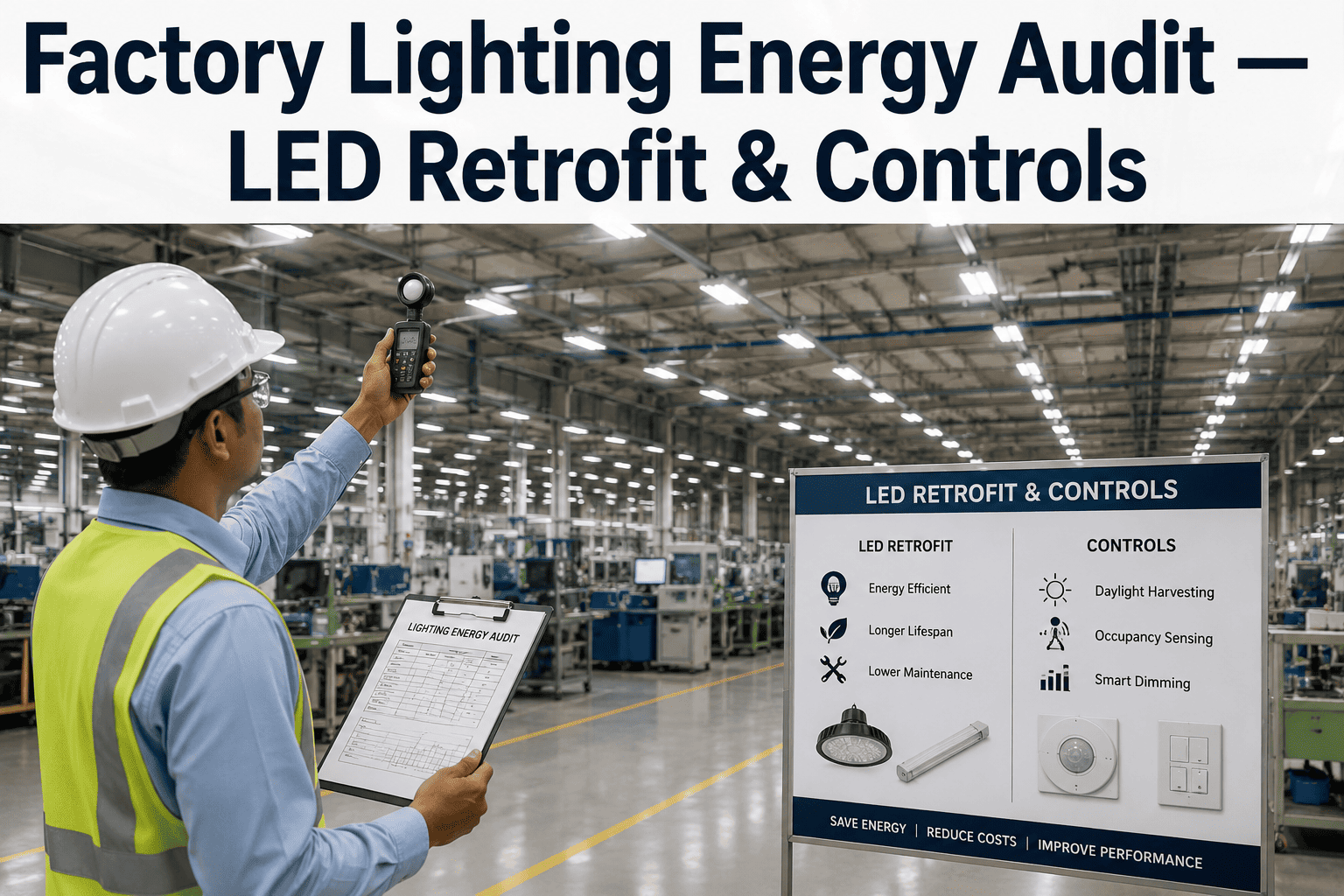
Factory lighting rarely gets the same attention as production equipment or HVAC, largely because a lighting system that's technically working never triggers a maintenance ticket the way a stalled conveyor does. High-bay fixtures installed a decade or more ago keep burning exactly as they were commissioned, often running at full output in aisles nobody's walked through in an hour and in areas that get plenty of daylight through skylights nobody's accounted for in the control logic. None of that shows up as a fault, only as a bill that stays higher than it needs to be. A structured lighting audit typically finds retrofit and control opportunities with payback under two years, which is fast even by energy-project standards. This guide walks through what a factory lighting audit actually finds, how LED retrofits and controls pay back, and how a demo can show a lighting audit built from your own facility layout.
What a Factory Lighting Audit Actually Measures
A lighting audit starts with an inventory: fixture type, wattage, quantity, and run hours across every area of the facility, from high-bay production floor lighting down to office and warehouse fixtures that often get overlooked in favor of the more visible production areas. Run hours matter as much as fixture count, since a fixture running 24 hours a day in a continuous operation carries a completely different energy and payback profile than one running an eight-hour single shift.
The audit also documents current control strategy, or the lack of one: whether fixtures are switched manually, tied to a fixed schedule, or already using occupancy or daylight-based controls. A facility running legacy high-intensity discharge or fluorescent fixtures on simple on/off switches with no scheduling represents the largest opportunity, since it stacks fixture-level savings from LED conversion on top of control-level savings from occupancy and daylight strategies.
| Fixture Type | Typical Energy Reduction With LED | Common Payback Range |
|---|---|---|
| High-bay HID (metal halide) | 60-75% | 12-24 months |
| T8/T12 fluorescent | 40-60% | 18-30 months |
| Exterior and yard lighting | 50-65% | 12-24 months |
LED Retrofit: Why High-Bay Fixtures Are the Highest-Return Starting Point
High-bay metal halide and high-pressure sodium fixtures common on production floors run at high wattage and long hours, which is exactly the combination that produces the fastest LED payback. These fixtures also carry a maintenance cost LED eliminates: metal halide lamps degrade in output well before they actually fail, meaning facilities often over-light early in a lamp's life to compensate for expected depreciation later, and LED fixtures avoid that entire compensation cycle by maintaining consistent output over a much longer service life.
Occupancy Sensors: Capturing Savings LED Alone Doesn't Reach
Switching a fixture to LED reduces the energy cost of every hour it runs, but it doesn't address whether the fixture needs to be running at all. Aisles, storage areas, and intermittently used spaces often have fixtures burning continuously through an entire shift even though they're only occupied a fraction of that time. Occupancy sensors close that gap by tying fixture output directly to actual presence rather than a fixed schedule.
Daylight Harvesting: Free Light Most Facilities Already Have
Facilities with skylights or significant window area often run interior lighting at full output regardless of how much natural daylight is already reaching the floor. Daylight harvesting controls use a photosensor to dim fixtures automatically as ambient light increases, maintaining a consistent target illumination level while drawing less electricity whenever the sun is doing part of the job already.
The opportunity is largest in facilities with skylights installed for a different reason entirely, like natural ventilation or architectural design, where nobody connected the daylight already entering the building to a corresponding reduction in electric lighting. A photosensor-based control retrofit is often one of the least invasive projects on this list, since it typically requires no fixture replacement, just a control layer added to existing or newly installed LED fixtures.