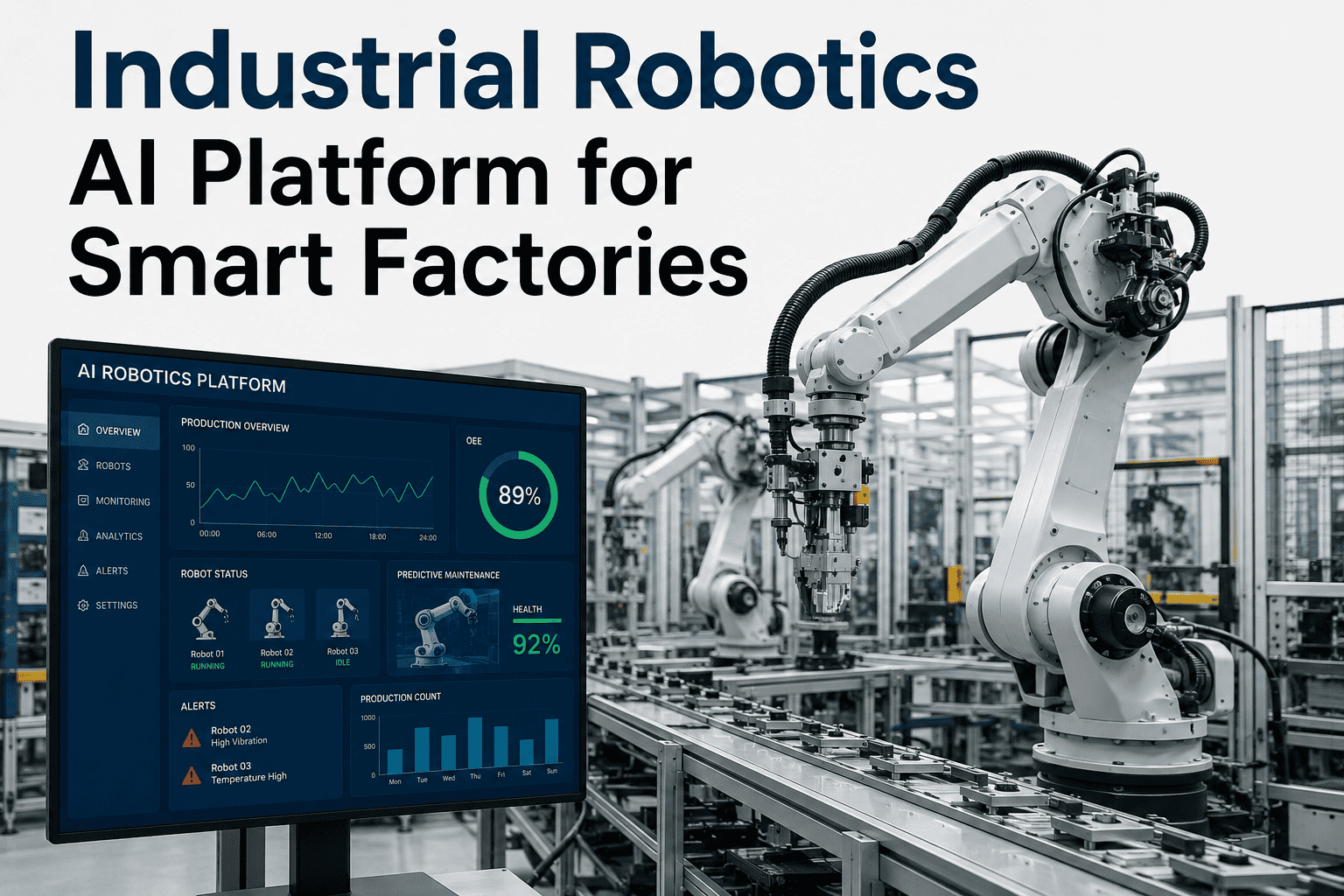
Walk any plant floor in 2026 and the machines look different than they did five years ago. A cobot works elbow to elbow with an operator on final assembly. An AMR threads through the aisle carrying totes to a packaging cell. A fixed-arm welder runs the same weld path it has run for a decade, only now a vision system watches every seam. Each of these machines is intelligent on its own, yet none of them know the others exist, and that gap between individually smart robots and a genuinely smart factory is exactly where an industrial robotics AI platform earns its place.
One AI Brain for Every Arm, Cobot, AMR, and Humanoid on Your Floor
iFactory unifies your entire robotic fleet, fixed-arm welders, collaborative robots, autonomous mobile robots, and emerging humanoid and quadruped platforms, under a single orchestration layer that allocates tasks, prevents traffic conflicts, and ties every robot's output back to your production schedule.
Robot Orders Are Climbing While Coordination Software Lags Behind
North American robot orders have continued climbing year over year, a signal of sustained capital commitment to automation even as broader manufacturing output growth has been revised more cautiously. What has changed is not just how many robots plants are buying, it is how many different categories of robot a single plant now runs at once. A few years ago, a typical automated cell meant one arm on one task. Today the same floor might run a fixed arm on welding, a cobot on final assembly, an AMR fleet on internal logistics, and a pilot humanoid or quadruped program running alongside all of it.
Edge AI, vision-guided automation, and digital twins are consistently named among the technology themes manufacturers are scaling fastest, and each of those themes assumes a level of connected visibility that isolated robot fleets simply do not provide on their own. A vision-guided cobot cell is only as useful as the schedule data it receives about what is coming down the line next. A digital twin of a production line is only accurate if it reflects where every AMR and cobot actually is in real time, not where a per-vendor dashboard last reported it. Orchestration is the layer that makes every other 2026 automation investment actually pay off as a system rather than as a collection of disconnected upgrades.
There is also a workforce dimension to this shift. As cobots take on tasks that previously required dedicated safety enclosures and AMRs handle more of the internal logistics that used to be manual, the operators, technicians, and supervisors on the floor increasingly need one coherent picture of what the automated layer of the plant is doing, not five separate logins for five separate robot types. Coordinated orchestration is as much a usability improvement for the people running the floor as it is a throughput improvement for the machines on it.
A Fleet of Smart Robots Is Not the Same Thing as a Smart Factory
Most plants did not set out to build a fragmented robotics fleet, it happened one purchase order at a time. A cobot arrived to solve a labor shortage on one line. An AMR fleet was added to move totes between packaging and shipping. A vision-guided arm replaced manual inspection on another cell. Each purchase solved a real problem, and each robot is genuinely well managed by its own vendor's software. What none of them share is a common view of the production schedule, so the AMR does not know the cobot cell is about to run out of parts, and the cobot does not know a changeover is coming that will change what it needs to pick next.
The result is a factory where individually optimized robots collectively underperform. Traffic congestion builds at intersections where AMR paths cross forklift routes. Cobots sit idle waiting for material that a coordinated system would have already dispatched. Humanoid and quadruped platforms, still early in most deployments, get treated as isolated pilots rather than integrated into the same task queue as everything else. iFactory closes that gap by giving every robot class a seat at the same orchestration table, regardless of the vendor, the protocol, or the robot type.
This fragmentation is rarely visible in any single vendor's performance report, which is exactly what makes it so persistent. A cobot vendor's dashboard will correctly show high uptime and cycle time within spec. An AMR fleet manager's console will correctly show strong task completion rates. Both reports can be accurate and green across the board while the plant as a whole is still losing throughput to the gaps between them, gaps that show up as idle time, blocked aisles, and manual interventions that never appear on any single system's own scorecard because no single system was ever responsible for the interaction itself.
Every Robot Class, Coordinated From One Layer
Welding, stamping, and machine-tending arms achieve positional repeatability that no other robot class currently matches, typically in the range of a few hundredths of a millimeter, and they remain the correct tool for high-speed, high-precision, fixed-path work such as body-in-white welding and CNC tending. Orchestration does not touch their motion control, it simply gives them visibility into what upstream and downstream cells are doing so cycle time is never wasted waiting on a part that has not arrived yet.
Cobots work without the dedicated safety enclosures that traditional arms require, combining 3D vision, force sensing, and natural-language programming to handle assembly, dispensing, and inspection tasks that change frequently between runs. As cobots take on more industrial-grade, high-duty applications, coordinating their task queue with the rest of the fleet becomes as important as the cobot's own onboard intelligence.
AMRs move material between cells with real-time spatial awareness, and coordinated routing keeps them out of the same intersections where forklifts and towing vehicles create the highest collision risk on a plant floor. Multi-site AMR rollouts have moved well past pilot stage, and orchestration is what lets a fleet manager oversee routing logic across every site from one console instead of one per facility.
Humanoids are proving out in narrow, well-defined tasks such as continuous tote movement and inter-process transport, while quadrupeds handle overnight patrol and inspection rounds in areas that are impractical to wire with fixed sensors. Neither platform class is positioned to replace fixed arms on precision work in the near term, but both are production-credible enough to justify a seat in the same task queue as everything else on the floor.
Increasingly, inspection stations built around AI vision are treated as their own coordinated node in the fleet rather than a standalone checkpoint. When a vision cell flags a defect trend, that signal can automatically slow the upstream cobot's feed rate or reroute a batch to secondary inspection without a human relaying the message between systems.
See Your Fleet Fragmentation Mapped in a Live Session
iFactory reviews your current robot mix and shows exactly where unified orchestration would remove the most friction.
Three Layers Between a Robot and a Production Schedule
Every robot vendor speaks a different language, ROS 2, proprietary REST APIs, PLC-based interlocks. This layer translates all of it into a single, consistent task and status model so the orchestration engine never has to know which vendor built which machine. New robots, including future humanoid or quadruped additions, are onboarded by extending this same normalization layer rather than building a bespoke integration from scratch each time.
Work is assigned across the fleet based on current production priority, not on which robot happens to be closest, and physical routing is planned to prevent the gridlock that occurs when AMRs, humanoids, and human traffic converge in the same aisle.
The production schedule that should be driving robot task queues finally has the authority to do so, and quality outcomes from robotic cells feed straight back into the same analytics used for the rest of the plant.
Where Robot Adoption Actually Stands Heading Into 2026
| Robot Class | Current Deployment Stage | Best-Fit Task Profile |
|---|---|---|
| Fixed-Arm Industrial Robots | Mature, high-volume production | Precision welding, stamping, CNC tending |
| Collaborative Robots | Rapidly expanding beyond light duty | Assembly, dispensing, inline inspection |
| Autonomous Mobile Robots | Multi-site deployment at scale | Intersection-heavy internal logistics |
| Humanoids and Quadrupeds | Narrow, production-credible pilots | Flexible transport and patrol tasks |
What Coordinated Fleets Deliver Over Isolated Robots
What Usually Goes Wrong When a Fleet Grows Faster Than Its Coordination
The most common mistake is treating each new robot purchase as an isolated project with its own dashboard, its own integrator, and its own success metric. That approach works fine for the first robot on the floor and starts costing real money by the third or fourth, because nobody is measuring the interaction cost between machines, only each machine's individual performance. A plant can hit every vendor's stated uptime target for its cobots, its AMRs, and its arms individually while the combined system still underperforms because of avoidable handoff delays and routing conflicts.
A second common pitfall is waiting too long to bring humanoid or quadruped pilots into the same coordination framework as the rest of the fleet. Pilots are often run by a separate innovation team with separate reporting, which feels lower-risk at first but creates a second integration project down the line once the pilot proves out and needs to move into daily production alongside everything else. Bringing new robot classes into the shared task and traffic model from the start, even at pilot scale, avoids that rework entirely.
A third pitfall is underestimating how much of the fragmentation problem is a data model issue rather than a hardware issue. Plants sometimes assume that better robots will solve coordination problems on their own, when in most cases the individual robots are already performing well within spec, and the gap is purely in how their outputs and statuses are represented to a shared scheduling system.
Getting From a Fragmented Fleet to a Coordinated One
Inventory the Fleet
Every arm, cobot, AMR, and pilot humanoid or quadruped is catalogued along with its vendor protocol and current control software.
Connect Without Disruption
Each robot is connected through its native API or a lightweight gateway, with no changes required to the safety logic already validated on the machine.
Enable Shared Task Allocation
The orchestration layer begins assigning work across the fleet based on production priority rather than per-vendor scheduling logic.
Expand to Humanoids and Quadrupeds
As pilot programs prove out, new robot classes are added to the same task queue rather than run as standalone experiments.
Questions Plant Leaders Ask About Robotics AI Orchestration
Why Plant Leaders Are Prioritizing Orchestration Over Adding More Robots
Adding another robot to a fragmented fleet produces a familiar curve of diminishing returns. The first robot on a floor delivers close to its full rated benefit because it has no coordination overhead to contend with. The fifth robot, competing for the same aisles, the same material buffers, and the same maintenance attention as four others, often delivers noticeably less than its rated benefit purely because nothing is managing the interactions between machines. Plant leaders who have run this math internally increasingly conclude that the next dollar spent on orchestration software returns more than the next dollar spent on additional robot hardware, at least until the coordination layer catches up with the fleet that is already installed.
There is also a talent dimension to the business case. Robotics integrators and maintenance technicians are already stretched thin, and asking that team to master five separate vendor consoles slows troubleshooting during exactly the moments when speed matters most, a stalled line, a missed handoff, an intersection conflict blocking a critical path. A single orchestration view does not replace vendor-specific expertise, but it does mean the first responder to a floor issue has one place to look for what is actually happening across the fleet before diving into a specific robot's own diagnostics.
Finally, orchestration data becomes an asset in its own right. Every task assignment, every routing decision, and every handoff delay is logged in one consistent format, which turns what used to be anecdotal floor knowledge, "the AMRs always back up near the packaging line on Tuesdays", into a dataset that can be analyzed, benchmarked, and improved deliberately rather than left to institutional memory.
Stop Managing Five Robot Dashboards Instead of One Factory
iFactory brings every arm, cobot, AMR, humanoid, and quadruped onto a single AI orchestration layer built around your actual production schedule.