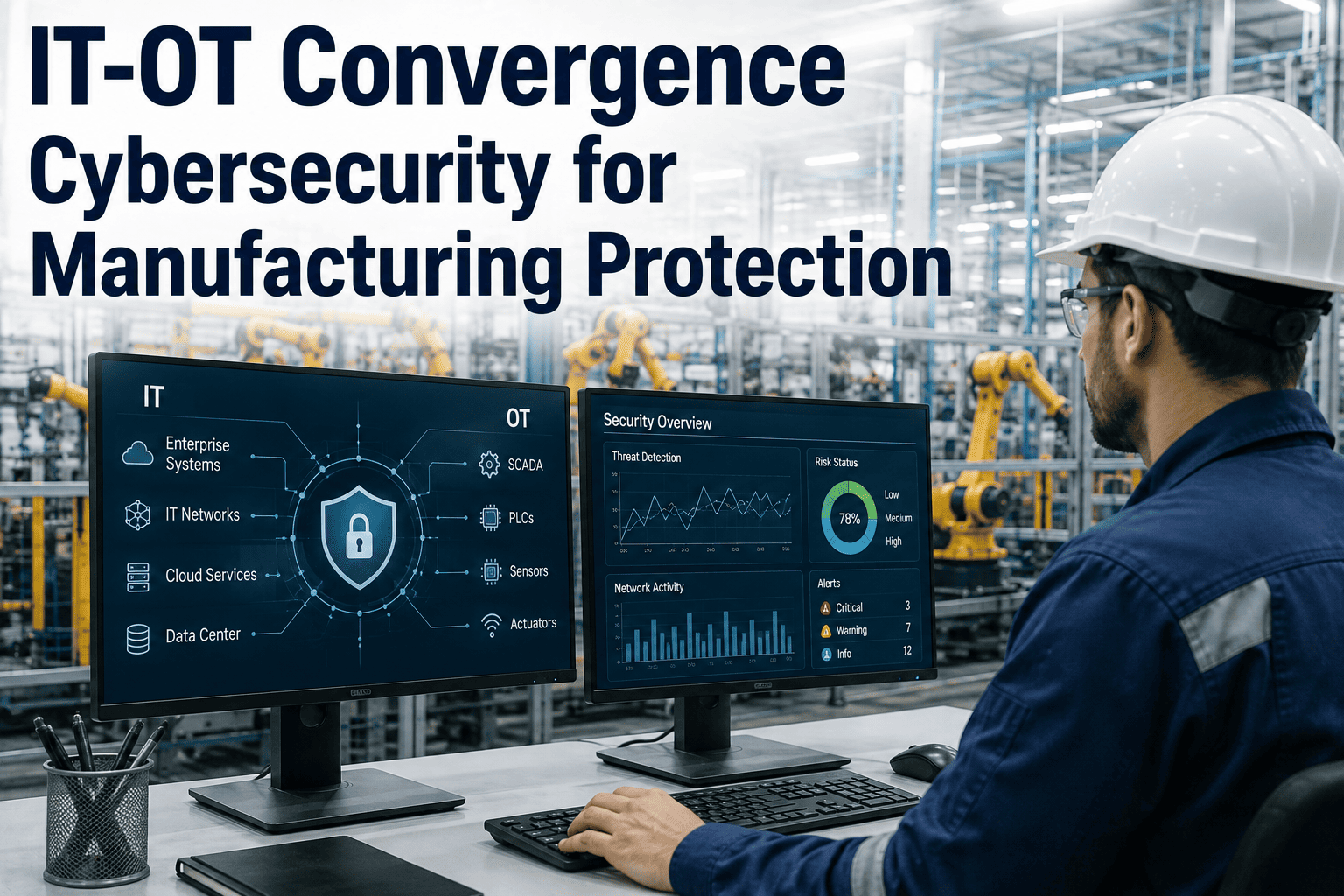
A production line running for eighteen years on a flat network never had to think about who could reach its PLCs, because nothing outside the plant fence could reach them either. That assumption breaks the day someone connects a historian to the cloud, lets a vendor remote in to a robot cell for support, or plugs a laptop into a switch that was never meant to see anything beyond ladder logic. IT-OT convergence brings real value, remote diagnostics, predictive maintenance, enterprise visibility into shop floor performance, but every one of those benefits rides on a network path that an attacker can also use. iFactory builds the segmentation, monitoring, and access control layer that lets plants get the benefits of convergence without leaving controllers exposed to a corporate network, a VPN, or the open internet. You can book a demo to see how it maps against your own plant network today.
Connect the Plant Floor to the Enterprise Without Opening the Door to Everyone Else
iFactory designs and monitors the segmentation between your operational technology and your IT network, so historians, dashboards, and remote support connections stay useful without turning a PLC into a reachable endpoint.
Every Integration Project Quietly Expands the Attack Surface
Most plants did not choose to merge IT and OT in one deliberate project, it happened gradually, a historian tag here, a remote access tool there, a vendor support laptop plugged in during a shutdown. Each connection solved a real problem at the time, but few of them were built with a documented segmentation boundary, and fewer still are reviewed once the person who set them up has moved on. The result is a network where operational technology, PLCs, HMIs, safety systems, sits closer to the internet than anyone on the plant floor realizes.
The people who understand the plant floor best, control engineers and maintenance technicians, are rarely the ones who own network security decisions, and the IT team that does own those decisions often has limited visibility into what a given controller actually does or how disruptive an unplanned reboot would be. That gap in shared understanding is exactly where segmentation projects stall, since neither side wants to make a change without the other's confidence that production will not be affected. Closing that gap requires a process that brings both groups into the same conversation from the start, not a security mandate handed down after the fact.
Segmentation Works Because Each Layer Has a Narrow, Defined Job
A defensible IT-OT architecture is not one firewall, it is a series of zones, each with a specific purpose and a specific, minimal set of things allowed to cross into it. This layered approach, commonly aligned to the Purdue Enterprise Reference Architecture, means that even if an attacker compromises the enterprise network, they still face a DMZ, a monitored broker, and a segmented control network before reaching anything that can move a machine.
What makes this model effective is not the number of zones but the discipline of only allowing specific, documented traffic to cross each boundary, everything else is denied by default rather than permitted unless specifically blocked. Many plants that believe they already have segmentation in place actually have a series of firewalls configured permissively over time, rules added to solve an immediate problem and never removed once that problem passed. A proper implementation audits every existing rule, keeps only what is still justified, and documents the rest so the next engineer does not have to guess why a rule exists before removing it.
The Same Convergence Goals, Reached Without the Same Exposure
The features plants want from convergence, remote diagnostics, centralized dashboards, cloud analytics, do not require a flat network to work. They require a monitored path that only carries the specific traffic it was designed for, logged, alerted, and reviewed as a matter of course rather than an afterthought after an incident.
This distinction matters most during the moments plants care about it least, a shutdown, a changeover, or an emergency vendor call, exactly when someone under time pressure is most tempted to open a shortcut around the architecture rather than through it. A managed segmentation program accounts for that pressure directly, giving operations a fast, still-monitored path for legitimate urgent access instead of leaving the only fast option as an undocumented workaround.
| Capability | Flat or Ad Hoc Network | iFactory-Designed Architecture |
|---|---|---|
| Remote Vendor Access | Persistent VPN or direct connection left open indefinitely | Time-boxed, logged sessions through a monitored broker |
| Historian to Cloud | Historian server bridges OT and cloud directly | One-way data flow through a DMZ with no inbound path |
| Traffic Visibility | Unknown until someone investigates after the fact | Continuously monitored with anomaly alerting |
| Patch and Update Path | Ad hoc, often manual USB transfer to controllers | Controlled distribution through a dedicated patch server |
| Incident Containment | Entire network potentially exposed, hard to isolate | Zone boundaries limit spread to a single segment |
See Your Own Network Mapped Against This Architecture
iFactory reviews your current plant network, identifies undocumented paths between IT and OT, and designs the segmentation to close them without disrupting production. Book a demo to walk through it with your team.
The Entry Points Attackers Look for First
Attackers rarely target a PLC directly, they target the easier path around it, the connections and devices that were added for convenience and never reviewed for exposure. Knowing where these paths typically form is the first step to closing them.
Any Plant Running Both Control Systems and an Enterprise Connection
This applies wherever operational technology and enterprise IT already share a building, a vendor, or a network switch, which today describes nearly every manufacturing site with any digital reporting at all.
Segmentation Succeeds or Fails on Cross-Team Buy-In, Not Just Technical Design
The technical architecture described above is well understood and has been implemented successfully across thousands of industrial sites, so the harder part of most projects is rarely the design itself, it is getting plant operations, control engineering, and corporate IT to agree on scope, timing, and risk tolerance before any configuration change happens. A change that looks routine to an IT security team can carry real production risk if it touches a network path a control engineer depends on during a changeover, and a control engineer's caution about touching anything on a running line can look like resistance to a security team trying to close a known gap.
The projects that move fastest are the ones where an assessment phase produces a shared, plain-language map of the current network that both groups can review together, not a report written for one audience and handed to the other. That shared starting point turns a segmentation project from a mandate imposed on plant operations into a joint effort both teams have reason to support, which matters as much for the long-term maintenance of the architecture as it does for the initial rollout.
What Plant and IT Teams Ask Before Starting
Get Convergence Benefits Without the Convergence Risk
iFactory designs the segmented architecture that keeps your plant floor productive, connected, and out of reach of everything it was never meant to talk to. Book a demo to start with a review of your current network.