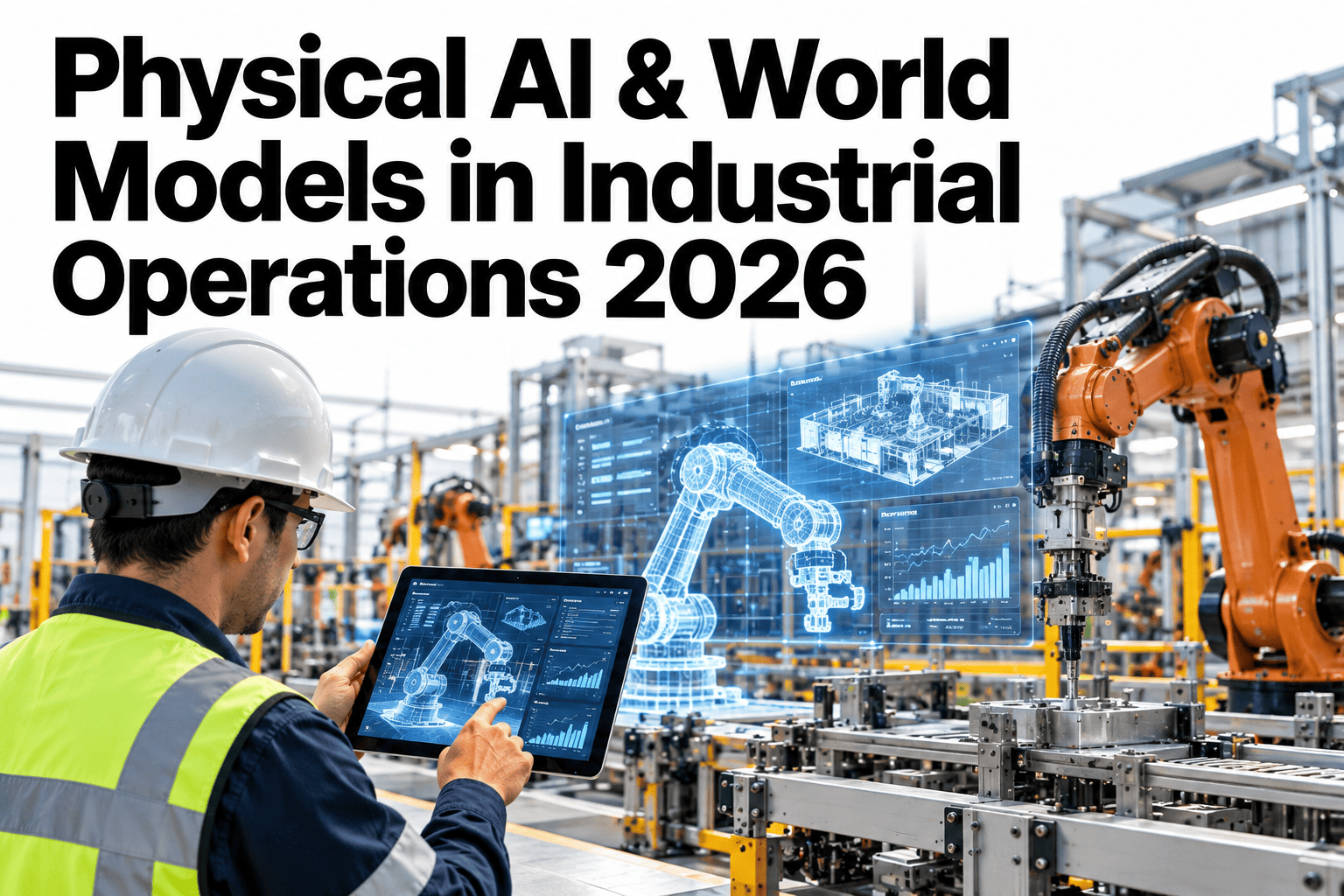
A new vocabulary has crept into industrial AI reports this year. Physical AI, world models, foundation policies, sim-to-real. The language suggests the next factory will be run by machines that have taught themselves what the world is like. The reality on the plant floor is more layered, with some capabilities already shipping and others still inside research labs. CTOs weighing where to invest can walk through a short readiness map with iFactory AI before committing budget.
Physical AI and World Models: What Is Deployable Now, What Is Still Research
iFactory AI maps the physical-AI stack onto your plant so technology directors can tell shipping capabilities apart from research promises, and move the pilot to the line that is ready for it.
The Four Layers of Physical AI, Sorted by What Works Today
Industry analysts frame physical AI as perception, reasoning, action and autonomy stacked on top of each other. The columns below show which layer is production-grade and which is still earning its stripes in research.
A useful test for any vendor pitch is to ask which of the four columns the demo was actually filmed in. A vision system catching a scratch on a moving part is perception, already proven across thousands of installed lines. A robot arm that re-grasps a dropped part without a programmer rewriting its path is action, also proven on repeat tasks. A system that tells an engineer what would happen if the furnace ran ten degrees cooler before anyone tries it is prediction, and that is the layer most 2026 announcements are actually about. A machine that walks into an unfamiliar storage room and sorts boxes it has never seen before is autonomy, and that remains a research answer dressed as a product pitch more often than plant teams expect.
A Five-Year Timeline, From Dashboards to World Models
The jump the industry is talking about is not sudden. The timeline shows how each layer of industrial AI was added, and where physical AI sits in the sequence.
What changed between 2024 and 2026 was not that vision got smarter in isolation. It was that the industry stopped treating each layer as a standalone purchase and started treating them as a stack, where the output of one becomes the input of the next. A vision model that flags a surface defect now feeds a twin that asks whether the defect correlates with a furnace set-point. A twin that answers that question now feeds a world model that can propose ten set-point combinations and rank them before anyone touches the real furnace. Technology directors who bought each layer as a separate tool in separate years are now discovering that the real value sits in the connective tissue between them, which is exactly where a turnkey platform earns its budget line.
What Exactly Is a World Model, in Plant Language
The term can feel abstract. The sketch below strips it down to one function: a model that can predict the next state of a physical system from the current state and a proposed action.
The output is not a decision. It is a prediction that a planner uses to decide. iFactory AI integrates these predictions into shop-floor logic without replacing the engineers who own the process. Walk through a live prediction loop on a real cell with iFactory AI.
See Which Physical-AI Layer Fits Your Line Today
iFactory AI brings the perception, action and twin layers to industrial operations in a 30-minute workshop, with an honest readout on what is production-ready for your plant and what is still a pilot.
Market Signals a CTO Should Weigh
The capability wave is backed by capital. The tiles below pull together the clearest 2026 signals a technology director will be asked about in a board meeting.
Sim-to-Real: The Bridge That Decides Deployment
A policy trained inside a world model only matters if it survives the move onto real hardware. The flow below shows the standard sim-to-real pipeline most industrial robotics teams now follow.
The gap shows up in specific, almost mundane ways. A gripper trained in a simulator with perfectly clean depth data will mis-time a grasp the first time it meets a reflective part under real warehouse lighting. A locomotion policy trained on a flat virtual floor will stumble on a real floor with a two-centimeter lip it never saw in training. The fix is not a smarter model, it is a harder simulator: more randomized lighting, more varied friction coefficients, more synthetic sensor noise, so the policy has already seen something close enough to the surprise before it meets it on the real line. This is also why the training-data scale numbers in recent announcements matter more than the model names. A world foundation model that generates hundreds of thousands of synthetic manipulation trajectories in hours is really generating hundreds of thousands of chances for the policy to fail safely in simulation instead of on a real conveyor.
Where Each Capability Pays Back First
The scatter below places the common physical-AI capabilities on two axes a CTO cares about: how mature the capability is today, and how quickly it recovers its investment on a typical industrial line.
iFactory AI focuses capability investment where the two axes overlap, so operations leaders see return in a quarter rather than a horizon. CTOs can compare the same quadrant against your plant map in a focused session.
Research Lab vs Production Floor: Where the Gaps Still Hide
Research demos look impressive. The split below is the honest view engineering teams need before trusting a claim on a roadmap.
- Reports peak success rates on curated setups
- New model drops weekly, benchmarks shift
- Tolerant to supervised recovery after a slip
- Human experts tune the demo for the video
- Hardware changes handled by the researcher
- Needs 24x7 reliability across shifts and lots
- Change management locks the stack for months
- Perturbations drop foundation-model accuracy sharply
- Operator action must be clear when the model fails
- Safety sign-off, cell certification, downtime cost
One concrete figure from current robotics research illustrates the gap well: foundation models that report success rates in the mid-90s on clean benchmark tasks can lose a large share of that accuracy once lighting changes and a few unexpected objects are added to the scene at the same time. That is not a flaw unique to one vendor, it is a structural property of models trained primarily on curated data. The implication for a plant is simple. Before any physical-AI claim earns a place on your line, ask for the accuracy number under your actual lighting, your actual product mix and your actual shift patterns, not the number from a published benchmark. iFactory AI runs that validation on your plant before a model is handed control of anything, which is the difference between a research citation and a production commitment.
A Pragmatic 2026-2027 Roadmap for Industrial Operations
The quarters below are a sequencing suggestion many iFactory customers follow. Each quarter adds a layer whose predecessor is already working.
Where iFactory AI Sits in the Stack
iFactory AI is the industrial platform that gets the stack running on a real plant, with the data plumbing, hardware and change management included.
Guardrails Every Technology Director Should Set
Physical-AI pilots fail quietly without a few hard rules. The strip below is the short list iFactory AI uses with every rollout.
Frequently Asked Questions
Is physical AI just a new name for industrial automation?
No. Industrial automation runs fixed logic written by an engineer, while physical AI learns the logic from data and uses perception to adapt. The two work together on modern lines, with automation handling the deterministic motion and physical AI handling the variable perception and decisions. The newer piece is the predictive layer, the world model, which lets a system imagine outcomes before acting rather than reacting after the fact.
Do we need humanoid robots to benefit from this wave?
Not at all. Humanoid robots sit on the horizon end of the maturity spectrum, and most industrial payback today comes from fixed cells with vision and learned policies. A CTO can capture the operational value of physical AI without any humanoid hardware on site. iFactory AI focuses on the cells and lines already in your plant, bringing the perception, action and twin layers to the robots and conveyors you already own. iFactory AI can map the capability to your current fleet during a short planning call.
How is a world model different from a digital twin?
A digital twin is a physics-informed model of a specific plant or asset you already know. A world model is a learned simulator that can predict future states for any situation it is trained on, including ones that never happened on your plant. Twins and world models combine well, with the twin providing structure and the world model providing imagination for things like policy training. Many iFactory deployments use both in sequence.
What happens when the model is wrong on a real line?
Every physical-AI deployment needs a clear failure mode. Perception models flag low-confidence frames for a human reviewer rather than silently guessing. Action policies pause and ask for operator intervention when a scenario falls outside the training envelope. World-model recommendations are advisory, not control, until a safety case is signed off. These behaviours are configured during deployment and tested, not left to the model's defaults.
How does iFactory AI help a CTO sequence this safely?
iFactory AI starts with the layers that pay back fastest, which are perception and vision-guided action. The twin and world-model pieces follow once the data foundation and operator comfort are in place. Each stage ships with a clear scope, a measurable outcome and a rollback option, so the plant is never dependent on a single pilot. A quick walkthrough covers the full sequence on your own plant map.
Position Your Plant for the Physical-AI Decade
iFactory AI turns the physical-AI stack into a staged rollout matched to your line, with the perception layer live now, the twin layer next, and world-model pilots on cells that are ready for them. Book a walkthrough to see the sequence against your own operations.