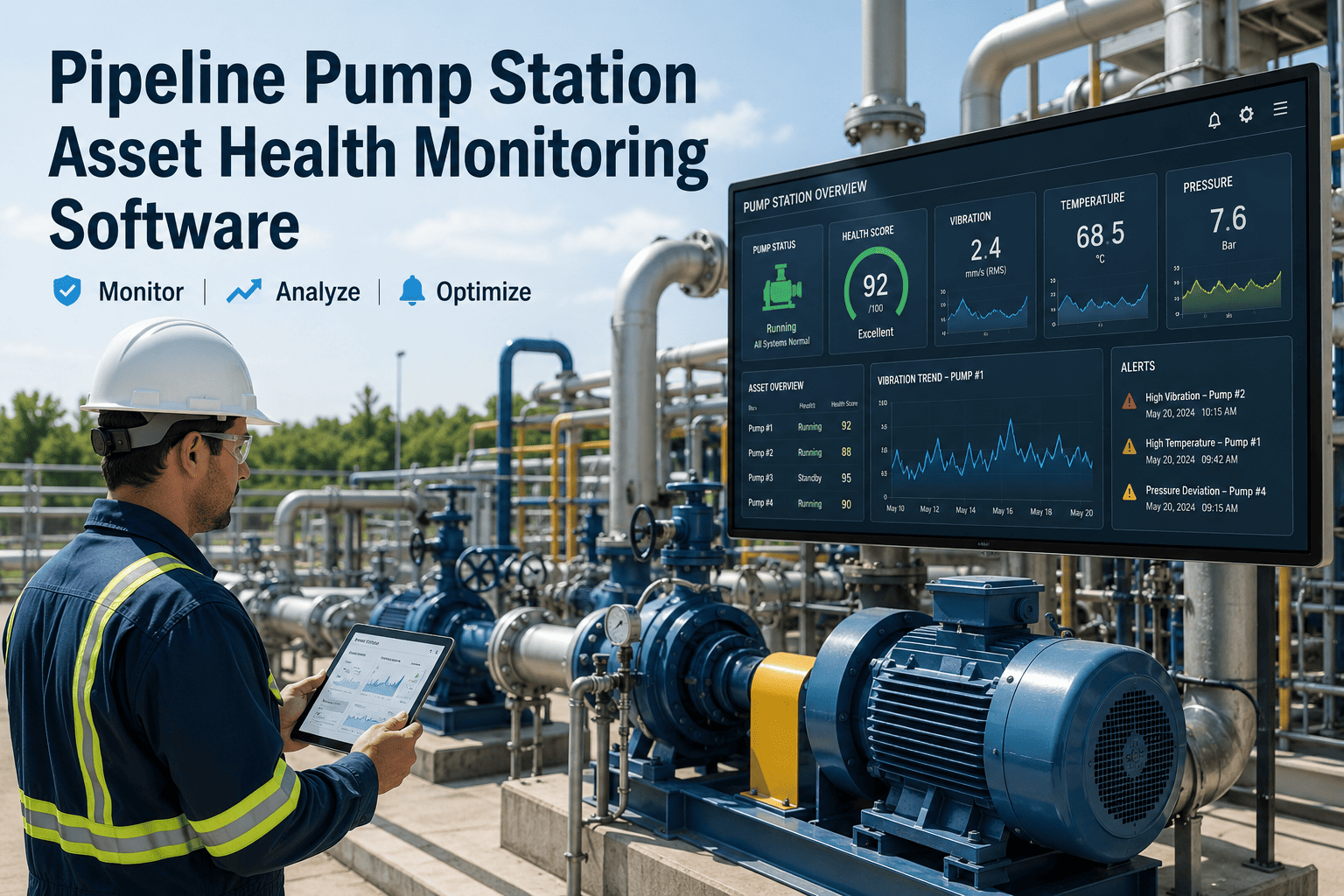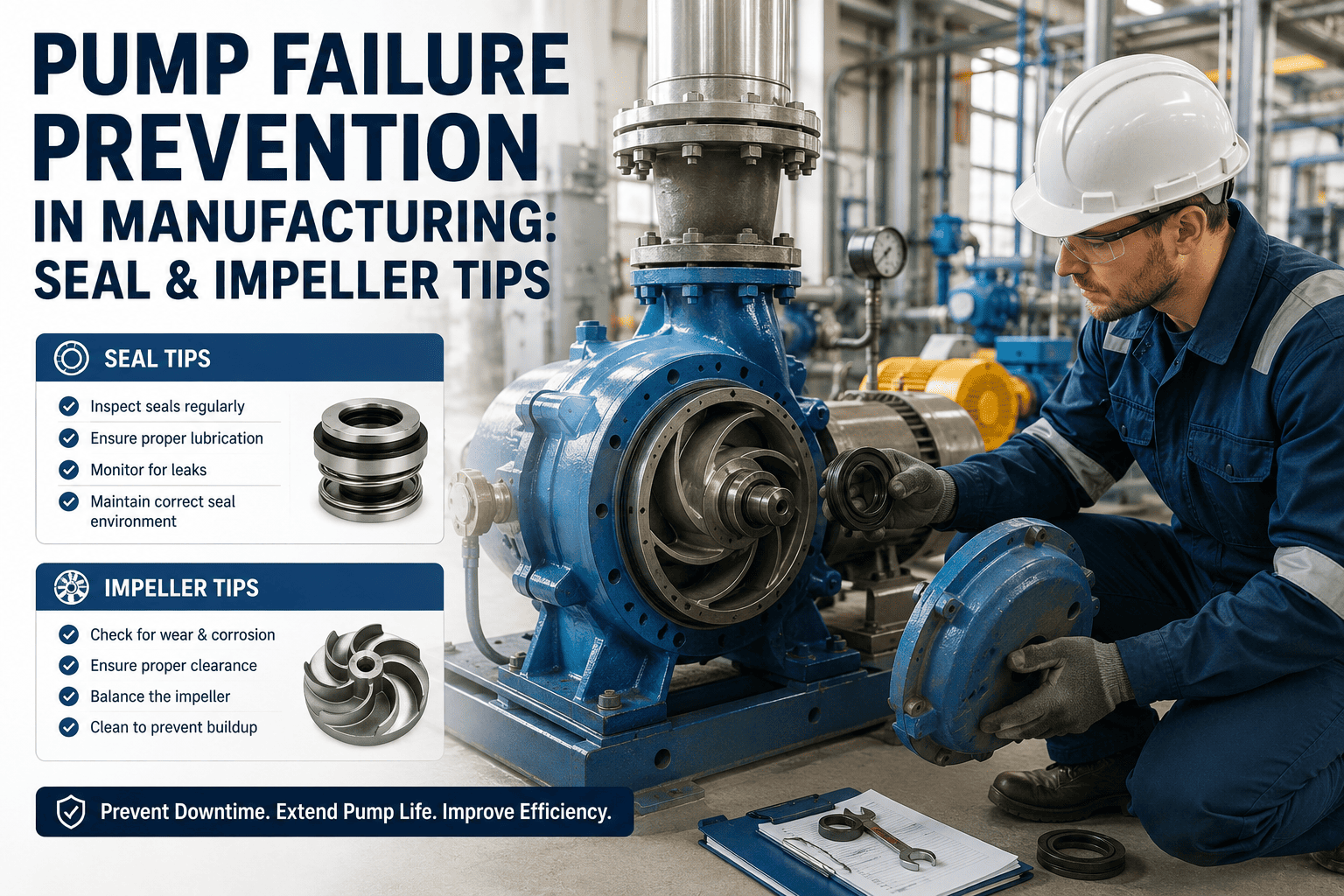
Shaft misalignment on its own accounts for roughly half of all rotating equipment failures, and it rarely announces itself — a coupling can look perfectly seated, the vibration reading can sit just inside the green zone, and a pump can still be running twelve mils out of true, quietly halving the bearing's expected life with every rotation. Mechanical seals fail for similar reasons: dry running, cavitation damage, or misalignment stress usually get the seal first, and the seal failure gets logged as the root cause when it was actually the last domino to fall. iFactory's rotating equipment monitoring tracks vibration, discharge pressure, and motor amperage together, so the pattern behind a pump failure shows up before the pump does.
Pumps Rarely Fail Without Warning. Most Plants Just Aren't Reading the Signs.
Seal leakage, impeller erosion, cavitation, and misalignment each leave a distinct signature — in sound, vibration, pressure, and power draw — long before the pump actually stops. Catching that signature early is the difference between a scheduled seal swap and an emergency teardown.
The Four Failure Vectors — And Why They're Rarely Independent
Pump reliability engineering tends to organize failures into four categories: seal failure, impeller damage, cavitation, and misalignment. Treating them as four separate problems is common, but it's also misleading, because in practice they form a chain. Misalignment stresses the seal. Cavitation erodes the impeller and shakes the shaft enough to accelerate misalignment. A worn impeller changes the flow characteristics enough to induce cavitation that wasn't there when the pump was new. By the time a technician is standing in front of a leaking seal, the actual root cause is frequently one of the other three — the seal is just where the damage became visible first.
This chain reaction is exactly why a work order that says "replace seal" so often gets repeated on the same pump within a year. The seal did what it was designed to do — fail visibly and safely rather than catastrophically — but if nobody investigates what put it under stress in the first place, the replacement seal inherits the same conditions and starts the same clock. A more useful diagnostic habit is to treat every seal failure as a question rather than a completed repair: what upstream condition made this seal fail now, on this pump, rather than at its rated service life?
Mechanical Seal Failure
Mechanical seals are responsible for a disproportionate share of unplanned pump outages — and dry running, misalignment stress, and cavitation damage are the three conditions that get to a seal before it fails on its own. A seal replaced without addressing the underlying cause will fail again on a similar timeline.
Impeller Condition
Impeller damage comes from three distinct mechanisms — cavitation erosion, abrasive wear from particulate in the fluid, and corrosion from chemical incompatibility — and each requires a different fix. A pump losing head at stable flow, without any change in system conditions, is the clearest early signal that impeller condition has degraded.
Cavitation
Cavitation happens when suction pressure drops below the fluid's vapor pressure, forming vapor bubbles that implode violently as they reach the higher-pressure zone near the impeller. It's often intermittent — tied to changing tank levels, temperature swings, or valve adjustments — which makes it easy to miss without continuous monitoring rather than a periodic walkthrough.
Shaft Misalignment
Misalignment is the quiet root cause behind a large share of bearing and seal failures precisely because it's invisible to the eye and to a straightedge — a few thousandths of an inch off center is enough to meaningfully shorten bearing life while the coupling still looks correctly seated. It rarely gets checked unless something has already failed.
Cavitation, Explained the Way It Actually Happens on the Floor
Cavitation gets described in textbooks as a pressure phenomenon, which is accurate but not always useful to someone standing next to a pump trying to figure out why it suddenly sounds like it's grinding gravel. Here's the mechanical sequence: as fluid accelerates through the eye of the impeller, pressure drops. If that pressure falls below the fluid's vapor pressure at the operating temperature, the fluid locally boils — not from heat, but from the pressure drop — forming vapor bubbles. Those bubbles travel with the flow into the higher-pressure zone near the impeller discharge, where they collapse violently, producing localized shock waves strong enough to erode metal over time.
The practical driver in almost every case is insufficient Net Positive Suction Head — NPSH available (NPSHa) falling too close to, or below, NPSH required (NPSHr) as specified by the pump manufacturer. NPSHa can degrade for reasons that have nothing to do with the pump itself: a falling tank level, a partially closed suction valve, a clogged strainer, or fluid temperature rising closer to its vapor point. This is exactly why cavitation is often intermittent and hard to pin down through a periodic inspection — the pump can run clean for a full shift and cavitate hard for twenty minutes when a tank runs low, with no operator anywhere near it to hear the difference.
The recommended engineering practice is to maintain a safety margin between NPSHa and NPSHr — commonly a few feet of head, though the exact figure depends on system complexity and how much the suction conditions vary during normal operation. A pump specified with only a razor-thin margin above NPSHr on paper will almost certainly cavitate in the field, because real suction conditions rarely match the clean, steady-state numbers used during initial sizing. Building in margin at the design stage is far cheaper than diagnosing intermittent cavitation on an installed system years later.
| Cavitation Type | Primary Cause | Typical Fix |
|---|---|---|
| Suction cavitation | NPSHa below NPSHr — low suction pressure, high fluid temperature, or elevation | Increase suction pipe diameter, lower pump elevation, reduce fluid temperature |
| Discharge (recirculation) cavitation | Pump operating far below its best efficiency point, often from an oversized pump | Match pump sizing to actual system demand, install a minimum flow bypass |
| Vane passing / turbulent cavitation | Flow disturbance from poor inlet piping geometry near the impeller eye | Add straight pipe run before suction, remove flow-disturbing fittings near inlet |
A Cavitating Pump Rarely Fails Alone — It Takes the Seal and Bearings With It
iFactory correlates suction pressure, vibration signature, and motor amperage on the same asset record, so a cavitation event gets flagged before it becomes an impeller replacement and a seal job on the same work order.
Alignment: The Precision Maintenance Task Most Plants Treat as Optional
There's a persistent misconception on plant floors that a pump aligned at the factory or during initial installation stays aligned indefinitely unless something obviously moves it. In practice, alignment shifts from thermal growth during operation, foundation settling, pipe strain from connected piping, and even the simple act of removing and reinstalling a motor for an unrelated repair. A bearing replacement that doesn't include a fresh alignment check is one of the most common ways a plant re-introduces the exact problem the repair was meant to fix.
Thermal growth deserves particular attention because it's the misalignment cause most likely to be invisible during a cold, shut-down alignment check. A pump and motor aligned perfectly at ambient temperature can shift measurably once the system reaches normal operating temperature, especially on hot process fluids or in applications where the motor and pump run at different thermal rates. Facilities running high-temperature processes sometimes need to intentionally offset a cold alignment to compensate for expected thermal growth — a nuance that a straightedge check will never catch, but that a laser alignment procedure informed by the manufacturer's thermal growth data will.
Alignment tolerance for most standard-speed rotating equipment is tight — commonly cited at within about two thousandths of an inch along the shaft's full length at operating temperature. That's a tolerance no straightedge or eyeball check can reliably verify; it requires a dial indicator at minimum, and a laser alignment system for anything approaching precision. The forces generated by even modest misalignment are transmitted continuously, every rotation, directly into the bearings and the mechanical seal — which is why misalignment shows up downstream as a bearing or seal failure rather than being diagnosed as alignment in the first place.
Check baseplate and soft foot before touching the coupling
A pump sitting on an uneven or distorted baseplate will pull itself out of alignment the moment the bolts are torqued down, regardless of how carefully the shafts were positioned beforehand.
Remove pipe strain before measuring
Rigid piping that doesn't naturally meet the pump flange without force will distort the casing once bolted up, silently reintroducing misalignment even after a technically correct alignment procedure.
Measure with a laser system, not a straightedge
Misalignment in the range that damages bearings and seals is invisible to the eye — a laser or dial indicator is the minimum standard for any alignment that's expected to hold under continuous duty.
Re-check after any coupling-adjacent work
Bearing replacement, motor swap, or seal service all disturb the coupling relationship enough to warrant a fresh alignment check — assuming alignment is unchanged because the pump "wasn't moved" is a common and costly mistake.
Record the baseline and track vibration trend over time
A single good alignment reading is a snapshot, not a guarantee — logging startup baseline data and tracking vibration trend over months is what catches gradual drift before it becomes a failure.
What a Preventable Pump Failure Actually Costs
The direct repair cost of a failed seal or a scored impeller is rarely the biggest number on the incident report. A pump failure that takes down a cooling loop, a wash-down line, or a process transfer system can halt production well beyond the pump itself, and the lost production time on a critical asset frequently costs several times more than the labor and parts required for the repair itself. Emergency teardowns also carry a compounding risk: a pump reassembled under time pressure, without a proper alignment check or the correct flush plan for the new seal, has a real chance of failing again within weeks — turning one unplanned outage into two.
There's a second, quieter cost that rarely makes it onto a maintenance report: energy waste from degraded hydraulic efficiency. Pumping systems account for a meaningful share of total plant electricity consumption, and a worn impeller running at reduced efficiency draws more power to move the same volume of fluid — a cost that accumulates silently on the utility bill with no work order attached to explain it, until someone eventually notices the pump has been running hotter and drawing more current for months without anyone connecting the two.
Common Mistakes That Undermine Pump Reliability Programs
Every pump failure I've investigated that looked sudden turned out to have a paper trail once we went looking — a vibration reading that had been climbing for weeks, a head curve that had been quietly sagging, a seal chamber temperature that ran a few degrees hotter every month. Nothing about pump failure is actually sudden. What's sudden is the moment someone finally looks at the trend instead of the snapshot.
Frequently Asked Questions
How can I tell if a pump problem is cavitation or just normal wear?
Cavitation has a fairly distinctive audible signature — a cracking, popping, or gravel-like sound coming from inside the casing near the impeller, often accompanied by fluctuating suction pressure rather than a steady reading. Normal wear tends to show up as a gradual, steady decline in head or flow without the noise component, and without the correlation to suction-side conditions like tank level or valve position that cavitation typically shows.
The clearest way to confirm it is checking whether the symptoms track with suction conditions — if the noise and efficiency loss get worse when a tank runs low or a valve is partially closed, cavitation is very likely the cause rather than ordinary wear. Book a demo to see how iFactory correlates suction pressure trends with vibration and noise signatures automatically.
How often should pump alignment actually be checked?
Alignment should be verified during initial installation, after any work that disturbs the coupling — bearing replacement, motor swap, or seal service — and on a periodic schedule tied to criticality, typically every three to six months for standard-duty pumps and more frequently for critical or high-vibration applications. Vibration monitoring between full alignment checks can catch drift developing between scheduled inspections, since misalignment tends to worsen gradually rather than appear all at once.
The single most commonly skipped trigger is post-repair verification — many plants correctly schedule periodic alignment checks but skip the check immediately after a bearing or motor replacement, which is exactly when alignment is most likely to have shifted. Book a demo to review how iFactory can build post-repair alignment verification into your standard work order templates.
Why does my pump seal keep failing even after we replace it?
A repeat seal failure on the same asset almost always means the underlying cause was never addressed — the seal is a symptom, not the disease. The three most common root causes are shaft misalignment placing uneven load on the seal face, cavitation damage transmitting shock through the shaft, and an incorrect flush plan for the fluid and operating conditions, which leaves the seal running dry or at the wrong temperature.
Before the next replacement, it's worth checking alignment with a laser tool and reviewing whether the flush plan matches the fluid's actual temperature and pressure conditions, since both are frequently the real cause behind what looks like a simple seal wear issue. Book a demo to see how iFactory's support team can help you review flush plan selection against your current operating data.
What's the difference between angular and parallel misalignment, and does it matter which one I have?
Angular misalignment occurs when the two shafts meet at an angle rather than running parallel, and it tends to produce vibration concentrated at the running speed in the axial direction — along the length of the shaft. Parallel misalignment happens when the shafts are parallel but offset from each other, creating uneven radial loading and typically showing up as vibration at twice the running speed.
Both accelerate bearing and seal wear, but distinguishing between them matters for the repair — a shimming correction for one type won't necessarily resolve the other, and most real-world misalignment is a combination of both rather than a pure case of either. Book a demo to see how vibration signature analysis in iFactory helps distinguish misalignment type before a technician even opens the coupling guard.
Can an oversized pump actually cause reliability problems, or is bigger always safer?
An oversized pump is a common and underappreciated reliability risk. Running a pump well below its best efficiency point — which happens routinely when a pump is sized with excessive margin "to be safe" — creates internal recirculation that behaves much like cavitation, eroding internal surfaces and generating vibration even though the pump technically has more capacity than the system needs.
The fix isn't always a smaller pump; a minimum flow bypass line or a variable-speed drive can often correct the operating point without a full replacement, and either option is usually far cheaper than the accumulated wear from years of off-curve operation. Book a demo to get guidance from iFactory on evaluating whether an existing pump is operating too far from its best efficiency point.
Stop Discovering Pump Problems at the Point of Failure
iFactory tracks vibration signature, suction pressure, discharge head, and motor amperage together on every rotating asset — so a misalignment trend, a cavitation pattern, or an impeller quietly losing efficiency shows up as a scheduled work order, not an emergency teardown.