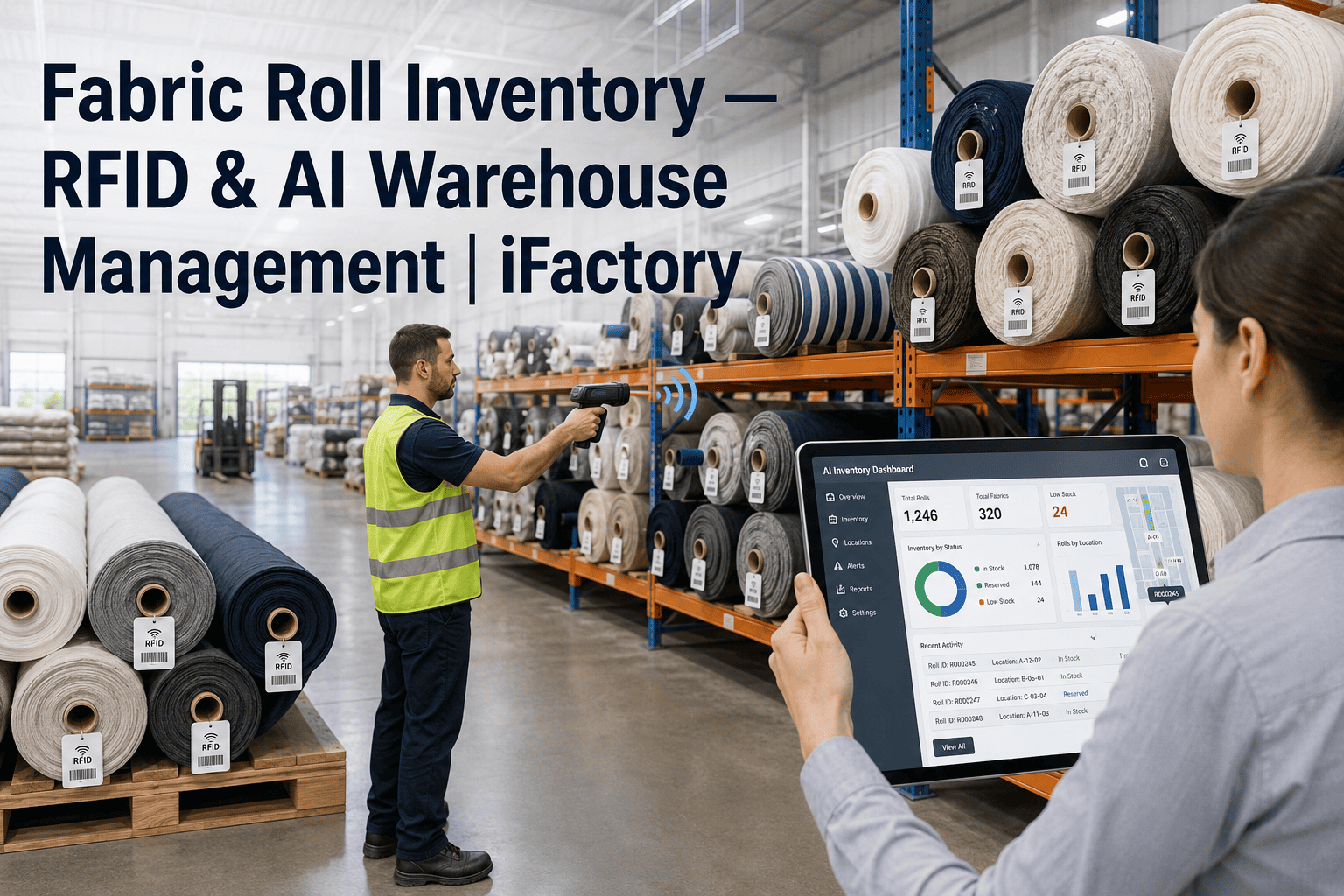
A material lot that cannot be found is not just an inventory problem — it is a production stoppage waiting to happen. In a smart factory, knowing where every component, WIP batch, and finished good is located in real time is not a luxury; it is the operational foundation that makes just-in-time production, quality traceability, and rapid recall response possible. RFID creates that foundation by tagging materials at receipt, reading them automatically at every movement point, and building a continuously updated location and status record without scanner guns, manual logs, or production delays. iFactory AI, an on-premise AI platform for smart manufacturing, integrates RFID readers, tag data, and production records into a single traceability layer that connects the shop floor to the warehouse to the shipping dock. Teams that want to understand what real-time material visibility looks like for their production environment can book a traceability architecture walkthrough with iFactory AI's team.
Track Every Material Lot — From Receiving Dock to Finished Goods — in Real Time With RFID
iFactory AI integrates RFID readers, tag data, and production records to build a live traceability layer across receiving, warehouse, WIP, production, and shipping — with full audit trail and no manual scanning.
What Is Real-Time Material Traceability With RFID?
Real-time material traceability with RFID is the continuous, automated tracking of material lots and components through every stage of the manufacturing process — from supplier receipt through production to finished-goods shipment — using RFID tags that are read automatically at defined points without manual scanning or data entry. The result is a live record of where every material is, what its quality status is, and which production orders, machines, and operators it has passed through.
The Four RFID Traceability Layers in a Smart Factory
A complete RFID traceability system in a smart factory has four layers, each building on the one below. Missing a layer leaves a gap in the genealogy record that cannot be reconstructed after the fact.
Build a Four-Layer RFID Traceability System for Your Factory
iFactory AI integrates RFID infrastructure, production data, quality records, and ERP lot data into a single traceability layer — deployed on-premise with no cloud dependency.
RFID Hardware Selection for Smart Factory Traceability
The right RFID hardware for a smart factory traceability system depends on the material types, movement distances, environmental conditions, and read-accuracy requirements. iFactory AI integrates with UHF RFID infrastructure from leading vendors and validates read performance in the deployment environment before go-live.
| Application point | Recommended RFID type | Read range | Environmental consideration |
|---|---|---|---|
| Receiving dock gate | UHF fixed reader + portal antenna array | 3–6 metres portal width | Forklift and pallet traffic — requires robust antenna mounting |
| Warehouse bin location | UHF passive tags on bins or shelves | Handheld reader for cycle count | Dense metal shelving requires specialised tags (on-metal) |
| Production line entry | UHF fixed reader at conveyor or staging gate | 0.5–2 metres | High vibration areas require shock-rated antenna mounts |
| WIP carrier / pallet | UHF passive label or hard tag | Passive: up to 8m; hard tag: 10m+ | Metal carriers require on-metal or spacer-mounted tags |
| Finished goods / shipping | UHF fixed reader + conveyor antenna | 0.3–1 metre at conveyor speed | High throughput — requires multi-antenna reader setup |
Forward and Backward Traceability: The Two Queries That Matter
Every material traceability system must support two fundamental queries. These are the queries that matter when a supplier notifies you of a contaminated lot or a customer reports a field failure.
Frequently Asked Questions
What is the difference between RFID traceability and barcode traceability in manufacturing?
Barcode traceability requires a line-of-sight scan of each item individually — it only records a movement when someone deliberately scans the barcode, which means unscanned movements are invisible. RFID traceability reads multiple tags simultaneously without line of sight, capturing every movement through a reader gate automatically. The practical difference is completeness: RFID produces a continuous record of every movement; barcode produces a record of every intended scan. For recall response or genealogy audit, the RFID record is orders of magnitude more complete. See a comparison of RFID vs barcode traceability record completeness in a live walkthrough.
Can RFID tags survive the temperatures and chemicals in our manufacturing process?
Industrial RFID tags are available in a wide range of environmental ratings — from standard UHF passive labels (suitable for ambient warehouse and production environments) to high-temperature ceramic-core tags rated to 200°C+ (for foundry, casting, and heat-treatment applications) and chemical-resistant encapsulated hard tags (for washdown, chemical exposure, and food-grade environments). iFactory AI's deployment team selects and validates the appropriate tag specification for each application point in your factory during the hardware design phase. Ask the support team about tag selection for your specific process conditions.
How does RFID traceability integrate with our existing ERP or WMS system?
iFactory AI integrates RFID traceability data with ERP and WMS systems through REST API, SAP RFC, or file-based interfaces. When a material lot is received and tagged, iFactory AI reads the ERP purchase order and lot data to pre-populate the tag record — the warehouse team does not retype information the ERP already holds. When materials are consumed in production, iFactory AI writes goods-issue transactions back to the ERP automatically. The RFID system extends the ERP's material management visibility to the physical shop floor level. Review the ERP integration architecture for your specific platform.
How is the RFID traceability data stored and for how long?
The RFID genealogy record is stored on-premise in iFactory AI's local database — no cloud dependency. Retention period is configurable and is typically aligned with the product's warranty period or the customer's or regulator's traceability requirement. For automotive suppliers, 15-year retention is common; for food packaging, 2–5 years; for aerospace, life-of-product. The on-premise deployment means retention is not subject to a cloud provider's pricing or policy changes. Ask about configuring retention periods for your compliance requirements.
What is the typical read accuracy of a UHF RFID system in a production environment?
Well-designed UHF RFID portal systems achieve 99.5–99.9% read accuracy in production environments when the antenna layout, tag placement, and reader power settings are validated for the specific material and movement speed. The main factors that reduce accuracy are metallic packaging (which absorbs RF energy), high-speed conveyor movement (which reduces dwell time in the read zone), and dense tag concentrations (which cause tag collision). iFactory AI's RFID validation protocol tests read accuracy in each deployment zone before go-live and adjusts hardware configuration until the target accuracy is achieved. Review the validation protocol for your production environment.
Give Your Factory Real-Time Material Visibility — From Dock to Dispatch
iFactory AI deploys RFID traceability on-premise — integrating tag data, production records, quality status, and ERP lot data into a single live genealogy record for every material in your factory.