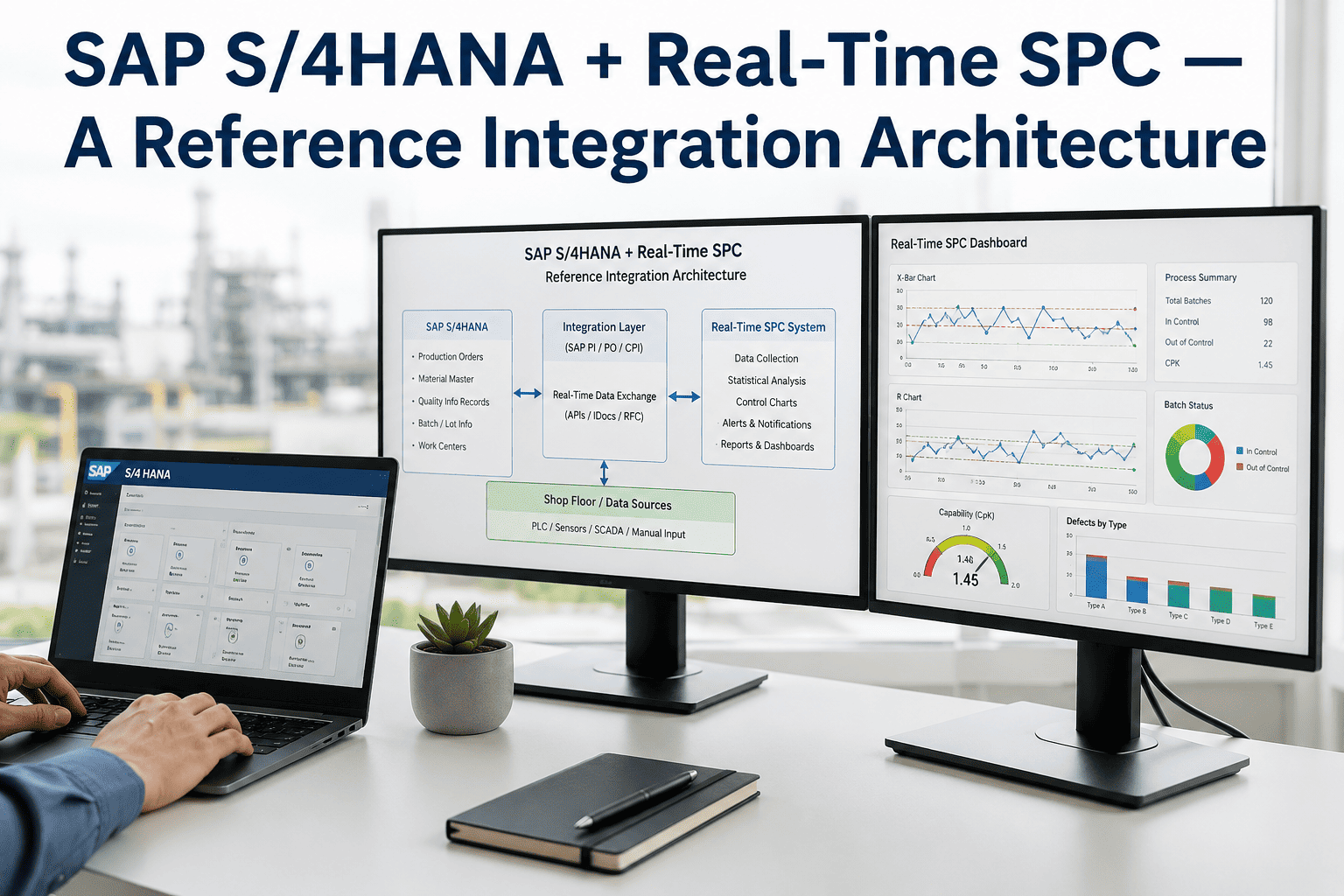
Most S/4HANA manufacturing programs are scoped around finance, order management, and master data — and then quality shows up as an afterthought, bolted on as a quarterly report nobody in operations actually reads in time to act on it. A digital transformation program that includes a live statistical process control layer changes what the S/4HANA investment is actually worth to the plant floor. Here is the reference architecture deployed at heavy-industry plants running this integration live.
Your S/4HANA Program Needs a Live SPC Layer, Not a Quarterly Report
A statistical process control feed that updates once a quarter tells you what already went wrong. A live SPC layer connected to S/4HANA tells operations while there's still time to act.
What Most S/4HANA Scopes Leave Out
Finance and order management modules get the budget. Quality and process control usually get whatever's left.
Three Connection Paths, One Live Picture
The architecture deployed at heavy-industry plants routes data through three complementary paths rather than a single point of integration.
REST API Layer
Shop floor systems push production and quality events into S/4HANA through standard REST calls, avoiding custom point-to-point interfaces.
IDoc Inbox
Structured business documents — order confirmations, goods movements, quality notifications — flow through the IDoc inbox using S/4HANA's native exchange format.
MSMQ Outbound Queue
Setpoints, recipe updates, and schedule changes flow back out to the shop floor through a message queue built for continuous, low-latency delivery.
Live SPC Engine
All three paths feed a single SPC engine that keeps control charts, Cpk trends, and out-of-spec alerts current with the actual state of production.
Quality Data Deserves the Same Real-Time Treatment as Finance
iFactory connects to SAP S/4HANA through a REST API, an IDoc inbox, and an MSMQ outbound queue — a production-grade reference architecture already running at heavy-industry plants.
What Changes When SPC Stops Waiting for the Quarter
The same control limits and the same tolerance bands produce very different outcomes depending on how quickly a drift actually reaches someone who can act.
| Capability | Quarterly SPC Report | Live SPC Layer on S/4HANA |
|---|---|---|
| Data currency | Weeks to months old | Continuously updated |
| Out-of-spec detection | After the batch is complete | While the run is still in progress |
| Cost center visibility | Reconciled after the fact | Linked to quality events as they occur |
| Recipe adjustment speed | Next planning cycle | Same shift |
What This Adds to an S/4HANA Business Case
Digital transformation directors need the SPC layer to justify itself against the same benchmarks as the rest of the program.
Faster Quality Root Cause
Live Cpk trends tied directly to production orders shorten the time between a defect and its diagnosis.
Reduced Scrap and Rework
Drift caught mid-run instead of after batch completion prevents the scrap that a quarterly report only explains afterward.
Cleaner Cost Center Data
Quality events linked to cost centers in real time give finance a truer picture without a manual reconciliation cycle.
Audit-Ready Traceability
Every SPC reading tied to its S/4HANA production order creates a traceable record without extra manual documentation.
How This Slots Into an Existing S/4HANA Program
The SPC layer is designed to attach to a program already underway, not to require restarting the S/4HANA rollout.
Confirm the S/4HANA Interfaces in Scope
Identify which REST endpoints, IDoc message types, and outbound queues are already active in the current program.
Attach the SPC Data Feed
Route live process readings from the shop floor into the same integration layer S/4HANA already uses for production data.
Link Cost Centers to Quality Events
Map SPC-driven quality events to the correct S/4HANA cost centers so scrap and rework post in near real time.
Validate Against Program Milestones
Test the live SPC layer against the S/4HANA program's own cutover and go-live milestones before full rollout.
S/4HANA + Live SPC — Questions Answered
What digital transformation directors typically ask before adding a real-time SPC layer to an S/4HANA program.
Q: Does this require a separate S/4HANA implementation project?
No, the SPC layer is built to attach to whichever REST, IDoc, and MSMQ interfaces your S/4HANA program has already scoped, so it doesn't require a parallel implementation track. It's designed as an addition to an existing program timeline rather than a competing project asking for separate budget and sequencing. You can book a demo to see exactly where it slots into your current program plan.
Q: How does this work with S/4HANA Cloud versus an on-premise deployment?
Both deployment models are supported, since the integration relies on standard REST and IDoc interfaces that exist in both S/4HANA Cloud and on-premise editions, with the specific connection details adjusted for whichever your program is running. RISE with SAP customers can integrate through the same interface layer without additional custom middleware. Our support team can confirm the exact configuration for your deployment model.
Q: Where does the live SPC data actually get stored?
Live SPC readings feed a dedicated SPC engine that maintains control charts and Cpk trends in near real time, while the quality events and cost center postings that result from those readings flow into S/4HANA through the standard IDoc and REST paths. This means the high-frequency process data doesn't need to live inside S/4HANA itself, only the business-relevant events it triggers.
Q: Can this integration handle multiple plants on different S/4HANA instances?
Yes, the reference architecture is designed to connect per-plant, so a multi-site program can roll the SPC layer out plant by plant, even where different sites run separate S/4HANA instances or client configurations. Each plant's connection is scoped independently, which also makes it easier to validate one site fully before extending to the next.
Q: What's the typical timeline to add this to an in-flight S/4HANA program?
Timelines depend on how much of the REST, IDoc, and MSMQ interface work is already complete within the broader program, but most single-plant additions move from interface confirmation to a validated live SPC feed within a few months. Programs further along in their S/4HANA rollout, with interfaces already active, tend to move faster since less foundational connection work is needed.
Give Your S/4HANA Program a Live Quality Layer
Finance and order management shouldn't be the only real-time modules in your S/4HANA rollout. iFactory's reference architecture connects live SPC data through REST, IDoc, and MSMQ — already proven at heavy-industry plants.