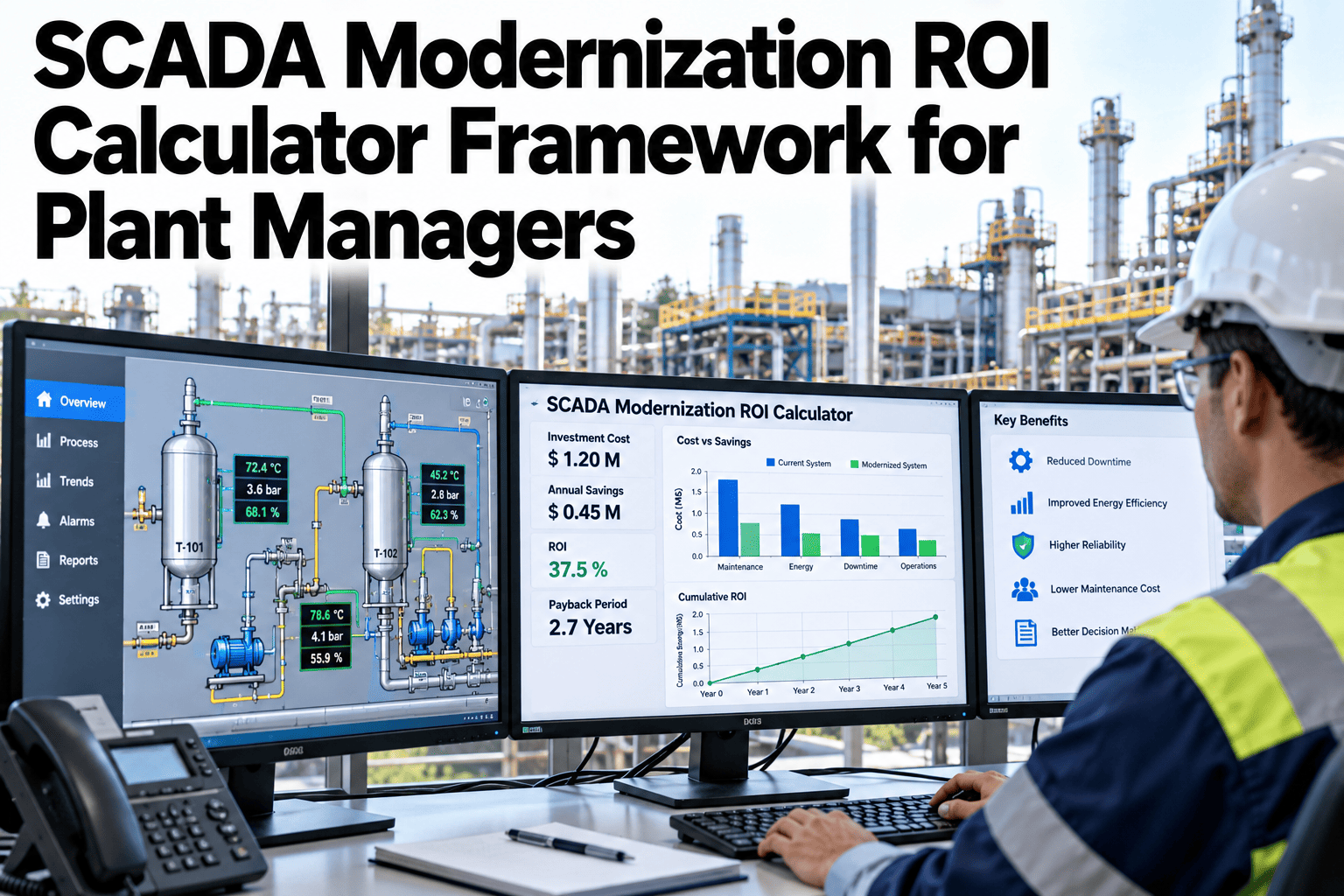
A SCADA modernization proposal often gets stuck at the budget approval stage because the business case leans on vague language like "improved visibility" instead of numbers finance can evaluate. Downtime reduction, maintenance cost savings and engineering hours freed up from manual troubleshooting are all quantifiable, and building the ROI case around these specific categories, rather than a general modernization narrative, is what actually gets a proposal approved. Plant managers can build their own ROI case this way in a short session.
Three Numbers That Build a SCADA Modernization Business Case
iFactory quantifies downtime reduction, maintenance savings and engineering hours freed up, building a defensible ROI case.
Where SCADA Modernization Savings Actually Come From
An aging SCADA system doesn't just risk obsolescence, it actively costs money in ways that are easy to underestimate because they're spread across downtime, maintenance budgets and engineering time rather than showing up as one line item.
| Cost Driver | Mechanism | Modernization Benefit |
|---|---|---|
| Downtime | Fault diagnosis takes longer on legacy systems with limited visibility | Faster detection and clearer alarming cuts diagnosis time |
| Maintenance cost | Legacy hardware and software require specialized, costly support | Modern systems reduce specialized support dependency |
| Engineering hours | Engineers spend time on manual workarounds for system limitations | Modern capabilities reduce time spent on patchwork fixes |
Quantify Your Own SCADA Modernization Case
Book a 30-minute session and iFactory will build a sample ROI case using your own downtime and maintenance data.
ROI Calculation Checklist
A practical checklist for building a defensible SCADA modernization ROI case.
Signals Your Current Case Won't Hold Up
Where iFactory Fits
iFactory builds the modernization ROI case from your own downtime, maintenance and engineering time data, structured as three separately defensible figures.
Downtime Impact Modeling
Historical downtime is analyzed to quantify the specific diagnosis-delay portion modernization would address.
Maintenance Cost Analysis
Current legacy support spend is compared against expected costs under a modernized system.
Engineering Time Quantification
Time spent on manual workarounds is measured and modeled against a realistic redirection plan.
Finance-Ready Case Output
The three categories combine into a structured, auditable business case ready for a capital approval process.
Reviewed by iFactory's Industrial Automation team for alignment with standard capital investment justification practice. The categories and figures shown are illustrative; actual ROI depends on your current system age, support costs and plant-specific conditions.
Frequently Asked Questions
How is downtime specifically tied to SCADA limitations rather than other causes?
This requires reviewing downtime records for cases where diagnosis time, not the underlying fault itself, was the main driver of extended downtime, which isolates the specific portion modernization would address. Support can help analyze your own downtime records.
What's a realistic payback period for SCADA modernization?
This varies significantly based on current system age and support costs, so a figure built from your own data is far more useful than a generic industry benchmark.
Can this ROI framework be used for a phased modernization rather than a full replacement?
Yes, the same categories apply whether the project is a full replacement or a phased approach, with the case scoped to match whichever path you're proposing. See this applied to a phased approach in a short session.
How do we handle uncertainty in the engineering hours category?
Using a conservative estimate and clearly labeling it as such, rather than overstating confidence, tends to hold up better in finance review than a precise-sounding figure built on soft assumptions.
Does this framework account for cybersecurity risk reduction as a benefit?
Risk reduction can be included as a qualitative factor alongside the quantified categories, though it's typically harder to assign a specific dollar figure to than downtime, maintenance or labor savings. Ask support how risk factors are typically presented.
Build a SCADA Modernization Case Finance Can Approve
iFactory quantifies downtime, maintenance and engineering time savings into one defensible case. Book a walkthrough on your own data.