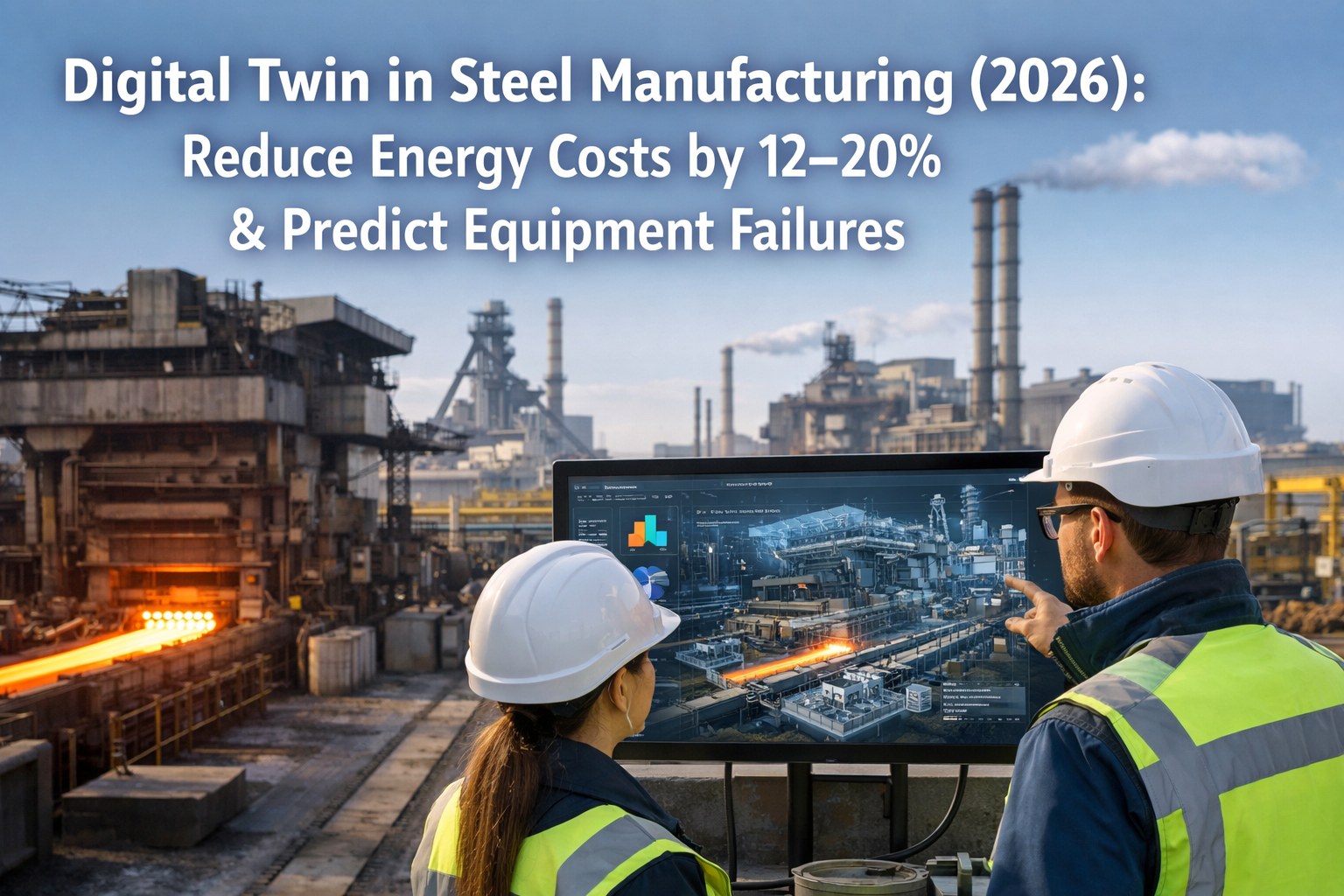
Every steel plant faces the same reckoning during a downturn: cut costs to survive the quarter, or invest in transformation that pays off when markets recover. The producers that emerged strongest from the last global steel crisis chose transformation — treating digital twins not as pilots but as a company-wide reimagining of how steel gets made. The pattern repeats across the industry: sustained investment in AI and digital twin technology during weak markets, followed by cumulative cost savings measured in hundreds of millions once demand returns. The digital twin approach doesn't just trim expenses — it changes the fundamental economics of steelmaking. This is the playbook, grounded in what leading producers have actually achieved, and how your plant can follow it. Schedule a digital twin assessment, or continue reading.
Digital Twins for Steel
Digital Twins for Steel Plants: The Playbook Behind Hundreds of Millions in Savings
Centralized optimization center · 90%+ first-time success · 250+ digital models · multi-year transformation
$1B+
Cumulative savings achievable over 5 years
250+
Digital twin models across a plant network
90%+
First-time success rate on process changes
The Journey: A Five-Year Transformation Timeline
Digital transformation in steel isn't a single deployment — it's a staged progression from crisis-driven urgency to a fully integrated optimization network. The timeline below reflects how leading producers have typically sequenced their rollouts, from first pilot to network-wide command center.
Yr 1
Crisis & Vision
Steel industry under pressure: overcapacity, import competition, mounting losses at high-cost operations. Leadership commits to a company-wide digital strategy rather than incremental cost-cutting. Typical initial commitment: a multi-year capital program of roughly $150–200M.
Yr 2
Optimization Center Foundation
A central optimization center is established at the flagship plant, built on an industrial IoT platform. First digital twins target the blast furnace. Proof-of-concept commonly delivers a 2–3% coke rate reduction — often worth ₹40–50 crore in annual savings on a single furnace.
Yr 3
Scale-Up Begins
Expansion to 50+ digital twins across blast furnaces, steel melt shops, and rolling mills. Real-time data integrated from 10,000+ sensors. Machine learning models deployed for quality prediction. Early-year savings frequently reach $150–200M, with project payback under two years.
Yr 4
Network Rollout
Digital twins extend across international operations. 150+ models deployed over a network of 15+ plants. Predictive maintenance cuts downtime by roughly 20%. Energy optimization adds $150M+. Cumulative savings cross the $500M mark.
Yr 5
Full Integration
The optimization center evolves into a 24/7 command hub managing global operations. 250+ digital twin models run live at a 90%+ first-time success rate on process changes. Supply chain optimization is integrated. Cumulative savings surpass $1B.
Yr 5+
Resilience Proven
Remote optimization becomes a permanent capability — plants continue running through disruptions (supply shocks, travel restrictions, workforce constraints) via the central center. Digital twins become the benchmark operating model for Industry 4.0 in steel.
Get a Digital Twin Roadmap for YOUR Plant
We'll create a phased digital transformation plan modeled on proven industry methodology — showing how to reach similar savings with digital twins and a central control-center approach.
Your custom roadmap includes:
- Phased implementation timeline
- Priority equipment identification
- Expected savings by phase
- Technology stack recommendations
- Investment requirements
- ROI projections (3–5 years)
The Command Center Behind the Savings
At the heart of every large-scale steel digital transformation is a central optimization center — a 24/7 operations hub monitoring an entire plant network through hundreds of digital twin models. Think of it as mission control for steelmaking: real-time data in, predictive analytics running continuously, remote optimization out to every plant on the network.
Real-Time Monitoring
10,000+
Sensors streaming data every 1–5 seconds from blast furnaces, BOFs, rolling mills, and utilities across the plant network.
AI-Powered Analytics
250+
Machine learning models predicting quality, optimizing energy, preventing failures, and scheduling maintenance across processes.
Virtual Testing
90%+
First-time success rate — process changes are tested virtually in the digital twin before physical rollout, eliminating trial-and-error.
Remote Optimization
24/7
Central experts optimize plants across regions remotely. Knowledge is centralized once and applied everywhere on the network.
Continuous Learning
Daily
Models retrain as new data arrives. Every plant's learnings benefit all plants — a network effect in optimization.
Performance Benchmarking
15+
Plants compared in real time on efficiency, quality, and cost. Best practices are identified and replicated across the network fast.
Where the Value Comes From: A Savings Breakdown
A billion-dollar savings figure isn't one big win — it's the sum of six distinct value streams, each optimized continuously across the plant network. The ranges below reflect what digital twin programs typically deliver over a five-year horizon.
01 · Raw Material Optimization
~$550M
- Blast furnace coke rate reduced 4–6% via AI optimization
- Iron ore blend optimization saving tens of millions annually
- Limestone and dolomite consumption optimized
- Digital twin simulates 1,000+ burden recipes before physical trials
02 · Energy Cost Reduction
~$380M
- Reheating furnace fuel optimization across 25+ furnaces
- Power consumption reduced 8–12% in rolling mills
- Waste heat recovery maximized via predictive models
- Peak demand management cutting grid costs by $20M+
03 · Yield Improvement
~$280M
- Steel yield increased 1.5–2% (less scrap, more saleable product)
- Rolling mill thickness control precision improved
- Defect rates reduced 30–40% via quality prediction
- First-time quality success rate lifted to 90%+ (from 75–80%)
04 · Predictive Maintenance
~$120M
- Unplanned downtime reduced ~22% across plants
- Equipment failures predicted 2–4 weeks early
- Maintenance scheduled during planned outages
- Spare parts inventory optimized, releasing working capital
05 · Quality Consistency
~$50M
- Customer claims and returns reduced ~35%
- Premium product grades achieved more consistently
- Alloy addition precision improved for expensive elements
- Testing costs reduced via AI quality prediction
06 · Supply Chain Efficiency
~$20M
- Production scheduling optimized across the network
- Logistics routes optimized via AI
- Inventory carrying costs reduced
- Demand forecasting accuracy improved ~25%
Total cumulative savings: $1B+ over five years
Against a digital investment of roughly $160M, that represents an ROI on the order of 700%+ over five years.
Technology Stack: What a Steel Digital Twin Actually Runs On
Behind the savings sits a five-layer architecture — from sensor-level data collection through to the visualization and control interfaces operators use. Each layer solves a specific problem, and the choices at each level determine whether the program scales or stalls.
Layer 1 · OT Data Collection
Challenge: 15+ plants with different DCS vendors and no standardization. Solution: universal OPC protocol gateways bridge Modbus, OPC-UA, and Profibus, with 10,000+ sensors streaming in. Edge computing pre-processes data locally, cutting cloud bandwidth by ~80%.
Layer 2 · Data Platform
Initial: a cloud industrial IoT platform. Evolved: hybrid cloud (public cloud + on-premise) for cost optimization and data sovereignty. A time-series historian retains high-resolution process data; a data lake feeds ML training.
Layer 3 · Digital Twin Models
Physics-based: heat balance, material balance, and combustion thermodynamics. ML-based: deep learning frameworks for quality prediction and optimization. Hybrid: physics-informed neural networks that combine domain knowledge with data. 250+ models span blast furnace, BOF, continuous casting, rolling, and annealing.
Layer 4 · Analytics & AI
Predictive: equipment failure prediction, quality forecasting, energy optimization. Prescriptive: linear programming and genetic algorithms for multi-objective optimization across cost, quality, and energy. Real-time: edge AI delivers sub-100ms response so critical control loops stay on-premise.
Layer 5 · Visualization & Control
Command dashboard: a custom control-center interface. Mobile apps: remote monitoring for plant managers. Integration: bi-directional with existing HMI/SCADA, so AI recommendations appear alongside operator controls. Collaboration: shared screens let central experts guide plant operators remotely.
See Digital Twin Technology in Action
Watch a live demonstration of digital twin simulation, virtual testing, and AI optimization — and see how 90%+ first-time success is achieved through virtual process trials before anything touches the plant.
The Numbers That Matter: 90%+ First-Time Success Explained
Across mature steel digital twin programs, a consistent set of performance benchmarks emerges. These are the metrics that determine whether a program pays for itself — and the headline among them is first-time success rate.
90%+First-time success rate
4–6%Coke rate reduction
22%Downtime reduction
1.5–2%Yield improvement
30–40%Defect reduction
8–12%Energy savings
25%Forecast accuracy gain
35%Customer claims drop
What "90%+ first-time success" actually means
Traditional steel optimization: try new process parameters, often fail, adjust, try again — taking weeks and wasting material. The digital twin approach: test 100+ parameter combinations virtually, let the twin predict the outcome, and implement only the best option physically — working 90%+ of the time on the first attempt. In a typical case, a blast furnace burden optimization tested more than 800 combinations virtually in two days, identified the optimal recipe, and achieved the predicted 4%+ coke reduction immediately, with no trial-and-error waste.
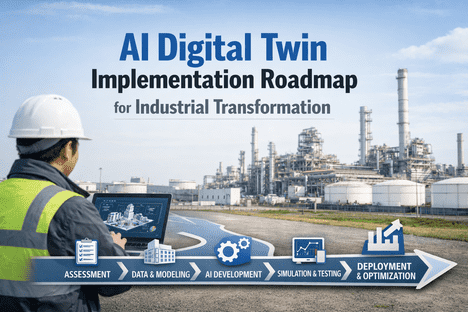
Implementation Roadmap: How to Replicate It
The path from first pilot to network-wide transformation typically runs 18–36 months across three phases. Each phase is designed to be self-funding: the savings from one phase pay for the next.
1
Foundation (Months 1–12)
Focus: data infrastructure, pilot digital twins.
Deploy: OPC servers, historians, 20–30 digital twins on 2–3 critical assets.
Target: $5–10M savings to fund Phase 2.
Investment: $10–15M.
2
Scale (Months 13–24)
Focus: expand digital twins plant-wide.
Deploy: 100+ models, predictive maintenance, energy optimization.
Target: $30–50M annual savings.
Investment: $20–30M.
3
Transform (Months 25–36)
Focus: central command center, network rollout.
Deploy: 200+ models, remote optimization, supply chain AI.
Target: $100M+ annual savings.
Investment: $30–50M.
Critical success factors from real deployments
Executive commitment: the CEO champions transformation personally — it is not delegated to IT. Urgency drives adoption: a burning platform accelerates change; don't wait for a crisis, create the urgency. Invest through the downturn: while competitors cut, transformers invest — and emerge stronger. Start with quick wins: a first blast furnace twin delivering a 2–3% coke reduction in six months proves the concept. Centralize expertise: a command-center model lets the best experts optimize every plant. Measure relentlessly: credible, audited savings figures — not marketing claims — sustain the mandate.
Five Lessons from the Industry's Digital Journey
The producers that scaled digital twins successfully learned similar lessons — often the hard way. These five apply to any steel plant considering the same path.
Lesson 1 · Digital twins deliver real ROI
Billion-dollar savings and 700%+ five-year ROI prove digital transformation isn't hype — it's profitable. Once the business case is demonstrated, skepticism collapses and the rest of the industry moves to replicate it.
Lesson 2 · Start small, scale fast
The winners didn't digitalize everything on day one. A single blast furnace pilot became a plant-wide deployment, then a network rollout. Proof of concept funded scale-up — reaching 250+ models across 15+ plants within five years.
Lesson 3 · Centralized expertise wins
A command-center model lets experts at one site optimize plants across regions remotely. Knowledge doesn't stay siloed — best practices replicate instantly. A single great metallurgist can effectively optimize 15 blast furnaces via digital twins.
Lesson 4 · Culture change is harder than technology
Technology deploys in 12–18 months; culture transformation takes 3–4 years. Operators initially distrust AI recommendations. The fix: always show the reasoning, allow override, and prove accuracy over months. A 90% success rate builds the trust.
Lesson 5 · Remote operations are now permanent
When disruptions hit — supply shocks, travel restrictions, workforce gaps — command centers enabled fully remote plant optimization, keeping operations running with minimal on-site presence. That capability is now a permanent part of the operating model.
Key Takeaways
- $1B+ cumulative savings over five years is achievable from 250+ digital twin models across a 15+ plant network.
- 90%+ first-time success rate on process optimization — virtual testing eliminates trial-and-error waste.
- Command-center model enables remote optimization — central experts optimize plants across regions 24/7.
- 4–6% coke rate reduction is typical for AI-optimized blast furnaces — the single largest savings contributor (~$550M).
- 700%+ ROI over five years against a ~$160M digital investment definitively proves the business case.
- Start small, scale fast — a single blast furnace pilot grows to 250+ models through proven, compounding value.
Build Your Own Digital Twin Success Story
Get a custom roadmap based on proven industry methodology, adapted for your steel plant — with a phased approach, expected savings, and investment requirements for your operations.