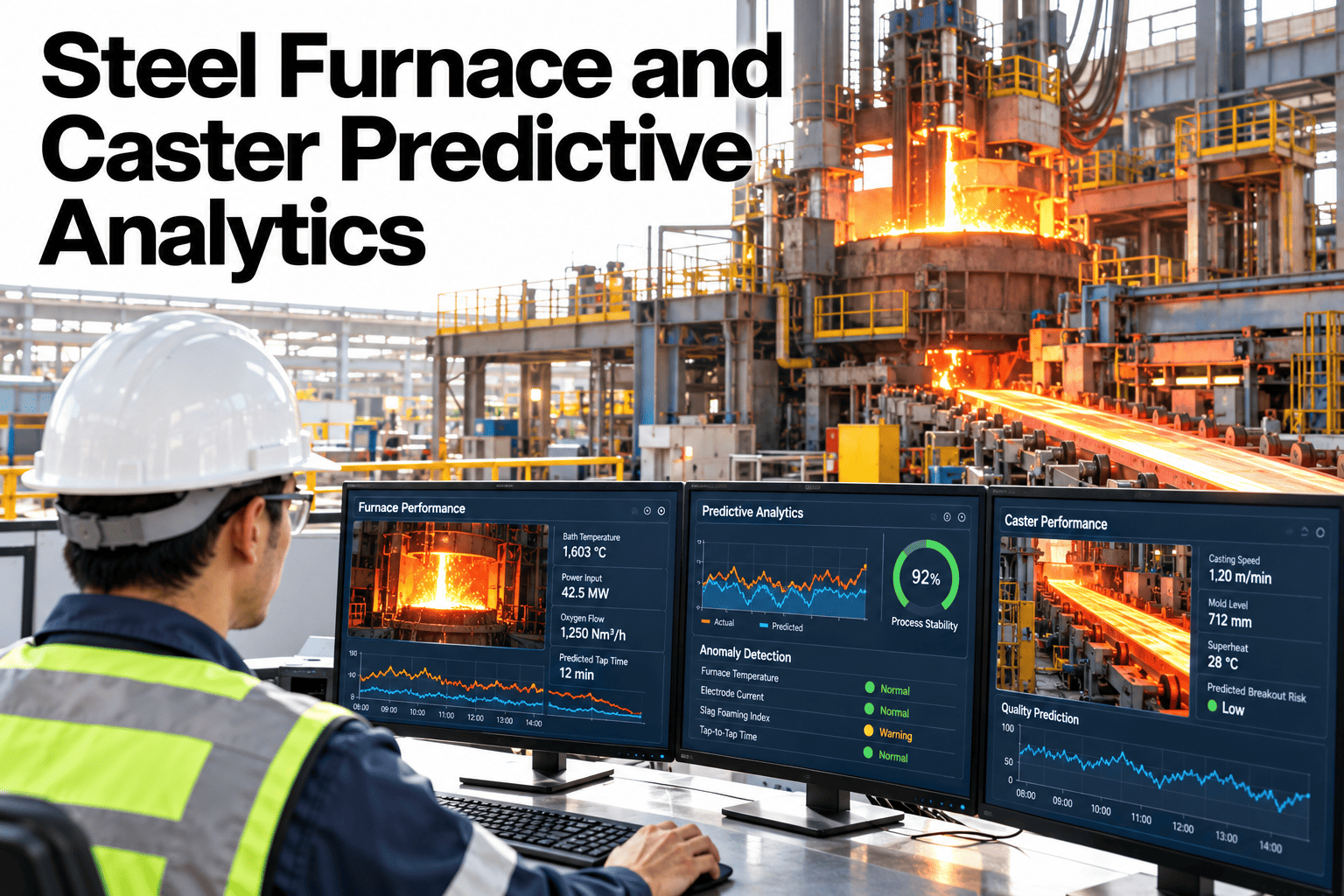
A furnace trip or an unplanned caster stop almost never happens without warning signs building up beforehand, a bearing temperature drifting upward, a hydraulic pressure trending slightly off, a refractory wear pattern accelerating. The trouble is that these signs usually look unremarkable in isolation, which is exactly why they get missed until the equipment actually fails. Predictive analytics works by watching combinations of these signals continuously and flagging the pattern that historically precedes a failure, giving maintenance teams a planned window instead of an emergency response. If you want to see what patterns your own furnace and caster data are already showing, you can review a predictive analysis with our team.
See Furnace and Caster Failures Coming Before They Happen
Predictive analytics that watches combinations of bearing, pressure, and refractory signals continuously, flagging the pattern that historically precedes a failure while there's still time to plan around it.
What Actually Causes Most Unplanned Furnace and Caster Stops
A small set of recurring failure modes typically account for the majority of unplanned stops across furnace and caster equipment, each with its own early warning pattern.
| Failure mode | Typical early signal | Usual lead time if caught |
|---|---|---|
| Bearing failure | Gradual vibration or temperature increase | Days to weeks |
| Hydraulic system failure | Pressure drift outside normal operating band | Hours to days |
| Refractory wear | Accelerating wear rate against the normal degradation curve | Weeks |
| Mold breakout risk | Thermal pattern deviation during casting | Minutes to hours |
The lead time available varies significantly by failure mode, which is exactly why a single generic alert threshold across all equipment types tends to miss the faster-developing risks.
What Predictive Signals Actually Look Like in Practice
No single sensor reading predicts a failure reliably on its own, it is the combination and the trend across several signals together that produces a usable warning.
Turning a Predictive Flag Into a Planned Maintenance Window
A prediction is only valuable if it leads to action within the available lead time, which is why the response process matters as much as the detection itself.
Check What Your Own Furnace and Caster Data Shows
Share a recent period of sensor data and we will show what predictive patterns are already present.
Unplanned Stop vs Predicted Maintenance Window
The equipment issue itself is often the same either way, what changes is whether the plant is reacting to a crisis or executing a plan.
What iFactory Steel Specialists See Across Furnace and Caster Lines
iFactory steel specialists who review predictive analytics deployments across multiple mills find that hydraulic system issues are usually the fastest-developing failure mode on this list, which makes them the category most worth prioritizing for continuous rather than periodic monitoring.
They also note that the feedback loop, confirming whether a flagged prediction was actually correct, is the step most often skipped early on, even though it is what determines how quickly the model's accuracy improves for a specific plant's equipment.
What Maintenance Teams Ask Before Adopting Predictive Analytics
Bring Predictive Analytics to Your Furnace and Caster Line
Book a session with iFactory AI to see predictive signals applied to your own furnace and caster equipment data.