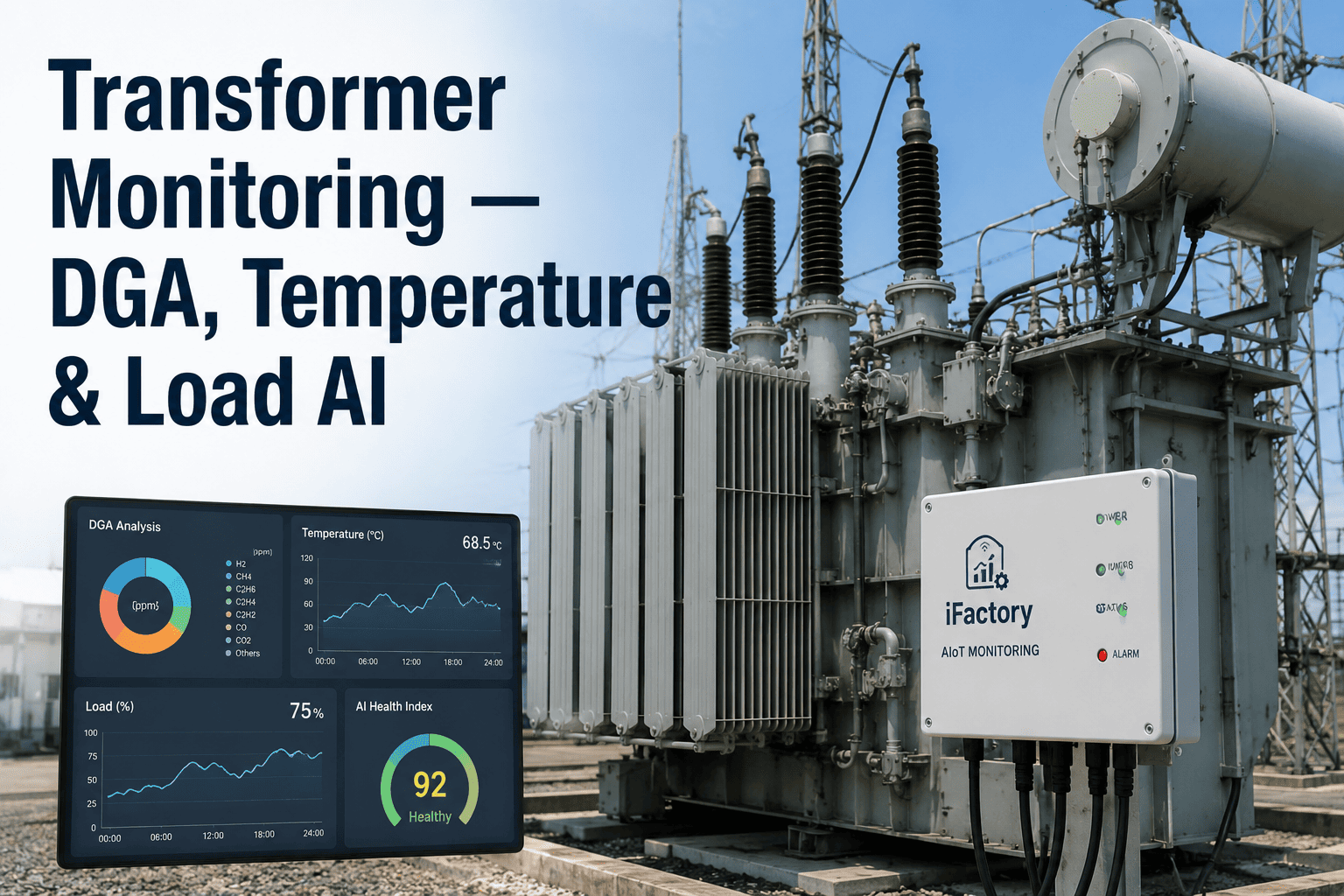
Power transformers are the silent giants of electrical infrastructure, often operating for decades with minimal oversight, yet their failure can trigger catastrophic outages, costly emergency repairs, and significant safety hazards. In modern smart factories and substations, transformer condition monitoring has evolved from simple periodic oil sampling to continuous, AI-driven surveillance of dissolved gas analysis (DGA), oil quality, winding temperature, and load dynamics. The convergence of Industry 4.0 sensors and machine learning algorithms now enables predictive maintenance windows of 6 to 12 months before an incipient fault escalates into a breakdown. This comprehensive guide delivers an enterprise-grade deep dive into the technical architecture, key parameters, and implementation strategies for transformer monitoring, empowering plant managers and maintenance directors to achieve unprecedented reliability and operational efficiency. Book a Demo to explore how iFactory's AI platform transforms your transformer fleet management.
Secure Your Transformer Fleet with Predictive AI
Prevent unplanned outages and extend asset life by 30%. Discover how our platform delivers 6–12 month failure warnings.
Why Transformer Monitoring Demands a Paradigm Shift
Traditional transformer maintenance relies on fixed-interval oil sampling and manual inspection, which fails to capture the dynamic, continuous degradation processes inside the asset. Thermal aging, moisture ingress, partial discharge, and load cycling create complex, non-linear failure modes that periodic checks miss. With the average cost of a transformer failure exceeding $2 million for large units, the business case for real-time, AI-enhanced monitoring is compelling. iFactory's platform synthesizes multi-parameter data streams — DGA, oil quality, winding temperature, and load — into a unified health index, enabling early intervention and optimized capital planning.
Dissolved Gas Analysis (DGA)
DGA is the cornerstone of transformer condition assessment, detecting gases such as hydrogen, methane, acetylene, ethylene, and carbon monoxide generated by thermal and electrical faults. iFactory's AI interprets gas ratios (e.g., Duval Triangle, Rogers Ratios) to classify fault types — from partial discharge to arcing — and trend evolution rates. Continuous online DGA sensors provide hourly data, enabling early detection of incipient faults months before conventional thresholds are breached. The platform flags abnormal gas generation rates and correlates them with load and temperature events for precise root cause analysis.
Oil Quality & Moisture Monitoring
Transformer oil degrades over time due to oxidation, thermal stress, and moisture ingress, reducing its dielectric strength and accelerating insulation aging. Key parameters include moisture content (ppm), acidity, interfacial tension, dielectric breakdown voltage, and furan compounds (indicators of paper insulation aging). iFactory integrates online moisture sensors and periodic lab results to model oil degradation kinetics. The system predicts when oil reclamation or replacement is needed, optimizing maintenance schedules and avoiding premature oil changes that waste resources.
Winding Temperature & Load Management
Winding hot-spot temperature is the primary driver of insulation aging, governed by load current and ambient conditions. iFactory monitors top-oil temperature, bottom-oil temperature, and winding temperature via fiber-optic sensors or thermal models. Combined with real-time load data, the platform calculates loss of life expectancy (per IEEE C57.91) and issues alerts when operational limits are approached. Dynamic load ratings are generated, allowing operators to safely maximize capacity during peak demand without exceeding thermal limits.
Bushing & Tap Changer Condition
Bushing failures account for a significant portion of transformer outages, often due to moisture ingress or partial discharge. iFactory monitors bushing capacitance and power factor via online sensors, detecting insulation degradation early. Tap changer condition is assessed through motor current signature analysis, contact resistance measurement, and oil analysis for metallic wear particles. The platform correlates tap changer operations with load and voltage variations to predict contact wear and oil contamination, scheduling maintenance before failure occurs.
AI-Driven Predictive Failure Timeline
Continuous Data Ingestion
Sensors collect DGA, moisture, temperature, load, and bushing data at intervals from minutes to hours. Data is cleaned, normalized, and time-stamped for AI processing.
Feature Extraction & Anomaly Detection
Machine learning models extract features such as gas generation rates, temperature gradients, and load profiles. Unsupervised algorithms detect deviations from baseline operation, flagging early-stage anomalies.
Fault Classification & Severity Assessment
Supervised models classify fault types (e.g., thermal, electrical, partial discharge) using DGA ratios and historical failure data. Severity is scored on a 0–100 scale, with actionable thresholds.
Remaining Life & Risk Prediction
Using degradation models and load forecasts, the platform estimates remaining useful life (RUL) with confidence intervals. Transformers are ranked by risk for fleet-level prioritization.
Actionable Recommendations & Alerts
Alerts are sent via email, SMS, or dashboard notifications with specific guidance: reduce load, schedule oil filtration, plan bushing replacement, or prepare for transformer overhaul. Integration with CMMS enables automated work order generation.
Technical Deep Dive: DGA Fault Gas Interpretation
Dissolved gas analysis is not merely about gas concentrations; the ratios between key gases reveal the nature and severity of faults. iFactory's AI implements multiple interpretation methods simultaneously to cross-validate findings. The Duval Triangle uses three hydrocarbon gases (CH4, C2H4, C2H2) to distinguish between thermal faults (low, medium, high temperature), electrical faults (partial discharge, low-energy arcing, high-energy arcing), and stray gassing. The Rogers Ratios (four ratios of five gases) provide finer granularity for complex scenarios. Machine learning models trained on thousands of DGA records improve classification accuracy by 15–20% over traditional methods, reducing false positives and missed detections. The system also tracks gas generation rates (ppm/day) to distinguish between stable, slow-developing faults and fast-accelerating critical conditions. For example, a rapid increase in acetylene (C2H2) indicates arcing, demanding immediate intervention, while a slow rise in ethylene (C2H4) suggests thermal aging that can be managed over weeks.
Key Transformer Health Indicators & Thresholds
| Parameter | Normal Range | Alert Threshold | Action Required |
|---|---|---|---|
| Hydrogen (H2) | < 150 ppm | > 300 ppm or rapid rise | Investigate for partial discharge or overheating |
| Acetylene (C2H2) | < 5 ppm | > 20 ppm | Immediate outage risk — possible arcing |
| Moisture (ppm) | < 20 ppm at 60°C | > 30 ppm | Initiate oil drying or replace desiccant |
| Furan (2-FAL) | < 0.1 ppm | > 1 ppm | Assess paper insulation aging; plan replacement |
| Winding Hot-Spot Temp | < 80°C | > 110°C | Reduce load or improve cooling |
| Load Factor | < 80% of nameplate | > 100% | Implement load shedding or dynamic rating |
Fleet Risk Ranking & Capital Planning
For organizations managing hundreds of transformers, prioritizing maintenance and capital investments is a complex challenge. iFactory's platform aggregates health indicators across the fleet into a single risk score per transformer, combining probability of failure (based on AI models) with consequence of failure (e.g., criticality to operations, replacement cost, safety impact). The fleet view displays a risk matrix with color-coded quadrants, enabling maintenance directors to focus resources on high-risk units. The system also generates long-term degradation trends, supporting 5-year capital planning for transformer replacements or major overhauls. By integrating with ERP systems, the platform automates budget forecasting and procurement triggers, ensuring that critical spares are ordered well before failure.
Transform Your Transformer Fleet Today
Stop reacting to failures. Start predicting them with AI. Gain 6–12 months of actionable warning and extend asset life by 30%.
Partial Discharge Detection
Partial discharge (PD) is a localized electrical discharge that erodes insulation over time, often leading to catastrophic failure. iFactory integrates UHF, HFCT, and acoustic PD sensors to detect and locate PD activity. The AI classifies PD types (internal, surface, corona) and trends intensity to predict remaining insulation life. Early PD detection allows for planned interventions such as drying, re-impregnation, or bushing replacement, avoiding unplanned outages.
Cooling System Efficiency
Transformer cooling systems (radiators, fans, pumps) are critical for maintaining safe operating temperatures. iFactory monitors oil flow, fan status, and pump currents to detect performance degradation. AI models predict cooling system failures before they cause overheating, scheduling cleaning, repair, or component replacement. The system also optimizes cooling based on load forecasts and ambient conditions, reducing energy consumption by up to 15%.
Integration with Substation Analytics
Transformer monitoring is most powerful when integrated with broader substation analytics, including circuit breaker condition, switchgear monitoring, and power quality analysis. iFactory's platform provides a unified view of substation health, correlating transformer events with upstream and downstream disturbances. This holistic approach enables root cause analysis of complex failures and optimizes maintenance across the entire substation, reducing overall operational risk.
Frequently Asked Questions
What is the difference between online and offline DGA monitoring?
Online DGA monitoring uses in-situ sensors that continuously sample transformer oil and analyze gas concentrations in real-time, providing hourly data on hydrogen, methane, acetylene, ethylene, and carbon monoxide. Offline DGA involves periodic manual oil sampling sent to a laboratory for analysis, typically quarterly or annually. Online monitoring offers the advantage of early detection of fast-developing faults, such as arcing, which can progress from inception to failure in days. Offline sampling is more cost-effective for low-criticality transformers but misses transient events. iFactory's platform supports both approaches, integrating lab results with online data for a complete picture. Book a Demo to see how hybrid monitoring optimizes your maintenance strategy.
How does AI improve DGA interpretation over traditional methods?
Traditional DGA interpretation relies on fixed ratio methods (e.g., Duval Triangle, Rogers Ratios) that can produce ambiguous or conflicting results, especially for complex fault scenarios. AI models, such as random forests, support vector machines, and neural networks, are trained on thousands of historical DGA records with known failure outcomes. These models learn non-linear relationships between gas concentrations and fault types, achieving classification accuracy of 95% or higher compared to 70–80% for traditional methods. AI also handles missing data, sensor drift, and varying operating conditions more robustly. Additionally, machine learning enables trend analysis of gas generation rates, providing early warnings weeks before thresholds are breached. Book a Demo to explore iFactory's AI models in action.
What sensors are required for comprehensive transformer monitoring?
A comprehensive monitoring system typically includes: (1) online DGA sensor for key gases (H2, CH4, C2H2, C2H4, CO, CO2); (2) moisture-in-oil sensor; (3) top-oil and bottom-oil temperature sensors; (4) winding temperature sensors (fiber-optic or thermal model); (5) load current transformer (CT) for real-time load data; (6) bushing capacitance and power factor sensors; (7) partial discharge sensors (UHF, HFCT, or acoustic); and (8) cooling system sensors (oil flow, fan current, pump status). iFactory's platform is sensor-agnostic and integrates with most major OEM sensors via standard protocols (Modbus, DNP3, IEC 61850). The system can also ingest data from existing SCADA or DCS systems, minimizing new hardware costs. Book a Demo to discuss your specific transformer fleet configuration.
How does iFactory's platform handle data security and integration with existing systems?
iFactory deploys a secure, edge-to-cloud architecture that ensures data is encrypted both in transit (TLS 1.3) and at rest (AES-256). The edge gateway aggregates sensor data locally and transmits only aggregated health indices to the cloud, minimizing bandwidth and latency. On-premises deployment is also available for air-gapped facilities. The platform integrates with common CMMS (e.g., SAP, Maximo, Infor) via REST APIs, enabling automatic work order generation based on AI recommendations. Integration with SCADA, DCS, and historian systems (e.g., OSIsoft PI) is supported via OPC-UA, Modbus, and MQTT protocols. Role-based access control ensures that only authorized personnel view sensitive data. Contact Support for detailed security documentation and integration guides.
What is the typical ROI for implementing AI-driven transformer monitoring?
The ROI for transformer monitoring is driven by three factors: (1) prevention of catastrophic failures — a single transformer failure can cost $2–5 million in repairs, lost production, and environmental cleanup; (2) extension of transformer life by 20–30% through optimized maintenance and load management; and (3) reduction in maintenance labor and material costs by 30–50% through condition-based interventions. Typical payback periods range from 12 to 24 months for a fleet of 10–20 large transformers. iFactory provides detailed ROI calculators based on your fleet size, criticality, and historical failure rates. Book a Demo to receive a customized ROI analysis for your facility.
Ready to Revolutionize Your Transformer Maintenance?
Join industry leaders who trust iFactory for predictive analytics. Book your demo today and discover how AI can protect your most critical assets.