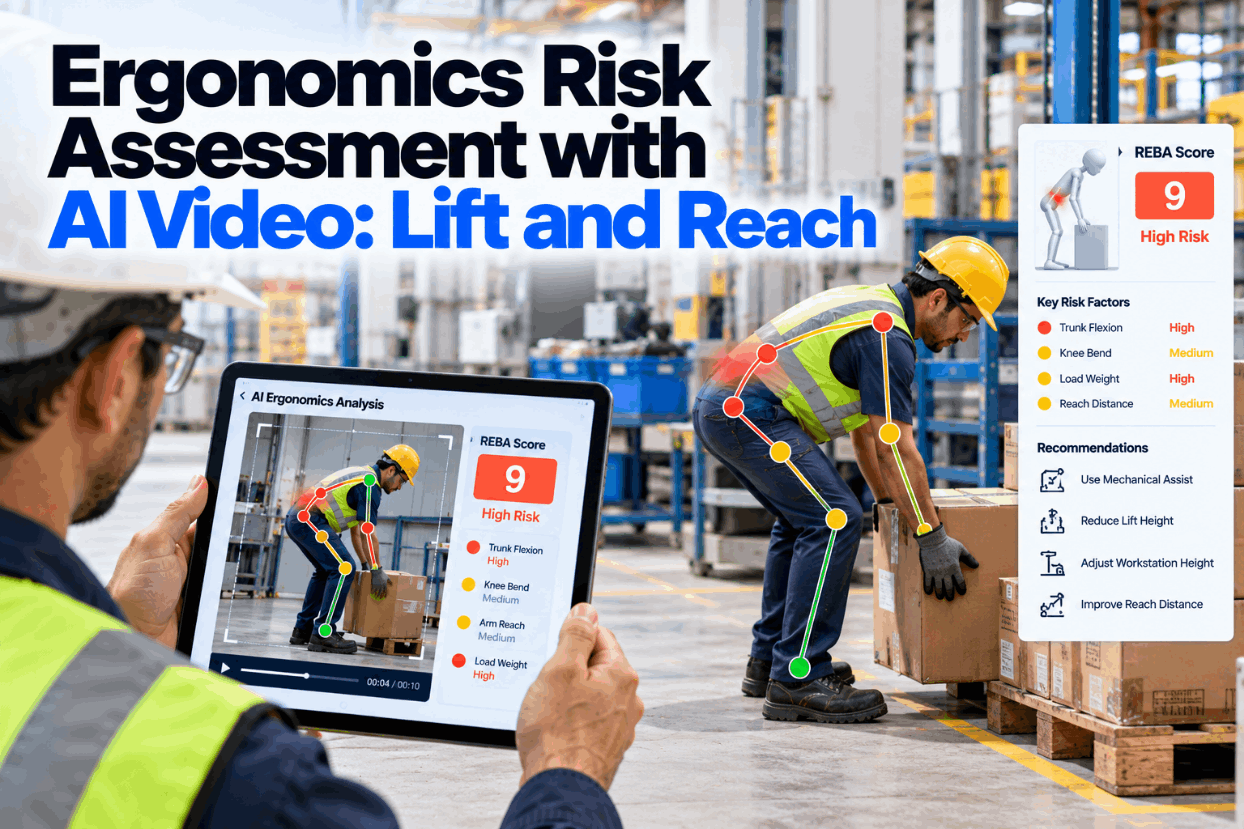
An operator at the end of a packing line lifts cases from a low pallet, twists and places them on a conveyor at shoulder height, hundreds of times a shift. A paper REBA can take an ergonomist hours per task. This guide shows how ergonomics risk assessment with AI video scores the same job from a phone recording in minutes. Try it on a sample video.
Ergonomics Risk Assessment with AI Video: Lift and Reach
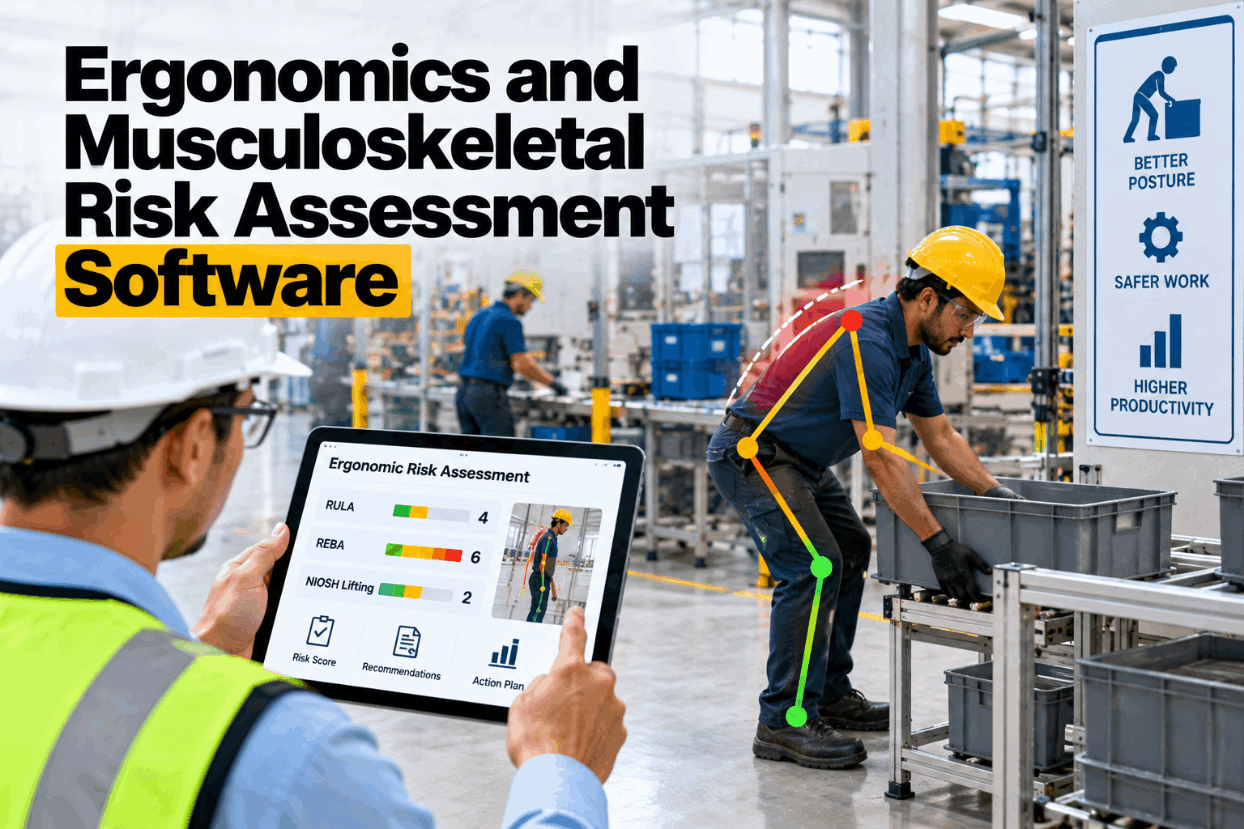
Upload a short phone video. Pose estimation tracks joints frame by frame, scores REBA, RULA and NIOSH lifting risk, marks the riskiest moments and lets you compare fixes before you spend.
- Why ergonomic risk goes unmeasured
- The methods behind the score
- How to turn a score into an engineering fix
Why Ergonomic Risk Goes Unmeasured
The data takes too long to collect.
BLS data for 2023 and 2024 show overexertion, repetitive motion and bodily reaction as the leading causes of cases involving days away from work. There is no OSHA ergonomics standard, but OSHA can cite serious ergonomic hazards under the General Duty Clause. Most plants know which jobs hurt. What they lack is time to score them, so the list never gets ranked. See video scoring in a short demo.
Slow by hand
One REBA or NIOSH study can take hours.
Scorer variation
Two assessors give two different scores.
Snapshots
One frame misses the worst moment.
No before and after
Fixes are made without proof they helped.
The Methods Behind the Score
Proven methods, applied to every frame.
AI video does not invent a new risk score. It applies the established methods ergonomists already use, frame by frame, so the peak posture is never missed. Ask our ergonomics team which method fits each task.
The NIOSH lifting equation starts from a 51-pound load constant and reduces it for distance, height, twisting, frequency and grip. A lifting index above 1.0 means the load is above the recommended limit for most workers, and the job should be changed.
How AI Video Scoring Works
From a phone clip to a ranked list.
Pose estimation finds the joints in each frame, measures the angles and applies the scoring rules. The ergonomist reviews the result, checks the load and frequency inputs and signs it off. Score your own tasks in a pilot session.
Record
Phone video of several work cycles.
Track joints
Body points found in every frame.
Score
REBA, RULA or NIOSH applied.
Flag peaks
Riskiest frames marked for review.
Compare fixes
Score the job again after a change.
Score Your Riskiest Tasks This Month
Record your top tasks on a phone and get a ranked list within the pilot.
Recording Video That Scores Well
A good clip takes a minute to plan.
Most scoring errors come from the video, not the model. These simple rules make clips easy to score and fair to the people in them. Ask our support desk for a recording guide.
Side view
Film from the side for lifting, from the front for reaching.
Whole body
Feet to hands in view for the full cycle.
Several repeats
Three to five cycles to catch the worst one.
Clear view
Avoid strong backlight and blocked views.
Ask first
Explain the purpose and get agreement.
Blur faces
Faces blurred in stored clips by default.
From Score to Engineering Control
Fix the job, not the person.
A high score is only useful if it leads to a change. The hierarchy of controls applies to ergonomics as much as any hazard: change the work first, then the way it is done. Plan fixes in a solutions workshop.
Engineering controls first
- Scissor lifts and pallet positioners
- Turntables to stop twisting
- Vacuum or assisted lifts
- Workstation height set to the task
Then admin and training
- Job rotation across tasks
- Fewer lifts per hour
- Team lifts for heavy items
- Training on the changed method
Record the job again once the change is in. A before and after score is the simplest proof a fix worked, and it builds the case for the next one.
Measuring Progress
Three numbers that show the program works.
Musculoskeletal injuries take time to show up in the injury log. Track the leading measures that change first. Agree them with our ergonomics team.
High-risk tasks
Number of tasks scored high, falling as fixes go in.
Fix rate
Share of high-risk tasks with an engineering change in place.
Score change
Average fall in REBA or lifting index after fixes.
Ergonomics Program Mistakes to Avoid
Scores alone do not reduce injuries.
Programs stall when assessments pile up without fixes. A short program review can show where the list is stuck.
What works
- Rank every task by score
- Engineering fixes first
- Before and after scores
- Workers involved in the fix
What fails
- Scoring tasks with no budget for fixes
- Training as the only control
- Single photos instead of video
- Filming without explaining why
How iFactory Runs AI Ergonomics
Phone video in, ranked risks out.
iFactory’s AI Ergonomics runs pose estimation on uploaded video to score REBA, RULA and NIOSH lifting risk, highlights the riskiest frames and suggests engineering controls, on an on-prem server so video stays inside your network. Fit questions go to our solutions team.
Pose tracking
Joint angles measured in every frame.
Standard scores
REBA, RULA and NIOSH lifting equation.
Peak frames
Riskiest moments marked for review.
Fix ideas
Engineering controls suggested by task.
Before and after
Scores compared once a fix is made.
Private by design
Faces blurred and video kept on-site.
Scores depend on video quality and correct load and frequency inputs. An ergonomist reviews every result, and we compare AI scores with manual scores during the pilot.
Turnkey AI: Delivered, Connected and Live in 6–12 Weeks
You do not build this. It arrives ready.
iFactory ships as a pre-configured NVIDIA AI server with the software pre-loaded, racked and ready. Rack it, plug in power and Ethernet, and the AI is live on your network. Our team handles cabling, network setup, PLC, SCADA and CMMS integration, task list set-up and recording guidance, operator training and 24×7 remote monitoring. Data stays on your network. For a scope matched to your plant, request a turnkey quote.
Ship, network and data
Server installed. Task list loaded. Recording guide shared.
Scoring and pilot
First tasks scored and checked against manual assessments.
Go-live and training
Scoring open to EHS and engineering. Teams trained. 24×7 monitoring begins.
Frequently Asked Questions
What is an AI video ergonomics assessment?
It is software that tracks body posture in a video of a task and applies standard methods, such as REBA, RULA and the NIOSH lifting equation, to score injury risk.
Is it as accurate as an ergonomist?
It applies the same rules consistently to every frame. An ergonomist still checks loads, frequency and context and signs off the result.
Is there an OSHA ergonomics standard?
No. OSHA can cite serious ergonomic hazards under the General Duty Clause, and some states have their own rules.
What does a lifting index of 1.6 mean?
The load is 60% above the recommended weight limit for that lift, which puts many workers at higher risk.
Do we need special cameras?
No. A phone video taken from the right angle is enough.
Are workers identified in the video?
Faces are blurred by default and video stays on your network.
How do we start?
Pick your ten riskiest tasks, record a few cycles of each and score them in a short pilot. To plan it, contact our team.
Find the Lifts That Hurt
In thirty minutes we look at your high-risk tasks, how they are assessed today and what a ranked list could look like. You keep the notes either way.
- 1A list of tasks people complain about
- 2Last year’s strain and sprain cases
- 3Any past REBA or NIOSH studies
- 4One phone video of a task
- 5One fix that worked