Overexertion is the costliest cause of disabling workplace injuries, and most of it comes from ordinary tasks: lifting cartons, reaching into bins, bending over low pallets, gripping tools all day. These injuries build slowly, so they are rarely traced to a single moment, and the jobs that cause them often look normal to everyone on the line. Ergonomic assessment tools such as RULA, REBA and the NIOSH lifting equation exist to score that risk objectively. The difficulty has always been time: a trained assessor can study only a few jobs a week. AI-based assessment from ordinary video changes that by scoring posture for every job, so specialists can spend their time on fixes. This guide covers the cost of musculoskeletal injuries, the main assessment tools, how AI video assessment works, its limits and how to run an ergonomics program. To see an AI assessment of one of your jobs, book a short walkthrough.
Ergonomics and Musculoskeletal Risk Assessment Software: Score Every Job With RULA, REBA and NIOSH
Posture and lifting risk scored from video for every job, ranked so engineers fix the worst tasks first and reassessed to prove the improvement.
Why Musculoskeletal Injuries Cost So Much
Liberty Mutual’s 2025 Workplace Safety Index ranks overexertion involving outside sources, which covers lifting, pushing, pulling, holding and carrying, as the number one cause of disabling workplace injuries, with direct costs of $13.70 billion a year, 23% of the total. Other exertions and bodily reactions add $3.90 billion and repetitive motions another $1.83 billion. Together these exertion-related causes account for roughly a third of the $58.78 billion total.
The Bureau of Labor Statistics counted 502,380 musculoskeletal disorder cases involving days away from work in 2021 and 2022. Overexertion and bodily reaction cases had a median of 14 days away from work, longer than most other injury types. Historically, manufacturing, retail and health care together have accounted for about half of all such cases.
These injuries are hard to manage because they have no single cause and no single moment. Risk builds from posture, force, repetition and duration, and two jobs that look similar can carry very different risk. That is why objective scoring matters.
Scoring every job shows where the risk really is. We can review your injury data on a call.
How Ergonomics Is Regulated
Ergonomics has an unusual regulatory history in the United States.
Because there is no checklist standard, the quality of an ergonomics program is judged by its method: whether jobs are assessed with recognized tools, whether high-risk jobs are fixed and whether results are tracked.
Our specialists can align your program with OSHA guidance and recognized tools.
RULA, REBA and the NIOSH Lifting Equation
Each tool answers a different question. Good programs use the one that fits the task.
| Tool | What it assesses | Score | Best for |
|---|---|---|---|
| RULA | Upper limb, neck and trunk posture, with force and repetition | 1 to 7 | Seated and standing work focused on arms and hands |
| REBA | Whole body posture, with load, coupling and activity | 1 to 15 | Jobs with varied whole-body postures and handling |
| NIOSH lifting equation | Two-handed manual lifting tasks | Recommended weight limit and lifting index | Repeated lifting and lowering |
| ACGIH hand activity level | Hand repetition and peak force | Compared with a threshold limit value | Repetitive hand-intensive work |
Choosing the right tool for each job is part of the assessment. See how jobs are matched to tools in a demo.
The NIOSH Lifting Equation in Practice
The revised NIOSH lifting equation calculates a recommended weight limit for a lifting task by reducing a load constant of 51 pounds (23 kg) with six multipliers.
Illustrative. Multipliers come from the task geometry and frequency in the NIOSH Applications Manual.
The lifting index is the load divided by the recommended weight limit. According to the NIOSH Applications Manual, a lifting index of 1.0 or less is acceptable for about 75% of female and 90% of male workers; above 1.0 risk increases, and above 3.0 nearly all workers are at increased risk.
The multipliers also show how to fix the job. In this example the horizontal and frequency multipliers do most of the damage, so bringing the load closer and reducing lift frequency would help more than a lighter carton alone.
Showing which multiplier drives the risk points engineers to the fix. We include that breakdown in every rollout.
How AI Video Assessment Works
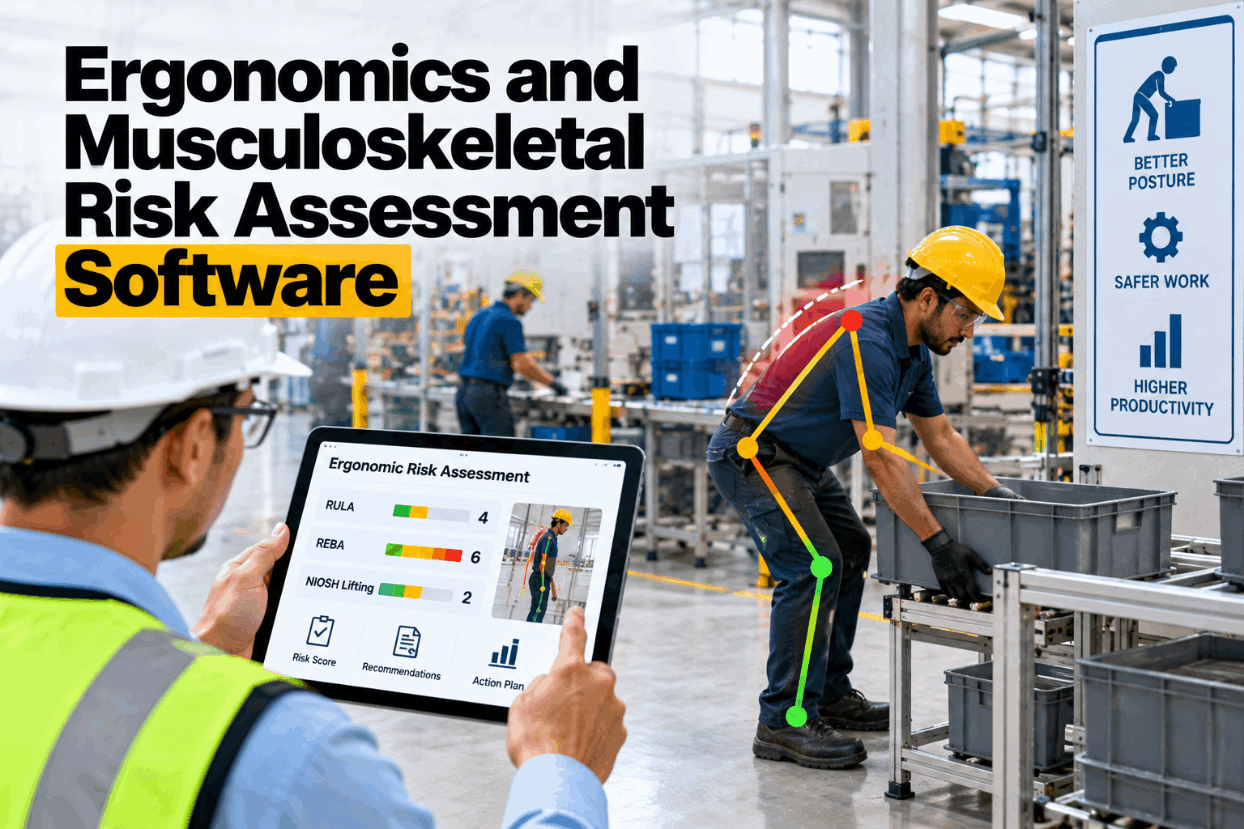
AI ergonomic assessment uses pose estimation: software that locates a person’s joints in each video frame and calculates joint angles over time.
A short video of the task from a phone, tablet or fixed camera.
Joint positions and angles calculated for every frame.
RULA or REBA posture scores computed across the whole cycle.
Weights, forces and repetition entered or taken from job data.
Scores, time in each risk band and the body regions driving the score.
An ergonomist or trained assessor confirms results and priorities.
Peer-reviewed research supports the approach. A 2020 study in Computers and Industrial Engineering compared computer-vision RULA scores with seven expert assessors and found agreement, measured by Cohen’s kappa, above 0.6 in most real-world tests, a level usually described as substantial.
The big gain is coverage. A manual assessment scores a few postures chosen by the assessor; video assessment scores every frame, so it shows how long a worker spends in each risk band over the whole cycle.
Our engineers can run a sample assessment on your own video.
What AI Assessment Can and Cannot Do
Used well, AI assessment is a powerful screening tool. It has limits that programs should respect.
Many jobs assessed quickly, every frame scored.
The same method applied to every job and site.
Reassessment after a fix shows the change objectively.
Video does not show weight or grip force; these must be entered.
Hidden limbs and poor camera angles reduce accuracy.
Priorities and solutions still need trained people.
Privacy deserves attention. Video should be used to assess the job, not the person. Good practice is to blur faces, keep video on premises, explain the purpose to workers and involve them in the assessment and the fix.
Worker involvement makes fixes better and adoption easier. Ask our team how sites introduce assessments.
From Scores to Fixes
A score matters only if it leads to a better job. Fixes follow a hierarchy.
Automate, conveyorize or redesign so the handling is not needed.
Lift platforms, tilters, height-adjustable benches and reach reduction.
Smaller packs, better handles, lighter containers.
Balancers, torque arms, better grips and powered tools.
Job rotation, pacing and rest; useful, but weaker than engineering.
Train on the new method and reassess to confirm the improvement.
- A few jobs assessed each week
- Postures sampled by eye
- Results vary between assessors
- Backlog of unassessed jobs
- Fixes hard to verify
- Program driven by injury reports
- Every job screened
- Whole work cycle scored
- Same method everywhere
- Specialists focus on high-risk jobs
- Before and after scores compared
- Program driven by risk scores
See a before-and-after comparison for a sample job in a session.
Ergonomics Program Checklist
Use this checklist to test an ergonomics program.
Most programs assess too few jobs to see the pattern. An ergonomics review shows your coverage.
What Ergonomic Risk Assessment Is Worth
The case for ergonomics is one of the better documented in safety.
A systematic review by Tompa and colleagues in the Journal of Occupational Rehabilitation examined 35 studies and found strong evidence that ergonomic interventions in manufacturing and warehousing are financially worthwhile from the firm’s perspective, while noting that many economic analyses were of limited quality.
Linking your injury costs to job scores shows where fixes pay first. We can build that view in a working session.
How iFactory Delivers AI Ergonomic Risk Assessment
Joint angles and posture scores for the whole work cycle.
Scores and risk bands with the body regions driving them.
Recommended weight limit and lifting index by multiplier.
All jobs ranked so the worst are fixed first.
Reassessment proves the improvement.
Faces blurred and video processed on premises.
It runs on premises on the iFactory AI server. Send a short video of one job and we will assess it in a pilot.
See One of Your Jobs Scored From Video
Send a short video of a manual handling job. We score it with REBA and the NIOSH lifting equation and show which part of the task drives the risk.
Video assessment gives a REBA score of 10, in the high band. Trunk flexion exceeds 60 degrees on 38% of cycles, and the lifting index for the lowest pallet tier is 1.8.
A Palletizing Job Ranked and Fixed
This exchange shows how a safety engineer might use iFactory.
iFactory ships as a pre-configured NVIDIA AI server, racked and ready with the ergonomic risk assessment models loaded. Rack it, plug in power and Ethernet, and the AI is live on your network. Our scope covers cameras, sensors and data connections across production lines, packaging and warehouse areas, CMMS, HR, training and access control integration, cabling and network setup, supervisor and safety team training, and 24×7 remote monitoring. Alerts and records support your safety team; they do not replace your procedures, competent persons or legal duties.
Server installed, system links live, existing permits, inspections, training and incident records loaded.
Workflows and models configured to your own procedures, then piloted in one area with your safety team reviewing every alert.
Rollout to the agreed areas and sites, supervisor and safety team training, and 24×7 remote monitoring in place.
Software, server and integration come as one package. For pricing on your site, contact our sales team.
Frequently Asked Questions
RULA scores upper limb, neck and trunk posture from 1 to 7 and suits arm-focused work. REBA scores whole-body posture from 1 to 15 and suits jobs with varied postures and handling.
A method that calculates a recommended weight limit for a lifting task from a 51-pound load constant and six multipliers. The lifting index is the actual load divided by that limit; above 1.0 risk increases.
No specific federal standard. A 2000 rule was repealed in 2001. OSHA uses its general duty authority and industry guidelines, and musculoskeletal disorders are recorded like other injuries.
A 2020 peer-reviewed study found agreement between computer-vision RULA scores and seven experts above 0.6 on Cohen’s kappa in most real-world tests. Accuracy depends on camera angle and visibility, and loads must be entered separately.
Overexertion involving outside sources, at $13.70 billion a year in direct costs and 23% of the total, according to Liberty Mutual’s 2025 Workplace Safety Index.
AI assessment can typically be in use on your first jobs within a 6–12 week rollout. Plan it with our specialists.
Find and Fix the Jobs That Injure People
iFactory scores every job from video with RULA, REBA and the NIOSH lifting equation, ranks the risk and proves each fix, so ergonomics effort goes where it prevents the most injuries.
Illustrative. Scoring every job shows where the few high-risk tasks are, so engineering effort goes there first.