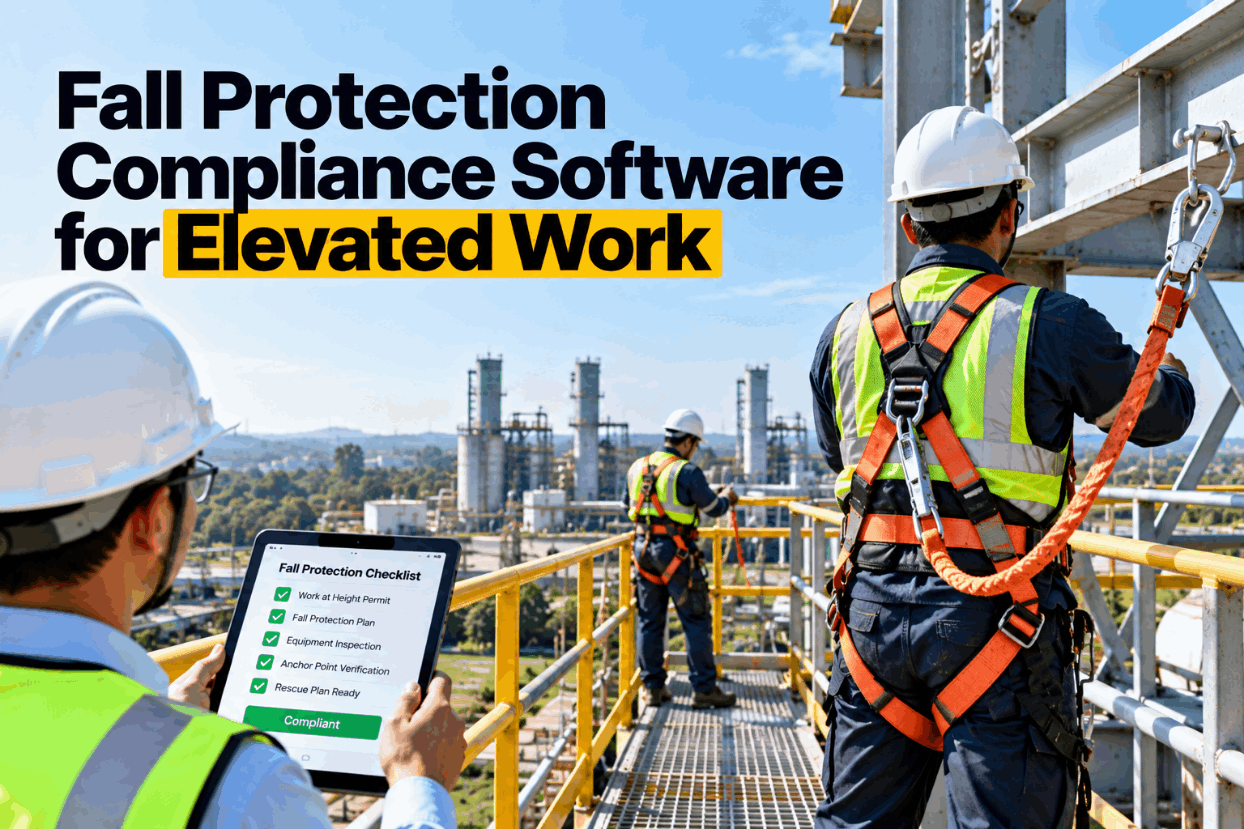
Fall protection has been OSHA’s most frequently cited standard for fifteen years in a row, and falls remain a leading cause of death in construction. The rules are not complicated: protect workers at set heights, use equipment that meets strength requirements, inspect it, train people and be ready to rescue someone left hanging in a harness. What makes compliance hard is the volume of detail. Hundreds of harnesses and lanyards, each with an inspection history. Anchor points across changing work areas. Training certificates that expire. Rescue plans that exist on paper but have never been practiced. Fall protection software keeps all of it current and visible before work at height starts. This guide covers trigger heights, equipment requirements, inspections, training, rescue readiness and what to look for in a tracking system. To see fall protection tracking in use, book a short walkthrough.
Fall Protection Compliance Software for Elevated Work: Plans, Equipment and Rescue Ready
Fall protection plans, harness and anchor inspections, training records and rescue readiness tracked for every crew, so nobody works at height on expired equipment or an untested plan.
Why Falls Stay at the Top of Every List
OSHA’s final list of most-cited standards for fiscal year 2025 puts fall protection general requirements, 29 CFR 1926.501, first with 6,992 citations, the fifteenth year in a row at number one. Related standards are also in the top ten: ladders (1926.1053) with 2,842 citations, scaffolding (1926.451) with 2,286 and fall protection training (1926.503) with 2,216.
The human cost is larger. The Bureau of Labor Statistics recorded 844 fatal falls, slips and trips in 2024, of which 666 were falls to a lower level. In private construction, 389 of 1,034 deaths were falls, slips and trips, more than one third, and almost all of those were falls to a lower level. OSHA describes falls as a leading cause of death for construction employees.
Most of these cases do not involve unusual hazards. They involve roof edges, floor openings, ladders and scaffolds, with missing protection or equipment that was not inspected or not used. The gap is in day-to-day control, which is where tracking helps.
Knowing every crew’s readiness before work starts closes that gap. We can review your program on a call.
When Fall Protection Is Required
OSHA sets different trigger heights for different kinds of work.
| Work type | Trigger height | Standard |
|---|---|---|
| Construction | 6 feet or more above a lower level | 29 CFR 1926.501(b)(1) |
| General industry | 4 feet or more above a lower level | 29 CFR 1910.28(b)(1)(i) |
| Scaffolds | More than 10 feet above a lower level | 29 CFR 1926.451(g)(1) |
| Shipyards | More than 5 feet for unguarded edges | 29 CFR 1915.73(d) |
| Dangerous equipment below | Any height | Protection required regardless of distance |
Many companies set their own lower trigger, often the general industry 4 feet everywhere, so that crews do not need to remember which rule applies on which site. A tracking system should let each site apply its own rule and flag work that crosses it.
The preferred order of controls is to remove the need to work at height, then to use guardrails or covers, then travel restraint, and only then personal fall arrest, which protects the worker after a fall has already started.
Our specialists can map trigger heights and controls for each of your work types.
What Personal Fall Arrest Systems Must Do
OSHA’s construction rule 1926.502(d) and general industry rule 1910.140 set the performance requirements for personal fall arrest systems.
Illustrative. Use the manufacturer’s figures for the actual equipment; self-retracting lifelines usually need less clearance.
Clearance is the calculation most often skipped on site. We build it into the pre-task check in every rollout.
Tracking Equipment and Anchor Inspections
Every piece of fall protection equipment has two kinds of inspection: by the user before each use, and periodic inspection by a competent person. The ANSI/ASSP Z359 family of standards sets out inspection roles and intervals for a managed fall protection program.
Webbing, stitching, D-rings, buckles and labels checked; date of manufacture and service life tracked.
Shock pack deployment, cable or webbing damage, locking function and service intervals.
Certified strength, installation records and periodic re-certification.
Height, strength and condition of rails; covers secured and marked.
Ladder condition and set-up; scaffold tags and competent person checks.
Equipment involved in a fall or failing inspection tagged out and recorded.
Tagging each item with a barcode, QR code or RFID tag makes inspection status visible at the point of use. A worker scans the harness before climbing; if its periodic inspection is overdue or it has been tagged out, the system says so.
Scan-before-use is the simplest control with the largest effect. See it in a demo.
Training and Written Certification
OSHA 1926.503 requires a training program for each employee who might be exposed to fall hazards, and a written certification record.
Every worker who may work at or above the trigger height.
Fall hazards, correct use of systems, equipment limits and the employer’s procedures.
Record the employee’s name, training date and the trainer’s signature.
Check training status when crews are assigned to work at height.
After changes in the workplace or equipment, or when a worker shows gaps.
Training coverage by crew, site and contractor.
Fall protection training was the seventh most-cited standard in FY2025 with 2,216 citations, which shows how often the paperwork, or the training itself, is missing. Linking training records to crew assignments catches gaps before the shift, not during an inspection.
Contractor crews are where training gaps are most common. Ask our team how contractor records are handled.
Fall Protection Plans and Rescue Readiness
Two documents are often confused: the site’s fall protection program and the specific fall protection plan allowed by 1926.502(k).
Most employers keep a written program covering hazards, controls, equipment, training and rescue for all work at height.
A specific plan allowed only for leading edge work, precast concrete erection and residential construction where conventional systems are infeasible or more hazardous.
A qualified person must prepare the plan for the specific site; it must be kept on site and implemented under a competent person.
Every job using fall arrest needs a way to reach and lower a suspended worker promptly.
OSHA’s 2004 safety and health bulletin on suspension trauma, also called orthostatic intolerance, warns of the danger of hanging motionless in a harness.
Rescue equipment on site, people trained to use it and drills recorded.
Rescue is the weakest part of many programs. Calling the fire department is not a plan if they cannot reach the worker quickly or lack the equipment for the location. A job-specific rescue method, with trained people and equipment on site, is what prompt rescue means in practice.
Tracking rescue readiness alongside equipment makes it visible. Our advisors can show how sites record drills.
Binders and Spreadsheets Versus Live Tracking
The difference shows at the start of every shift.
- Inspection logs kept in an office
- Harness status unknown at the point of use
- Training checked during audits
- Anchor certificates filed and forgotten
- Rescue plans generic
- Gaps found after an incident
- Inspection status on every tagged item
- Scan before use shows fit for service
- Training verified when crews are assigned
- Anchor register with re-certification dates
- Rescue plan linked to each job
- Gaps flagged before work starts
Live tracking also changes conversations with inspectors and clients. Instead of searching for paper, the site shows current status for every worker and every item on a tablet.
See a live readiness view for a sample crew in a session.
Fall Protection Compliance Checklist
Use this checklist to test a fall protection program.
Most programs score well on equipment and poorly on rescue. A program review shows where yours stands.
What Fall Protection Tracking Is Worth
The value is in prevented falls, avoided citations and work that is not stopped.
Because fall protection citations are so common, repeat violations are a real risk for multi-site contractors. A repeat can rest on an earlier citation at a different site, and carries the higher penalty tier.
A review of your equipment register and training records shows the exposure. Book one with our safety team.
How iFactory Delivers Fall Protection Tracking
Every item tagged with inspection history and service life.
Fit-for-service status at the point of work.
Certified anchors with locations and re-certification dates.
Certification verified when crews are assigned.
Job-specific rescue plans, equipment and drills.
Crew-by-crew status for supervisors and safety leaders.
It runs on premises and works on phones and tablets on site. Share your equipment list and we will load it in a pilot.
See Which Crews Are Ready to Work at Height Today
Share your equipment register and training records. We show which items are overdue, which workers lack certification and which jobs have no rescue plan.
This harness was scanned for today’s roof work, but its periodic inspection by a competent person lapsed six days ago. The wearer’s training record is current.
An Overdue Harness Caught Before the Climb
This exchange shows how a site safety manager might use iFactory.
iFactory ships as a pre-configured NVIDIA AI server, racked and ready with the fall protection and equipment tracking models loaded. Rack it, plug in power and Ethernet, and the AI is live on your network. Our scope covers cameras, sensors and data connections across work areas, equipment stores and site offices, CMMS, HR, training and access control integration, cabling and network setup, supervisor and safety team training, and 24×7 remote monitoring. Alerts and records support your safety team; they do not replace your procedures, competent persons or legal duties.
Server installed, system links live, existing permits, inspections, training and incident records loaded.
Workflows and models configured to your own procedures, then piloted in one area with your safety team reviewing every alert.
Rollout to the agreed areas and sites, supervisor and safety team training, and 24×7 remote monitoring in place.
Software, server and integration come as one package. For pricing on your sites, contact our sales team.
Frequently Asked Questions
At 6 feet in construction, 4 feet in general industry, more than 10 feet on scaffolds and more than 5 feet for unguarded edges in shipyards. Protection is required at any height above dangerous equipment.
At least 5,000 pounds per attached employee, or designed and installed under a qualified person with a safety factor of at least two.
OSHA requires inspection before each use. Managed programs under ANSI/ASSP Z359 also use periodic inspections by a competent person, at intervals set by the program and the manufacturer.
A written certification record with the employee’s name, the date of training and the signature of the trainer or employer, under 1926.503.
A job-specific method to reach and lower a suspended worker promptly, with equipment on site and trained people available, to prevent suspension trauma.
Equipment and training tracking can typically be live within a 6–12 week rollout, starting from your existing registers. Plan it with our specialists.
Know Every Crew Is Ready Before They Climb
iFactory tracks equipment inspections, anchors, training and rescue plans, and checks readiness at the point of work, so elevated work stays compliant and safe.
Illustrative. Rescue readiness is usually the weakest item, so it is tracked alongside equipment and training.