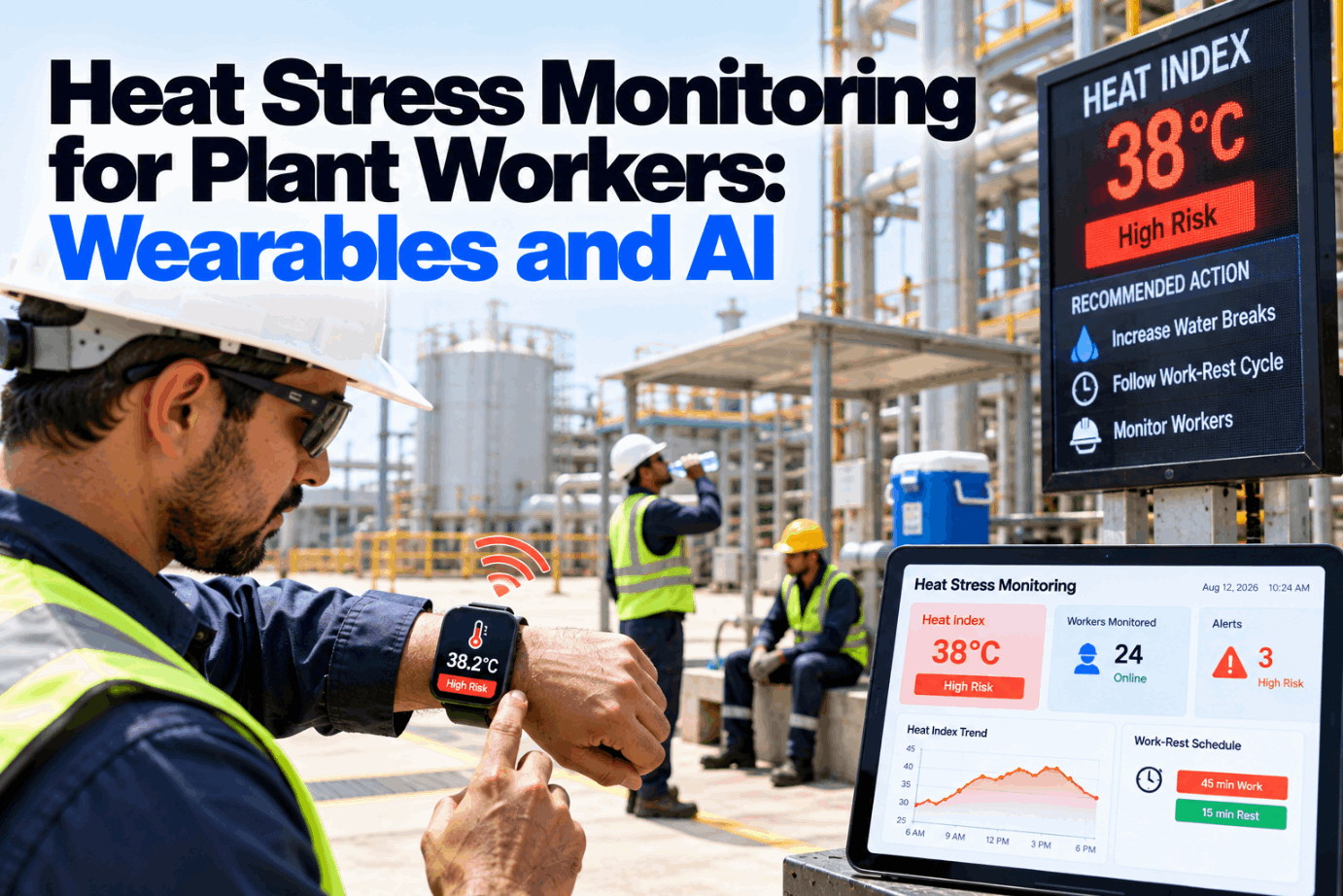
In a foundry, a die-cast cell or a boiler house, the heat index can pass 100°F on a summer afternoon while the office reads 72. New workers feel it first, and by the time someone looks dizzy the problem is already serious. This guide shows how heat stress monitoring combines heat index, wearables and work-rest schedules. Start with a heat review.
Heat Stress Monitoring for Plant Workers: Wearables and AI
Area heat index sensors and optional wearables trigger hydration and rest reminders by voice. New and returning workers get acclimatization schedules, and the program records an inspector would ask for are logged automatically.
- Why heat is a plant problem, not just outdoors
- What happens at each heat trigger
- Which records show your program is working
Why Heat Stress Is a Plant Problem
Indoor heat counts too.
OSHA published its proposed rule on heat injury and illness prevention in outdoor and indoor work settings on August 30, 2024. As of 2026 it is not final, and OSHA continues to cite heat hazards under the General Duty Clause. Several states, including California, Washington, Oregon, Maryland and Nevada, have their own heat rules. Plants with furnaces, ovens, boilers and poor ventilation carry real indoor heat risk. Our safety engineers can review your hot areas.
Radiant heat
Furnaces and molten metal add heat a thermometer misses.
PPE load
FR clothing and respirators trap body heat.
New workers
Most at risk in their first days on the job.
Humidity
Steam and wash areas push the heat index up.
Heat Triggers and What Happens at Each
Clear levels, clear actions.
The proposed federal rule uses two heat index triggers. Many plants already use similar levels in their written plans. The actions below follow the proposal and common practice; your own plan and any state rule set the final requirements. Map your areas to triggers in a heat mapping session.
The heat index combines air temperature and humidity but ignores radiant heat and air movement. Near furnaces and molten metal, a wet bulb globe temperature reading, as used in ACGIH guidance, gives a truer picture of heat stress.
How the Heat Safety Agent Works
Sense, remind, escalate, record.
Sensors in hot areas report conditions. When a trigger is crossed, the agent reminds crews by voice to drink and rest, adjusts schedules for workers who are acclimatizing and escalates if a wearable shows strain. Everything is logged. Ask our support desk which sensors and wearables connect.
Sense
Area sensors and optional wearables.
Compare
Readings checked against plan triggers.
Remind
Water and rest prompts by voice.
Escalate
Supervisor alerted on wearable strain.
Record
Readings, breaks and training logged.
Stay Ahead of the Summer Peak
Set up sensors and your plan before the hot months. The first summer gives you the records to prove the program works.
Acclimatization Schedules
Build heat tolerance step by step.
NIOSH recommends that new workers start with no more than 20% of usual heat exposure on day one and add no more than 20% each day after. The agent tracks each worker’s day count and warns supervisors before a limit is passed. Plan schedules in a planning call.
Wearables: Useful, Optional, Private
More signal, more care needed.
Wearables that track heart rate or skin temperature can spot strain before symptoms appear. They also collect personal health data, so they need clear rules on who sees what. Agree those rules with our safety team before rollout.
What wearables add
- Early signs of individual strain
- Alerts for workers alone in hot areas
- Data to tune work-rest cycles
- Better follow-up after a heat event
What to agree first
- Wearables are optional
- Who sees individual readings
- How long data is kept
- Readings never used for discipline
Records an Inspector Will Ask For
The paper trail matters either way.
Whether a final federal rule arrives or OSHA keeps using the General Duty Clause, a written plan and records of what you did are your best evidence. The agent keeps them as a by-product of daily work. Review your records in a records check.
Written heat plan
Triggers, actions, roles and emergency steps.
Heat readings
Area readings with times and locations.
Rest records
Breaks given at each trigger level.
Acclimatization
Day counts and limits for new and returning workers.
Who was trained
Workers and supervisors, with dates.
Heat incidents
Symptoms, response and follow-up.
Heat Program Mistakes to Avoid
Most heat illness is preventable.
Heat programs often exist on paper and fade on the floor. A short program check shows where.
What works
- Triggers tied to real area readings
- Acclimatization for new and returning workers
- Breaks logged, not assumed
- Supervisors trained to spot symptoms
What fails
- One thermometer in the office
- New starters on full shifts on day one
- Water but no shade or cool rest area
- No plan for radiant heat sources
How iFactory Runs the Heat Safety Agent
Sensors, voice reminders and records together.
iFactory’s Heat Safety Agent uses area heat index sensors and optional wearables to trigger hydration and rest reminders by voice and logs the program records an inspector would ask for, on an on-prem server inside your plant. Fit questions go to our solutions team.
Area sensors
Heat index or WBGT readings by zone.
Plan triggers
Your levels and actions built in.
Voice reminders
Water and rest prompts to crews.
Acclimatization
Day counts and limits per worker.
Wearable alerts
Optional strain alerts to supervisors.
Inspection records
Readings, breaks and training logged.
Sensor placement and plan quality drive results. We review placement and records with your team during the pilot.
Turnkey AI: Delivered, Connected and Live in 6–12 Weeks
You do not build this. It arrives ready.
iFactory ships as a pre-configured NVIDIA AI server with the software pre-loaded, racked and ready. Rack it, plug in power and Ethernet, and the AI is live on your network. Our team handles cabling, network setup, PLC, SCADA and CMMS integration, heat sensor placement and plan set-up, operator training and 24×7 remote monitoring. Data stays on your network. For a scope matched to your plant, request a turnkey quote.
Ship, network and data
Server installed. Hot areas mapped. Sensors placed.
Plan and pilot
Triggers, reminders and schedules run in one hot area.
Go-live and training
Live in all hot areas. Supervisors trained. 24×7 monitoring begins.
Frequently Asked Questions
Is there a federal OSHA heat standard?
Not yet. OSHA proposed one in August 2024, and it was still not final in 2026. OSHA cites heat hazards under the General Duty Clause in the meantime.
What are the proposed heat triggers?
An initial trigger at a heat index of 80°F and a high-heat trigger at 90°F, each with required actions.
Do indoor workplaces count?
Yes. The proposed rule covers indoor and outdoor work, and plants with furnaces or poor ventilation often have high indoor heat.
What is acclimatization?
Building heat tolerance gradually. NIOSH suggests starting new workers at 20% of normal exposure and adding 20% a day.
Are wearables required?
No. They are optional and add individual alerts. Area sensors cover the core program.
What records should we keep?
A written plan, heat readings, breaks given, acclimatization schedules, training and any heat events.
How do we start?
Map your hot areas, place sensors and load your plan before the hot months. To plan it, contact our team.
Get Your Heat Plan Running
In thirty minutes we look at your hot areas, your written plan and what records you keep today. You keep the notes either way.
- 1A list of your hottest areas
- 2Your written heat plan
- 3Last summer’s heat events
- 4Your new-starter schedule
- 5One day that felt too hot