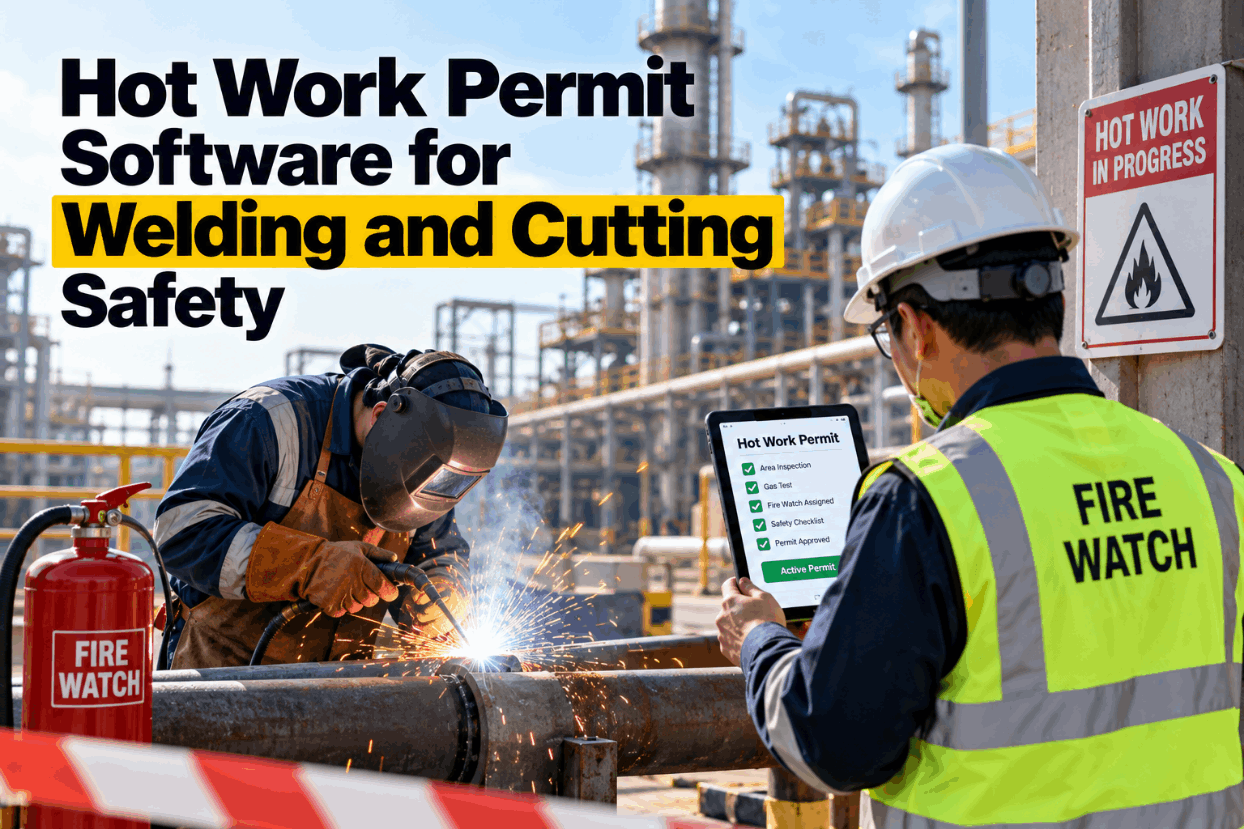
Welding, cutting, brazing and grinding start fires long after the sparks stop. A spark lands in a wall cavity or under a pallet, smolders for half an hour and flares up when the welder and the fire watch have already gone. The hot work permit exists to prevent exactly that: check the area before work, control combustibles, post a fire watch, keep watching after the job and only then close the permit. On paper, those steps are easy to skip and hard to prove. Hot work permit software makes each step a recorded, time-stamped control, with the fire watch verified instead of assumed. This guide covers what OSHA and NFPA require, how the permit lifecycle works, fire watch verification, gas testing, links to confined space and lockout, and what to look for in a digital system. To see a digital hot work permit in use, book a short walkthrough.
Hot Work Permit Software for Welding and Cutting Safety: Every Permit Checked, Watched and Closed
Pre-work checks, 35-foot clearance, fire watch and post-work monitoring recorded step by step, so no hot work starts without controls and no permit closes without proof.
Why Hot Work Still Starts So Many Fires
The National Fire Protection Association reports that hot work was involved in an average of 3,396 structure fires a year between 2017 and 2021, causing 19 civilian deaths, 120 injuries and $292 million in direct property damage each year. More than half of those fires were in non-home properties, and welding torches were the equipment most often involved.
Tanks and containers add an explosion risk. The US Chemical Safety Board’s 2010 bulletin on hot work in and around tanks analyzed 11 accidents and cited more than 60 deaths since 1990 from explosions and fires during such work. Its seven lessons include analyzing hazards, monitoring the atmosphere, using written permits and supervising contractors.
The controls are well known. What fails is execution: the area is not really inspected, the fire watch is assigned but busy elsewhere, or the watch ends when the welder leaves. FM Global’s guidance notes that most hot work fires start during the work or within 60 minutes of completion, which is why the post-work watch matters so much.
A digital permit makes every one of those steps visible. We can review your current permit process on a call.
What OSHA Requires for Welding and Cutting
OSHA’s general industry rule for welding, cutting and brazing is 29 CFR 1910.252. Its fire prevention paragraphs set the basic controls.
These are minimums. Many insurers and corporate standards go further, and OSHA’s rule itself references NFPA 51B, the fire prevention standard for hot work.
Our specialists can map your permit form to each requirement.
OSHA, NFPA 51B and FM Global Compared
The three most common references differ mainly on how long to watch after the work ends.
| Requirement | OSHA 1910.252 | NFPA 51B-2019 | FM Global permit |
|---|---|---|---|
| Clearance radius | 35 feet | 35 feet | 35 feet (11 m) |
| Written permit | Preferred form of authorization | Required outside designated areas | Required |
| Who authorizes | Individual responsible for authorizing | Permit authorizing individual (PAI) | Fire safety supervisor |
| Fire watch after work | At least 30 minutes | At least 1 hour | 60 minutes |
| Further monitoring | Not specified | Up to 3 more hours, as the PAI decides | 3 more hours |
| Designated areas | Recognized | Permit not needed in designated hot work areas | Recognized |
NFPA 51B’s 2019 edition doubled the minimum fire watch from 30 minutes to one hour and added fire monitoring for up to three more hours at the discretion of the permit authorizing individual. A site that follows only the OSHA minimum may fall short of its insurer’s or its own corporate standard.
Fire watch and fire monitoring are different duties. The fire watch stays in the area with extinguishing equipment and no other task. Monitoring can be periodic checks, detection systems or cameras, depending on the site rules.
A digital permit can enforce whichever rule set your site follows. See the options in a demo.
The Hot Work Permit Lifecycle
A good permit is a sequence of checks, each owned by a named person.
Job, location, equipment and duration entered; alternatives to hot work considered.
The authorizing person checks combustibles, openings, sprinklers and nearby processes.
Clearing, shielding, wetting, isolation and gas testing recorded.
Time-limited permit issued to named workers and a named fire watch.
Fire watch during work and after; further monitoring where required.
Area inspected, permit signed off and stored.
Permits should be valid for a single shift or job. If conditions change, such as a nearby process starting or a sprinkler system being taken out of service, the permit should be suspended until the area is rechecked.
The CSB’s first lesson is worth repeating: use alternatives where possible. Cold cutting, mechanical fastening or moving the job to a designated hot work area removes the risk entirely.
Building alternatives and designated areas into the request step reduces permit volume. Ask our team how sites set this up.
Verifying the Fire Watch
The fire watch is the control most often assumed rather than verified.
The fire watch watches for fire and has no other task while assigned.
Extinguisher at hand, alarm location known, trained to use both.
Including the far side of walls and the floor below where sparks can travel.
The watch accepts the assignment on a mobile device at the work location.
A timer starts when work ends and blocks closure until it completes.
Check-ins, photos or location confirmation during and after the watch.
Illustrative. Durations follow your site rules; the system enforces them and records each check.
Timed, acknowledged watches turn the most fragile control into the most reliable one. See it working in a session.
Gas Testing and Work on Tanks and Containers
The CSB’s bulletin draws seven lessons from fatal tank explosions. They apply to any hot work near flammable materials.
Avoid hot work where a safer method exists.
Assess the scope of work, the contents and nearby processes before starting.
Use a properly calibrated combustible gas detector before and during the work, even where a flammable atmosphere is not expected.
Drain, purge and isolate tanks and piping; test inside and around them.
Make sure the permit identifies the work, hazards and precautions.
Train workers on hot work policy, gas detectors and equipment in a language they understand.
Give contractors the hazard information and make sure they follow the same permit rules.
The bulletin cites NFPA 326, which requires all work to stop if combustible gas reaches 10% of the lower explosive limit. Recording gas readings on the permit, with the instrument and calibration date, shows the test was actually done and by whom.
Linking gas detector readings to the permit removes a common gap. Our engineers can connect your instruments.
Hot Work With Confined Space, Lockout and Contractors
Hot work rarely happens alone. It often overlaps with other controlled work.
A system that links permits by location and time can warn when a hot work request conflicts with another activity, such as an open confined space entry next door or an impaired sprinkler zone.
Conflict checks between permits are part of every rollout.
Paper Permits Versus Digital Permits
The difference between paper and digital shows in what can be proven afterward.
- Checkboxes ticked from memory
- Fire watch named, not confirmed
- No timer on the post-work watch
- Permits lost or filed unreviewed
- Conflicts with other work unseen
- Trends invisible to management
- Each check recorded with time and person
- Fire watch acknowledges on a device
- Closure blocked until the watch completes
- Every permit stored and searchable
- Conflicts flagged by location and time
- Volume, overruns and gaps reported
Digital does not mean slower. A well-designed mobile permit takes minutes, pre-fills location details and guides the authorizing person through the checks that matter for that area.
Most sites start with one area and extend after a few weeks. Discuss a pilot with our advisors.
Hot Work Permit Checklist
Use this checklist to test a hot work program.
Most gaps appear in the after-work steps. A permit review usually finds them quickly.
What Digital Hot Work Control Is Worth
The value is mostly in what does not happen.
NFPA’s figure of $292 million a year in direct property damage covers structures only; it does not count business interruption, which often exceeds the physical loss. One prevented fire can pay for the program many times over.
A look at last year’s permits usually shows how many closed without a recorded watch. We can run that check in a working session.
How iFactory Delivers Hot Work Permit Control
Area inspection and precautions recorded step by step.
Named watch acknowledges and checks in on a device.
Closure blocked until watch and monitoring are complete.
Readings, instrument and calibration linked to the permit.
Confined space, lockout and impairments checked by location.
Open permits, overruns and gaps visible to safety leaders.
It runs on premises and works on phones and tablets on the shop floor. Share your current permit form and we will configure it in a pilot.
See How Many Permits Close Without a Verified Fire Watch
Share a month of hot work permits. We check each one against your own rules and show where inspections, fire watch and sign-off are missing.
Work ended 40 minutes ago and the fire watch has not signed off. Site rules require a 60-minute watch, and the pre-work photo shows stored cartons inside the 35-foot radius.
A Fire Watch Sent Back Before Closure
This exchange shows how a safety supervisor might use iFactory.
iFactory ships as a pre-configured NVIDIA AI server, racked and ready with the permit and safety workflow models loaded. Rack it, plug in power and Ethernet, and the AI is live on your network. Our scope covers cameras, sensors and data connections across production areas, maintenance shops and contractor work zones, CMMS, HR, training and access control integration, cabling and network setup, supervisor and safety team training, and 24×7 remote monitoring. Alerts and records support your safety team; they do not replace your procedures, competent persons or legal duties.
Server installed, system links live, existing permits, inspections, training and incident records loaded.
Workflows and models configured to your own procedures, then piloted in one area with your safety team reviewing every alert.
Rollout to the agreed areas and sites, supervisor and safety team training, and 24×7 remote monitoring in place.
Software, server and integration come as one package. For pricing on your site, contact our sales team.
Frequently Asked Questions
A written authorization for welding, cutting, brazing, grinding or similar spark-producing work outside a designated area, recording the area inspection, precautions, fire watch and final check.
OSHA 1910.252 requires at least 30 minutes after welding or cutting. NFPA 51B-2019 requires at least one hour, with up to three more hours of monitoring at the authorizing individual’s discretion.
Combustibles should be moved at least 35 feet from hot work where practicable, floors swept for a 35-foot radius, and a fire watch posted where combustibles remain within that distance.
Whenever flammable gases or vapors may be present, especially on or near tanks and containers. The CSB recommends monitoring before and during work; NFPA 326 requires work to stop at 10% of the lower explosive limit.
Yes. Contractors should work under the host site’s permit system with the same inspection, fire watch and closure requirements.
A digital hot work permit can typically be live in one area within a 6–12 week rollout, starting from your existing form. Plan it with our specialists.
Make Every Hot Work Permit Provable
iFactory guides the pre-work checks, verifies the fire watch, times the post-work watch and blocks closure until the area is confirmed safe.
Illustrative. Every permit shows its stage, so nothing closes without the fire watch and final inspection recorded.