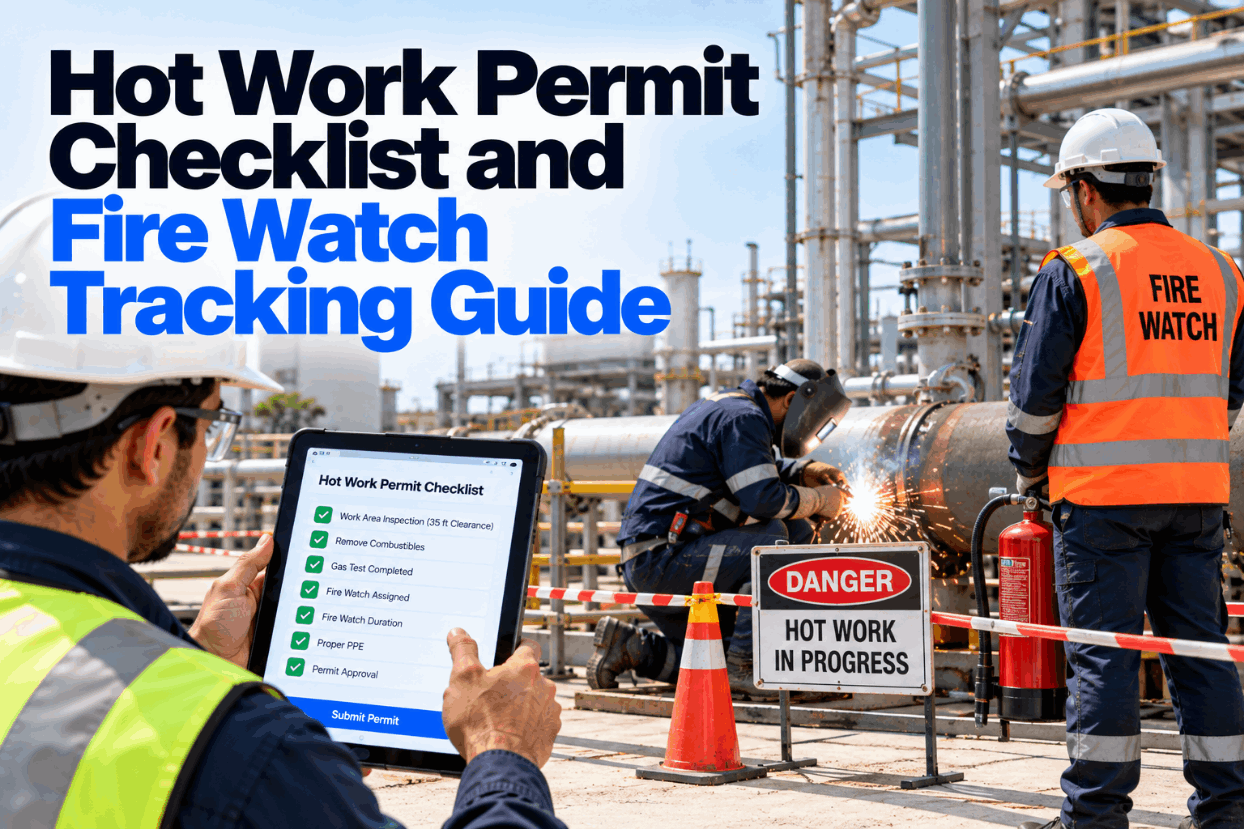
Many hot work fires do not start while the welder is working. They start later, when a spark has been smoldering in insulation, dust or packaging and the crew has gone to lunch. This guide gives you a hot work permit checklist with the 35-foot rule, combustible clearance and fire watch timing, plus digital sign-off. See the fire watch timer.
Hot Work Permit Checklist and Fire Watch Tracking Guide
An NFPA 51B-aligned checklist, a fire watch timer with voice check-ins and a permit that closes only after the post-work watch is done. Every step is time-stamped and tied to the job.
- Why fires start after the work stops
- A tick-box checklist for before, during and after
- How the fire watch timer keeps permits honest
Why Hot Work Fires Start After the Work Stops
The danger outlives the arc.
The 2019 edition of NFPA 51B raised the minimum fire watch after hot work from 30 minutes to one hour, and added up to three more hours of fire monitoring at the discretion of the permit authorizing individual. OSHA 1910.252 still sets a 30-minute floor, so many plants follow the stricter NFPA rule. Grinding and torch cutting count as hot work too. See how the timer enforces it in a permit demo.
Hidden smolder
Sparks lodge in insulation, dust or packaging.
Wall openings
Sparks pass through gaps to the next room.
No fire watch
The watcher is pulled onto another job.
Permits never closed
Nobody checks the area after work.
Roles: PAI, Operator and Fire Watch
Three people, three jobs.
NFPA 51B splits the work between the person who authorizes it, the person doing it and the person watching for fire. Combining roles is where shortcuts start. Questions on roles go to our fire safety team.
Authorizes the work
Checks the area, sets precautions and decides extra monitoring time.
Does the hot work
Keeps to the permit and stops if conditions change.
Fire watch
Has an extinguisher, sees the whole area and has no other duties.
Hot Work Permit Checklist
Tick each item before, during and after.
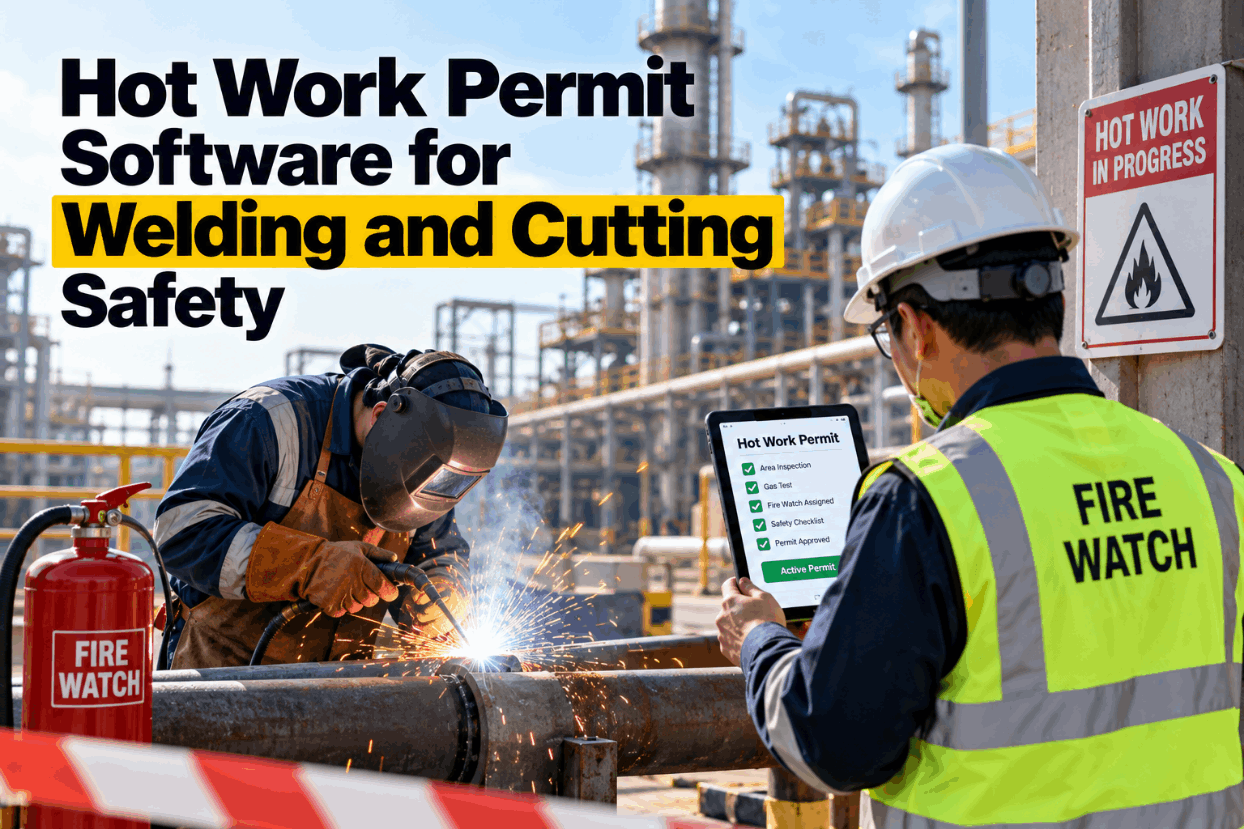
Use this checklist alongside your permit. Each item follows NFPA 51B and OSHA 1910.252. In the digital version every tick is time-stamped and the permit will not close until the after-work items are done. Map it to your form in a template session.
A hot work permit should cover one location for no longer than the shift it was issued for. If the job moves or runs over, issue a new permit and check the new area. Open-ended permits are where fire watches get skipped.
Never Close a Permit Before the Watch Ends
The timer starts when work stops and the permit stays open until the watch and monitoring are done.
How the Fire Watch Timer Works
The clock starts when the arc stops.
When the operator ends the work, the fire watch timer starts on the permit. The fire watch checks in by voice at set intervals. If a check-in is missed, the supervisor is alerted. The permit closes only after the watch and any extra monitoring end. Ask our support desk how check-in intervals are set.
Issue
Checklist done and PAI signs.
Work
Operator works with the fire watch present.
Stop
Work ends, timer starts.
Check in
Fire watch confirms by voice at intervals.
Close
Permit closes after the watch ends.
Combustible Clearance in Practice
What the 35-foot rule means on the floor.
The 35-foot rule is simple on paper. In a crowded plant, it means making choices about what to move, what to cover and when to stop. Review your common cases in a clearance walk.
Measuring Hot Work Discipline
Three numbers to watch.
Hot work fires are rare, so counting fires tells you little. Count the habits that prevent them instead. Agree the measures with our fire safety team.
Watch completion
Share of permits where the full fire watch was timed and logged.
Missed check-ins
Check-ins missed per hundred permits, by area.
Field audit score
Share of live permits where the area matched the checklist.
Hot Work Mistakes to Avoid
Most fires trace back to the same few habits.
Hot work rules are well known. Fires happen when they are bent under time pressure. A short permit check spots where that happens in your plant.
What works
- Cold methods considered first
- A dedicated fire watch
- Timed watch after work
- Permits closed in the field
What fails
- Fire watch with other duties
- Blankets used instead of moving material
- Permits closed at the desk
- Multi-day permits for moving jobs
How iFactory Runs the Hot Work Permit Module
Checklist, timer and close-out together.
iFactory’s Hot Work Permit Module gives you an NFPA 51B-aligned checklist, a fire watch timer with voice check-ins and auto-close only after the post-work watch is complete, on an on-prem server and tied to the work order. Fit questions go to our solutions team.
51B checklist
Before, during and after items with time stamps.
Fire watch timer
Starts when work ends, runs to the end of monitoring.
Voice check-ins
Fire watch confirms hands-free at set intervals.
Missed check alerts
Supervisor alerted if a check-in is late.
PAI controls
Extra monitoring time set per permit.
Field close-out
Permit closes only after the watch is done.
Fire watch discipline depends on people. We measure watch completion and check-in rates on your own permits during the pilot.
Turnkey AI: Delivered, Connected and Live in 6–12 Weeks
You do not build this. It arrives ready.
iFactory ships as a pre-configured NVIDIA AI server with the software pre-loaded, racked and ready. Rack it, plug in power and Ethernet, and the AI is live on your network. Our team handles cabling, network setup, PLC, SCADA and CMMS integration, permit template and area set-up, operator training and 24×7 remote monitoring. Data stays on your network. For a scope matched to your plant, request a turnkey quote.
Ship, network and data
Server installed. Areas, roles and hot work locations loaded.
Templates and pilot
Checklist and timer run on pilot permits in one area.
Go-live and training
Live plant-wide. PAIs and fire watches trained. 24×7 monitoring begins.
Frequently Asked Questions
How long must a fire watch last after hot work?
NFPA 51B 2019 requires at least one hour after work ends, with up to three more hours of monitoring set by the PAI. OSHA 1910.252 sets a minimum of 30 minutes.
What is the 35-foot rule?
Combustible materials within 35 feet of hot work must be moved or protected, and openings within that distance must be covered.
Does grinding need a hot work permit?
Yes. NFPA 51B treats grinding, cutting, brazing and similar spark-producing work as hot work.
Who is the PAI?
The permit authorizing individual, who checks the area, sets precautions and approves the work.
Can the fire watch do other work?
No. The fire watch should have no other duties during the watch.
Can the permit close early?
Not in the digital module. It stays open until the timed watch and any extra monitoring end.
How do we start?
Pick one area with regular hot work, load your permit form and run a short pilot. To plan it, contact our team.
Keep the Fire Watch Honest
In thirty minutes we look at your hot work permit, fire watch practice and how permits close today. You keep the notes either way.
- 1Your hot work permit form
- 2Last month’s permit log
- 3Your fire watch training record
- 4A plant map with hot work areas
- 5One near miss involving sparks