The oxygen reading was 20.9% when the entrant went into the tank at 9 a.m. By 10:30 a cleaning solvent had started to give off vapor, and nobody had looked at the monitor since the permit was signed. This guide gives you a confined space entry checklist with live gas monitoring, so readings stay on the permit all the way through. Get a permit demo.
Confined Space Entry Checklist with Live Gas Monitoring
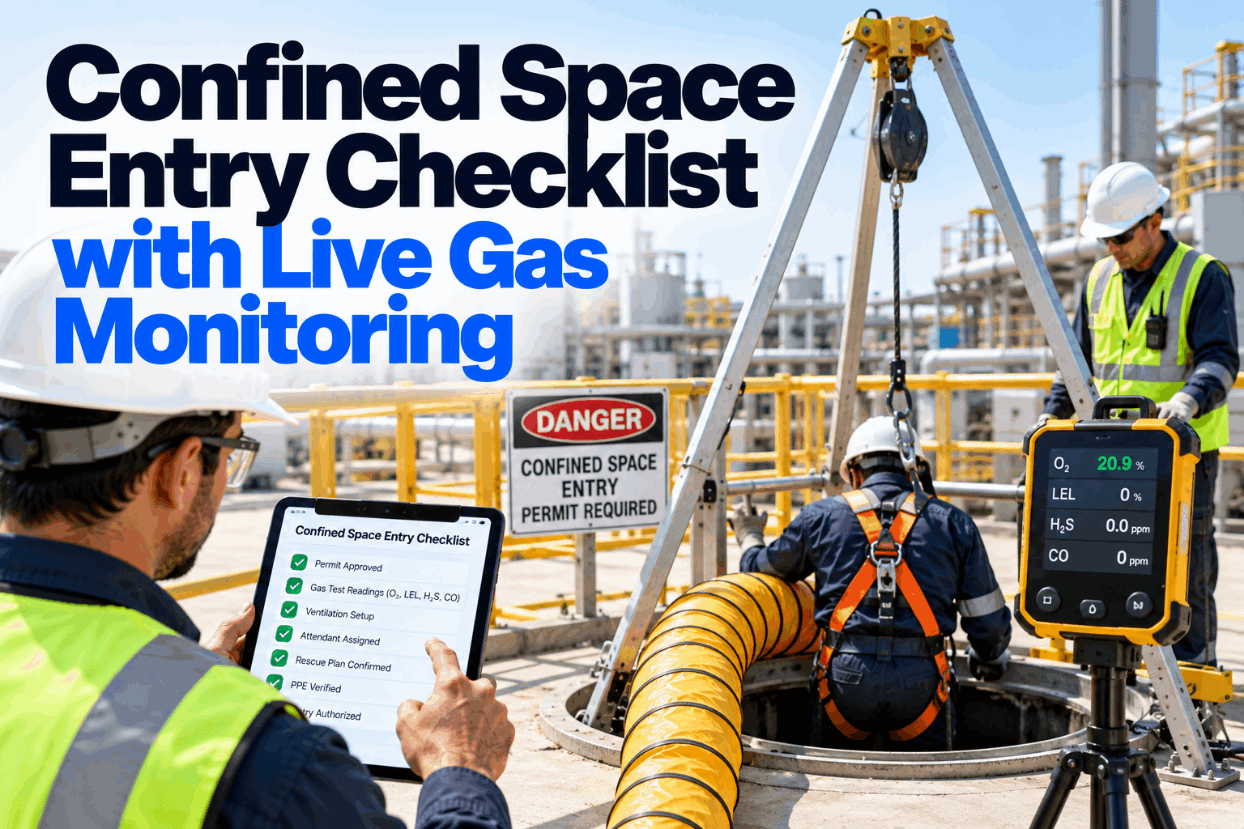
Connected gas monitors stream O2, LEL, H2S and CO readings into the permit. An alarm suspends entry automatically, attendants check entrants in by voice and the rescue plan is confirmed before anyone goes in.
- Why entries go wrong after the permit is signed
- The testing order and limits for entry
- A tick-box checklist from isolation to close
Why Confined Space Entries Go Wrong
Conditions change after the permit is signed.
OSHA 1910.146 defines a hazardous atmosphere and requires testing before entry and monitoring during it. Yet many permits record one reading at the start and nothing after. Work inside the space, such as cleaning, coating or welding, can change the air within minutes. NIOSH has long warned that a large share of confined space deaths are would-be rescuers who went in without protection. Our safety engineers can review your current permit.
One-time test
A single reading at sign-off, then none.
Wrong order
Toxics tested before oxygen and flammables.
Distracted attendant
The attendant takes on other tasks.
Rescue assumed
The plan says call 911, nothing more.
Atmospheric Testing: Order and Limits
Oxygen first, then flammables, then toxics.
Under 1910.146(c)(5) and Appendix B, test for oxygen first, because many sensors need oxygen to read correctly, then for flammable gas, then for toxic gases. Test at the top, middle and bottom, because gases layer by weight. Review your setpoints in a monitoring session.
Hydrogen sulfide is heavier than air and pools low. Methane is lighter and rises. A reading at the manway can look clean while the bottom of the tank is not. Record readings at each level on the permit.
Confined Space Entry Checklist
Tick each item before and during entry.
Use this checklist with your own permit form. Every item ties back to a requirement in 1910.146. In the digital version, each tick is time-stamped and the gas readings fill in on their own. Ask our support desk for a version mapped to your permit.
Keep Readings on the Permit All Shift
Connect your gas monitors once, and every entry carries its own live record from first test to close.
How Live Gas Monitoring Connects to the Permit
The monitor talks, the permit listens.
Connected monitors send readings to the permit as they happen. If any reading crosses its limit, entry is suspended, the attendant is alerted and the event is recorded. Nobody has to remember to write it down. See the flow in a live demo.
Pair
Monitor linked to the permit by scan.
Pre-entry test
Levels tested and logged in order.
Stream
Readings sent every few seconds.
Alarm
Entry suspended, attendant alerted.
Close
Readings saved with the cancelled permit.
Roles: Entrant, Attendant and Entry Supervisor
Three jobs, clearly split.
1910.146 gives each role its own duties. Problems start when one person tries to cover two. The digital permit names each person and checks they are trained for that role. Questions on roles go to our safety team.
Inside the space
Knows the hazards, uses equipment, alerts the attendant and leaves when told.
Outside the space
Counts entrants, watches conditions, calls rescue and never enters to rescue.
Authorizes entry
Checks the permit, confirms rescue and ends the entry when work is done.
Everyone leaves the space at once. Re-entry only after the cause is found and the permit is re-checked.
- A gas monitor alarms
- A monitor fails or loses signal
- The attendant has to leave
- Communication with entrants is lost
- A condition appears that the permit does not cover
- An evacuation alarm sounds elsewhere
Rescue Planning
Calling 911 is not a rescue plan.
1910.146(k) requires a rescue service that can respond in time for the hazards present, with the right equipment, and practice at least once every 12 months. For vertical entries deeper than five feet, a retrieval system is usually required. Plan rescue coverage in a rescue review.
A real rescue plan names
- Who responds and how fast
- How they will get in and out
- Equipment staged at the space
- When the plan was last practiced
Warning signs
- Rescue relies on the fire service with no visit
- Retrieval line not rigged
- Rescue practice older than a year
- Attendant trained to go in
How iFactory Runs the Confined Space Workflow
Live readings inside the permit.
iFactory’s Confined Space Workflow streams connected gas monitor readings into the permit, suspends entry automatically on alarm and lets attendants check entrants in and out by voice, on an on-prem server inside your plant. Fit questions go to our solutions team.
Live readings
O2, LEL, H2S and CO streamed into the permit.
Auto suspend
Entry suspended the moment a limit is crossed.
Voice check-in
Attendants log entrants in and out hands-free.
Rescue check
Permit will not issue without a confirmed plan.
Role checks
Training confirmed for each named role.
Full record
Readings, people and events saved with the permit.
Monitor compatibility and signal coverage vary by site. We confirm connected monitors and coverage in your spaces during the pilot.
Turnkey AI: Delivered, Connected and Live in 6–12 Weeks
You do not build this. It arrives ready.
iFactory ships as a pre-configured NVIDIA AI server with the software pre-loaded, racked and ready. Rack it, plug in power and Ethernet, and the AI is live on your network. Our team handles cabling, network setup, PLC, SCADA and CMMS integration, gas monitor pairing and permit set-up, operator training and 24×7 remote monitoring. Data stays on your network. For a scope matched to your plant, request a turnkey quote.
Ship, network and data
Server installed. Spaces listed. Gas monitors paired.
Permit set-up and pilot
Live readings and alarms tested on pilot entries.
Go-live and training
Live for all permit spaces. Attendants trained. 24×7 monitoring begins.
Frequently Asked Questions
What is a permit-required confined space?
A space large enough to enter, with limited entry and exit, not designed for continuous occupancy, that also has a serious hazard such as a hazardous atmosphere or engulfment risk.
What is the safe oxygen range?
Between 19.5% and 23.5% for entry under 1910.146.
In what order should gases be tested?
Oxygen first, then flammable gases, then toxic gases.
Can the attendant go in to help?
No. The attendant stays outside and calls rescue. Untrained rescuers are a common cause of confined space deaths.
How long are permits kept?
Canceled permits must be kept for at least one year for the annual program review.
Does the software replace gas monitors?
No. It connects to your monitors and records what they read.
How do we start?
List your permit spaces, pair two or three monitors and run a short pilot on planned entries. To plan it, contact our team.
Make Every Entry Visible
In thirty minutes we look at your permit form, gas monitors and rescue plans, and where readings get lost today. You keep the notes either way.
- 1Your confined space permit form
- 2A list of permit spaces
- 3Your gas monitor models
- 4Your rescue plan
- 5One entry that had a close call