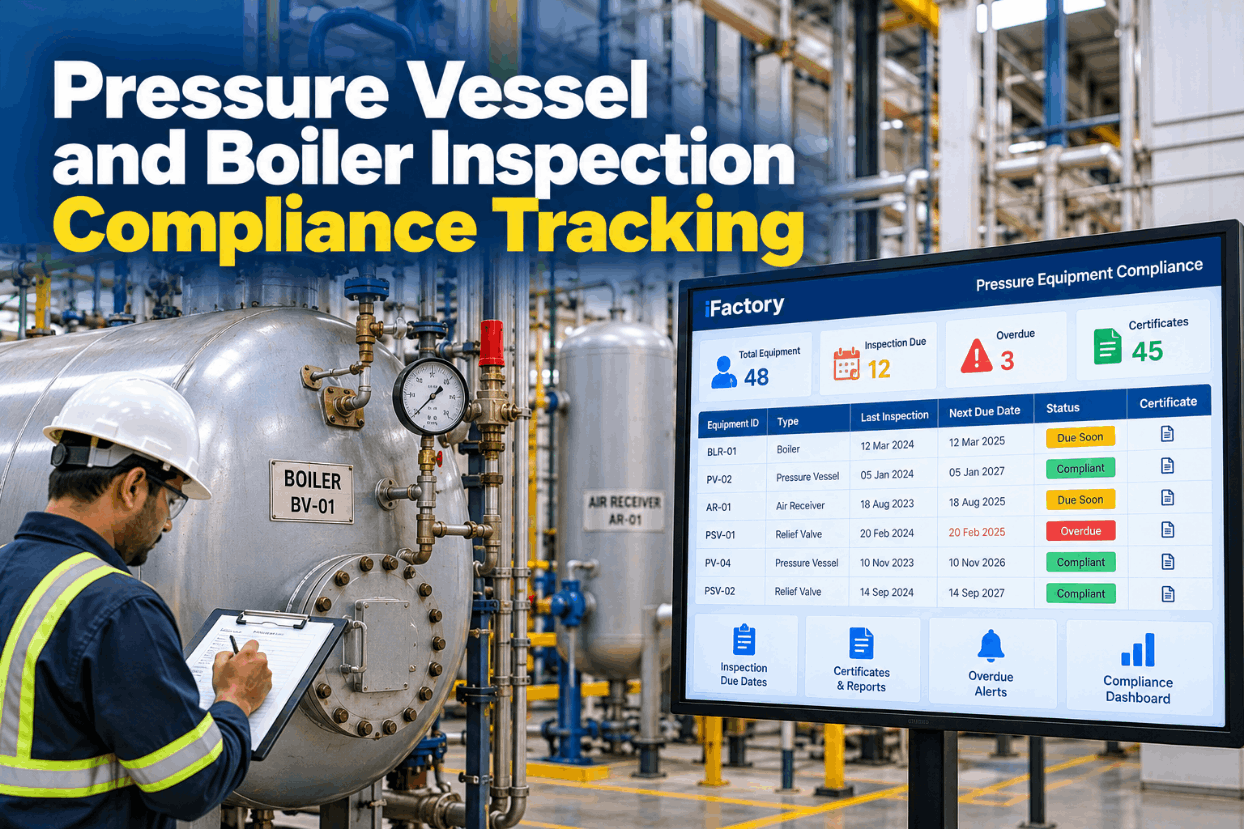
Pressure Vessel and Boiler Inspection Compliance Tracking

By Josh Brook on October 27, 2026

pressure-vessel-boiler-inspection-compliance-tracking

A plant with two boilers, a dozen air receivers and a row of jacketed kettles can carry forty or more inspection and relief valve due dates, each set by a different rule. Boiler certificates run on the state's clock, relief valves on a code cycle or your own program, and air receivers often on nobody's clock until one fails. When those dates live in a spreadsheet and a drawer of paper certificates, one of them slips. Keep every date and certificate in one place, and see how in a 30-minute pressure equipment register demo.

COMPLIANCE · PRESSURE EQUIPMENT

Every Boiler, Vessel and Relief Valve Due Date in One Register

The iFactory Pressure Equipment Register tracks jurisdictional inspection and PSV test due dates, keeps each certificate attached to its asset, and escalates anything overdue to maintenance and EHS at the same time. No more hunting for a certificate when the inspector walks in.

Pressure equipment register · Plant 238 items · 1 overdue
Illustration · four of 38 items shown, sorted by due date risk
Asset tagTypeJurisdiction due dateStatus
B-01Firetube steam boiler, 150 psiCertificate inspection · 14 Nov 2026Due in 19 days
PSV-B01-ABoiler safety valve, set 150 psiAnnual pressure test · 18 Oct 2026Overdue 8 days
V-12Jacketed kettle, unfired vesselExternal inspection · 09 Mar 2027Current
AR-03Air receiver, 240 galSafety valve test · 02 Dec 2026Scheduled
PSV-B01-A escalated to the maintenance planner and EHS lead · 07:00 today
PRESSURE EQUIPMENT REGISTER

Six Kinds of Equipment, Six Different Clocks

Pressure vessel inspection compliance starts with knowing what you own. Most plants find more than they expect once they walk the site: a heating boiler in the warehouse, a receiver behind the compressor house, an autoclave in the lab. Each class follows its own rule and its own due date, so each one needs its own line in the register. Walk your asset list through with our support team.

Power boilersSteam above 15 psi, built to ASME Section I. Usually the shortest inspection cycle
Low-pressure heating boilersSteam at 15 psi or less, or hot water heating, built to ASME Section IV
Unfired pressure vesselsKettles, retorts, autoclaves, heat exchangers and tanks under pressure
Air receiversCompressed air storage, covered by OSHA 1910.169 in general industry
Pressure relief devicesSafety valves, relief valves and rupture disks protecting each item
Certificates and reportsCertificates of operation, inspection reports, data reports and repair forms
BOILER INSPECTION CERTIFICATE

When the Certificate Lapses, So Does Your Permission to Run

After a passing inspection, the jurisdiction issues a certificate of operation for that one boiler or vessel. It is the first document an inspector or insurer asks to see, and it carries its own expiry date. Florida and Texas show how firm those dates are. Attach each certificate to its asset and let the expiry date drive the next due date. See certificate tracking on a sample site in a certificate walkthrough.

12 mo
Florida power boilersCertificate valid 12 months from the inspection date, also for high pressure, high temperature water boilers
24 mo
Florida heating boilersHeating and hot water supply boiler certificates run 24 months from the inspection date
Post
Shown in the boiler roomFlorida requires the certificate posted under glass, or similarly protected, in the room with the boiler
TX
Inspect before expiryTexas requires the certificate inspection before the current certificate expires, with late fees for certificates expiring from 1 December 2025
JURISDICTIONAL INSPECTION

The State Sets the Interval, Not the Code Book

In the US, most states and some cities adopt the ASME Boiler and Pressure Vessel Code for new construction and the National Board Inspection Code (NBIC) for in-service inspection and repair. The jurisdiction then decides how often each item is inspected and by whom, usually a state inspector or an authorized inspection agency working for your insurer. Washington's rule, WAC 296-104-100, is a clear example and is summarised below. Your own state may differ, so check the details with our code support team.

Equipment
External inspection
Internal inspection
Notes in the rule
Power boilers
Every year under pressure
Every year not under pressure
Owner-users in a National Board accredited program may extend the internal to as long as five years if conditions are met
Low-pressure boilers
Every 2 years in operation
Every 4th year where construction permits
Steam heating boilers also have the low-water fuel cutoff checked internally every two years
Unfired pressure vessels
Every 2 years
Every 2 years if subject to corrosion
No internal needed if not subject to corrosion; owner-user vessels may follow NBIC or API 510 intervals
Hot water heaters
Every 2 years
None required
Check your state's size and heat input limits, as small units are often outside the rule
RELIEF VALVE TESTING

PSV Recertification on the Right Cycle for Each Service

A boiler or vessel is only as safe as the device that stops it from over-pressurising. NBIC Part 2 gives recommended inspection and test frequencies for pressure relief devices, summarised here as California's pressure vessel unit lists them. For process vessels under an API 510 owner-user program, relief device intervals are set in the owner's own program, using API RP 576 guidance, service conditions and test history. Map each PSV to the right cycle in a relief valve review.

BOILER RELIEF VALVES · NBIC RECOMMENDED
  • Boilers under 400 psi: manual check every 6 months, pressure test every year
  • Boilers over 400 psi: pressure test every 3 years
  • High-temperature hot water boilers: pressure test every year
  • Low-pressure steam and hot water heating boilers: manual check every 3 months, pressure test every year before the heating season
VESSEL AND PIPING RELIEF VALVES · NBIC RECOMMENDED
  • Steam service: every year
  • Clean, dry air or gases: every 3 years
  • Propane or refrigerant service: every 5 years
  • Relief valve with a rupture disk: every 5 years
  • All other services: set from inspection history
Valve repairs go to a VR holder

The National Board VR symbol marks organisations accredited to repair pressure relief valves. Log the repair nameplate and test report against the PSV tag, so the next due date starts from the day the valve was actually tested.

Ask the Register What Is Due Before the Inspector Does

iFactory keeps each boiler, vessel, receiver and PSV on its own jurisdictional clock, with the certificate attached. Ask what comes due this quarter and get the list, with owners and booking status.

Plant 2 · Maintenance manager and iFactory
Maintenance managerWhat pressure items come due before year end?
iFactorySeven. Boiler B-01 certificate inspection on 14 Nov, five air receiver safety valve tests in December, and PSV-B01-A, already 8 days overdue.
Maintenance managerWho has the PSV?
iFactoryThe steam fitter crew, with the valve shop booked for Thursday. The EHS lead stays copied until the test report is attached.
AIR RECEIVER INSPECTION

Air Receivers, the Vessels Most Plants Forget

Compressed air receivers sit in corners and run for decades, which is exactly why they get missed. In general industry, OSHA 1910.169 says new receivers must be built to ASME Section VIII, never buried or placed out of reach, and fitted with a drain at the lowest point, a visible pressure gauge and spring-loaded safety valves. No valve of any kind may sit between a receiver and its safety valve, and safety valves must be tested frequently and at regular intervals. Use the walk-round below, then ask our support team how to log it.

01At the receiverEach round
02Safety valve and recordsEach test
NATIONAL BOARD REGISTRATION

R-Stamp Repairs and the Paper Trail Behind Them

Most US jurisdictions require pressure equipment to be registered with the National Board before it is installed. The manufacturer files a data report, and the item carries its National Board number for life. When a weld repair is needed, the work is done by a holder of the National Board R stamp under the NBIC, inspected by an authorized inspector and reported on Form R-1. Minnesota, for example, requires the owner to notify the chief boiler inspector, or the insurer, before each welded repair. Plan your repair records in a repair workflow session.

1FindAn inspection or operator report shows a defect on the item
2NotifyOwner tells the chief inspector or insurer, as the rule requires
3RepairAn R-stamp holder carries out the weld repair under the NBIC
4AcceptAn authorized inspector inspects and accepts the work
5FileForm R-1 attached to the asset, next due date confirmed
OUTSIDE THE US · PSSR 2000

A Written Scheme Instead of a State Calendar

Sites in Great Britain work to the Pressure Systems Safety Regulations 2000. PSSR covers systems above 0.5 bar and requires the user to have a written scheme of examination in place before a system is used. A competent person draws up or certifies the scheme, which sets what is examined, how and how often, then carries out the examinations. The register handles both models side by side: a state due date at one plant, a scheme interval at another. Ask our support team about multi-country sites.

ScopeSystems with a working pressure above 0.5 bar, such as air receivers, boilers, autoclaves and refrigeration
Written schemeIn place before use. Lists parts to examine, methods, intervals and preparation such as isolation
Competent personDraws up or certifies the scheme and examines at its intervals, often an insurer's engineer
RecordsScheme, examination reports and maintenance records kept and available to inspectors
PRESSURE VESSEL INSPECTION COMPLIANCE BEST PRACTICES

Due-Date Windows That Escalate Before Anything Expires

A due date nobody sees until the day it falls is a missed date. The register works back from each due date in windows you set, so the inspector, the valve shop and any outage are booked early. Anything past due goes to maintenance and EHS together until the report is attached. The windows below are an example only. Set your own in a workflow planning call.

90 days out
Planner notified to book the inspector or valve shop
60 days out
Outage window confirmed if an internal inspection is needed
30 days out
Owner reminded; gaskets and a spare PSV staged
Due date
Inspection or test done; report and certificate attached
Overdue
Escalated to the maintenance manager and EHS lead daily until closed
PRESSURE EQUIPMENT REGISTER TEMPLATE

One Record per Item, Filled In Once

Each line in the register holds the same core fields, so any item can be found by tag, National Board number or state number in seconds. Start from the fields below and add whatever your jurisdiction or insurer asks for. Ask our support team for a starter sheet.

Asset tag and locationB-01 · Boiler house
Type, code and MAWPFiretube boiler · ASME Section I · 150 psi
National Board numberFrom nameplate and data report
Jurisdiction and inspectorState inspector or insurer's agency
Certificate expiryFrom the certificate; drives the due date
Last internal and externalDates, with reports attached
Relief devicesPSV-B01-A · set 150 psi · last test
Owner and escalationMaintenance planner, then EHS lead
PRESSURE VESSEL INSPECTION COMPLIANCE COST AND ROI

Count the Hours Spent Chasing Paper

The value that matters most is the overdue item you never have, and nobody can price that honestly in advance. What you can measure is the time spent finding dates and certificates. Every input below is assumed, to show the arithmetic only. Build the case with your own figures in a value review call.

Pressure items in the register40, assumed
Minutes per item per month checking dates and files today15, assumed
Minutes per item per month with the register3, assumed
Time back each month40 × (15 − 3) = 480 min, or 8 hours

Count fewer late fees, a certificate ready for every inspector visit and a clean audit trail only where your own records support it.

TURNKEY AI DEPLOYMENT

Pressure Register and NVIDIA Server, Shipped Ready to Run

iFactory delivers the Pressure Equipment Register as a turnkey package. A pre-configured NVIDIA AI server ships racked and ready, with the register, a certificate and report reader, and CMMS connectors pre-loaded, so your records stay on site. You rack it, plug in power and Ethernet, and the AI is live. Ask our support team for a turnkey quote.

What's Included
  • Pre-configured NVIDIA AI server, racked and ready
  • Register for boilers, vessels, receivers and PSVs
  • Rule sets for your states or written schemes
  • Certificate reader that pulls expiry dates
  • CMMS link so due items become work orders
  • Overdue escalation to maintenance and EHS
  • 24×7 remote monitoring of models and hardware
Live in 6–12 weeks
Wk 1–4
Walk and Load

Site walk-down, nameplates captured, certificates and past reports loaded.

Wk 5–8
Rules and Windows

Jurisdiction intervals and PSV cycles set, due windows tested with planners.

Wk 9–12
Go-Live

Escalation switched on, planners and EHS trained, monthly compliance review started.

PRESSURE VESSEL INSPECTION COMPLIANCE FOR PLANT MANAGERS

Pressure Vessel Inspection Compliance Software That Knows Your Rules

Built for plants where a missed certificate can stop a boiler. See it on your own asset list in a register demo.

1
Every due date in one view. Boilers, vessels and receivers on their own jurisdictional clock.
2
Certificates attached. Each certificate and report sits on its asset, with the expiry read in.
3
PSVs tracked by tag. Test cycles by service, with repair and test reports logged.
4
Overdue goes to two desks. Maintenance and EHS are alerted together until the item closes.
1000+
Industrial clients running iFactory
99.9%
Platform uptime for plants that never stop
6-12 wks
From racked server to a live register
FREQUENTLY ASKED QUESTIONS

What Plant Managers Ask About Pressure Vessel and Boiler Compliance

How often must a pressure vessel or boiler be inspected?
It depends on the jurisdiction where it is installed. In Washington, for example, power boilers get an external and internal inspection every year, while unfired vessels get an external every two years and an internal every two years only if subject to corrosion. Other states set their own cycles, so the register stores the rule for each site. You can walk through your state's rules with us.
What is a boiler inspection certificate?
It is the certificate of operation the jurisdiction issues after a passing inspection. It applies to one specific boiler or vessel and has an expiry date. Florida, for example, makes power boiler certificates valid for 12 months and heating boiler certificates for 24 months, posted in the boiler room under glass or similar protection.
How often should relief valves be tested?
NBIC Part 2 recommends frequencies by service, such as a yearly pressure test for boilers under 400 psi, every year for steam service vessels and every three years for clean, dry air. Jurisdictions may adopt these or set their own, and API 510 owner-user programs set intervals from service and history. Our support team can help map your PSVs.
Does the register work for UK sites under PSSR?
Yes. For PSSR sites, the due dates come from the written scheme of examination your competent person draws up or certifies, rather than from a state rule. The register stores the scheme, its intervals and each examination report against the system it covers.
Who can repair a boiler or pressure vessel?
Welded repairs are normally done by a holder of the National Board R stamp under the NBIC, inspected by an authorized inspector and reported on Form R-1. Relief valve repairs go to a VR holder. The register keeps each R-1 and valve test report on the asset, and you can see that repair trail in a live demo.
How do we get started?
Walk the site and list every boiler, vessel, receiver and relief device with its nameplate data. Load the certificates and last reports, then set the jurisdiction rules and due windows. Book a 30-minute planning call to scope your first area.

No Expired Certificate, No Forgotten Relief Valve

Put every boiler, vessel, receiver and PSV on its own jurisdictional clock, with the certificate attached and overdue items escalated to maintenance and EHS. Delivered turnkey and live in 6 to 12 weeks.

Example monthly view · Plant 2
Items trackedBoilers, vessels, receivers, PSVs
Due in 90 days7 items, owners named
Overdue1, escalated to EHS
CertificatesAttached to every asset
Every date traced to a rule and a report

Share This Story, Choose Your Platform!