On a Toyota line, any worker who spots a defect can press a button and call for help — and if it is not fixed in time, stop the entire line. That is Andon, built on a simple lean idea: a problem made visible in seconds is far cheaper than one hidden until the end of the shift. A greenfield plant can design that instinct into its systems from day one, but the modern version is not a cord and a light tower. It is a digital, AI-driven Andon that triggers automatically, routes the right responder, escalates on its own, and turns every alert into data. This guide covers how to design one.
Designing the shop floor for a new plant? Book a 30-minute Andon design consultation to build digital, AI-driven alerting in from day one.
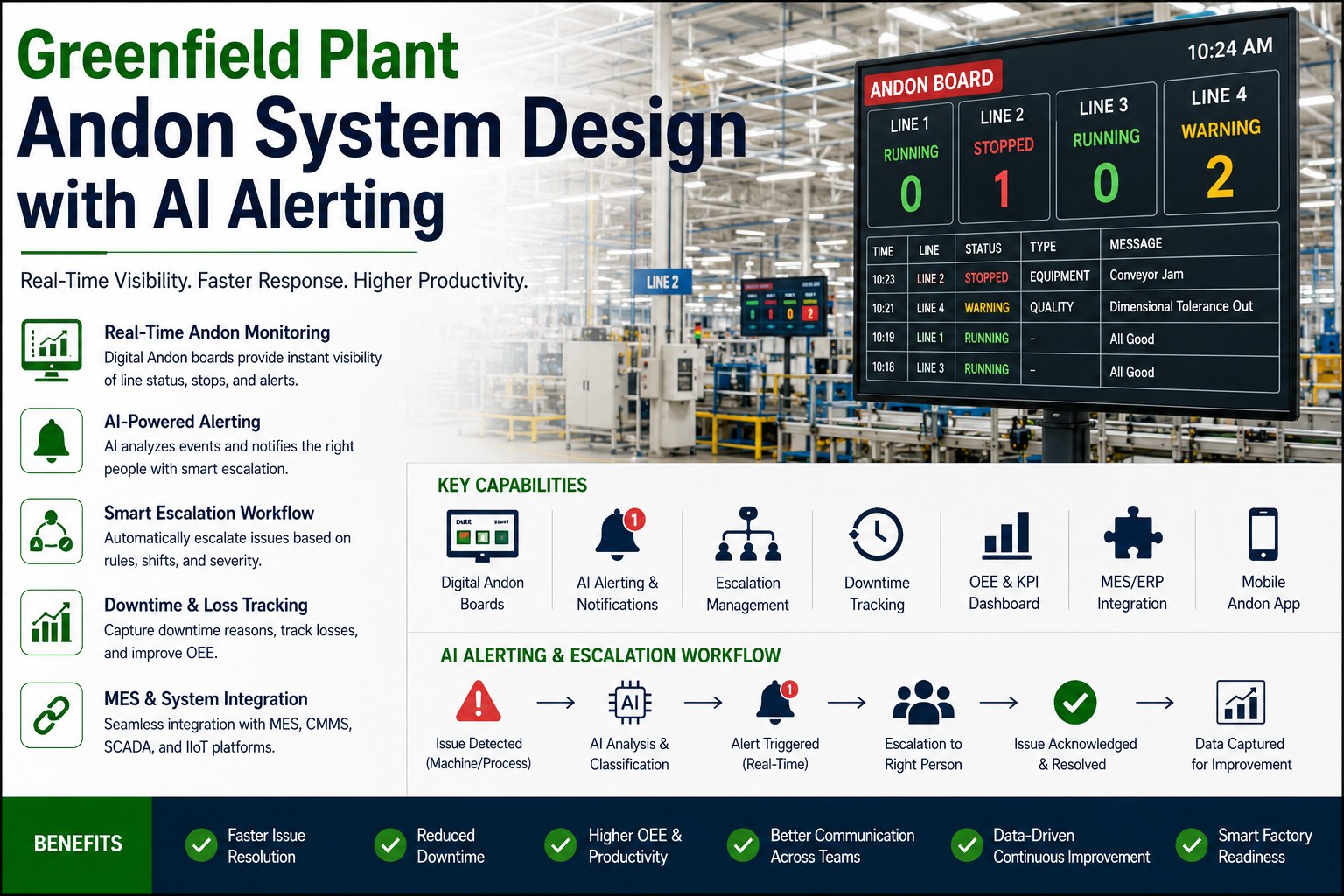
Line Status, Visible the Moment It Changes
A digital board shows every line at a glance and, unlike a stack light, remembers what happened — how long the stop lasted, who responded, and whether it has happened before.
What Andon Is and Why It Works
Andon takes its name from the Japanese word for a paper lantern, and Toyota built it into the production line in the 1950s as part of jidoka — the principle that any worker can halt production the instant something looks wrong. The mechanics are deliberately simple: an operator signals a problem, the board reflects it, and help comes to the workstation rather than the operator leaving to find it. Its power is cultural as much as technical, turning hidden problems into visible ones the whole team owns. Because andon only works if problems are surfaced the moment they happen, the system's job is to make the invisible visible and route it fast. If you want it designed for your lines and escalation tiers, you can map it with a smart-factory specialist.
lower defect rates at plants pairing andon with standardized work
typical window to respond before an unresolved call stops the line
the Toyota pillar andon is built on — automation with a human touch
From Light Towers to Digital Andon
The principle has not changed in seventy years, but the technology has. A stack light works when the right person is standing nearby; it falls short the moment a plant grows complex. Here is what digital and AI alerting add.
Replacing light towers with a connected system? Book a digital Andon walkthrough and see how alerts become trackable, analyzable data.
Designing the AI-Powered Andon System
A modern Andon system is six pieces working together — a board, a way to raise alerts, the intelligence to route them, an escalation engine, a record of every event, and a connection to the rest of the plant.
Digital Andon Boards
Live line status on floor screens and mobile, fed by PLC, SCADA, and MES — one source of truth, visible anywhere.
Automatic & Manual Triggers
Operators still raise alerts by button, but sensors and machines also auto-raise them on faults, downtime, or quality drift.
AI Alert Prioritization
AI ranks alerts by impact, routes each to the right responder, and cuts the alert fatigue that makes people tune signals out.
Escalation Workflows
If no one responds in the set window, the alert climbs automatically to a backup, then a supervisor, then a manager.
Downtime & Reason Tracking
Every event is logged with a reason code, duration, and owner — turning andon calls into downtime and OEE data.
MES Integration
Alerts inherit context from MES: the work order, product, machine parameters, and recent maintenance history.
Want AI routing and escalation scoped to your roles? Book an alerting design session and we will map triggers, priorities, and responders for your lines.
Escalation Workflows: Who Gets Called, and When
The point of escalation is that no call goes unanswered. Each tier has a window; if the problem is not resolved, the system climbs to the next one on its own — something a stack light could never do.
Operator
Raises the alert at the station, by button or automatic trigger, the moment a problem appears.
Team Lead
First responder, assesses and resolves within the window; if fixed, the line keeps running.
Supervisor
Notified automatically, brings maintenance or resources, and may stop the line to protect quality.
Plant Manager
Escalated for major or repeat losses, owning the response and the root-cause fix that follows.
Turn Every Alert Into Action and Data
iFactory brings digital Andon boards, automatic triggering, AI alert routing, and escalation together with MES on one platform — so a new plant surfaces problems in seconds and learns from every one of them.
Expert Perspective
People think Andon is about the lights, but the lights are the least interesting part. The real shift is that you stop hiding problems. A stack light tells you Line 3 needs help right now; it cannot tell you that Line 3 needed help eleven times this week, always for the same feeder, always at shift change. Digital Andon turns each pull into a timestamped record, and suddenly you are not just reacting — you are seeing patterns. That is where the value compounds. The first benefit is faster response. The second, and bigger one, is that the data points straight at the root cause. A greenfield plant gets to build that loop in from the first shift, instead of bolting analytics onto light towers years later.
— Smart Factory Practice, iFactory Engineering Team
a short pause now beats an expensive defect downstream
every digital andon call becomes analyzable data
the root-cause methods andon data feeds
The Bottom Line
Andon is one of the most durable ideas in manufacturing: make problems visible the instant they happen, and bring help to them fast. The principle is unchanged, but the implementation has moved on. A digital, AI-driven Andon triggers automatically, shows status on any screen, routes alerts to the right person, escalates when no one answers, and records every event so the same problem stops recurring. For a greenfield plant, the choice is not whether to use Andon but whether to build the modern version in from day one — with MES integration, escalation tiers, and analytics designed in — rather than wiring light towers you will outgrow. Design it in, and the plant gets faster and smarter with every alert.
Build Smart Andon Into Your Plant
From digital boards and automatic triggers to AI routing, escalation tiers, and MES integration, iFactory helps greenfield teams design an Andon system that surfaces problems in seconds and turns every alert into a lasting improvement — from the first shift.
Frequently Asked Questions
What is an Andon system in manufacturing?
Andon is a visual signaling system from the Toyota Production System that lets any worker flag a problem on a production line the moment it occurs. It is a pillar of jidoka, the lean principle that production should stop to fix abnormalities rather than let defects pass downstream. An operator raises an alert, a board reflects the line's status, and help comes to the workstation. The goal is to make problems visible instantly so they are solved at the source.
What do the Andon colors mean?
A traditional Andon board works like a stoplight. Green means the line is running normally, amber or yellow means a worker needs help or attention, and red means the line has stopped for a problem that must be resolved before production continues. Some plants add further colors for categories like quality holds or material calls. Digital boards keep the same meaning but can show far more detail, such as the reason, the elapsed time, and who is responding.
How is a digital Andon different from traditional Andon?
A traditional Andon uses physical stack lights that are visible only nearby and log nothing. A digital Andon connects to the plant's systems, so alerts can be triggered automatically by sensors and MES as well as by operators, shown on any screen or mobile device, escalated on a timer, and recorded as data. That record is the big difference: every alert is timestamped and tracked, which lets teams find recurring problems and eliminate root causes rather than just reacting.
How does Andon escalation work?
Escalation ensures no alert is missed. When a call is raised, a first responder such as a team leader has a set window to resolve it. If the problem is still open when that window expires, the system automatically notifies the next tier — a backup, then a supervisor, then a manager — often with the option to stop the line. This tiered, timer-based escalation is something stack lights cannot do, and it is one of the main reasons plants move to digital Andon.
How does iFactory help design an Andon system?
iFactory brings digital Andon boards, automatic and manual triggers, AI alert prioritization, escalation workflows, and downtime tracking together with MES on one platform, and its greenfield advisory helps design the triggers, tiers, and integrations into the plant from the start. The result is an Andon system that both responds in seconds and feeds continuous improvement. You can book a consultation to plan it for your facility.