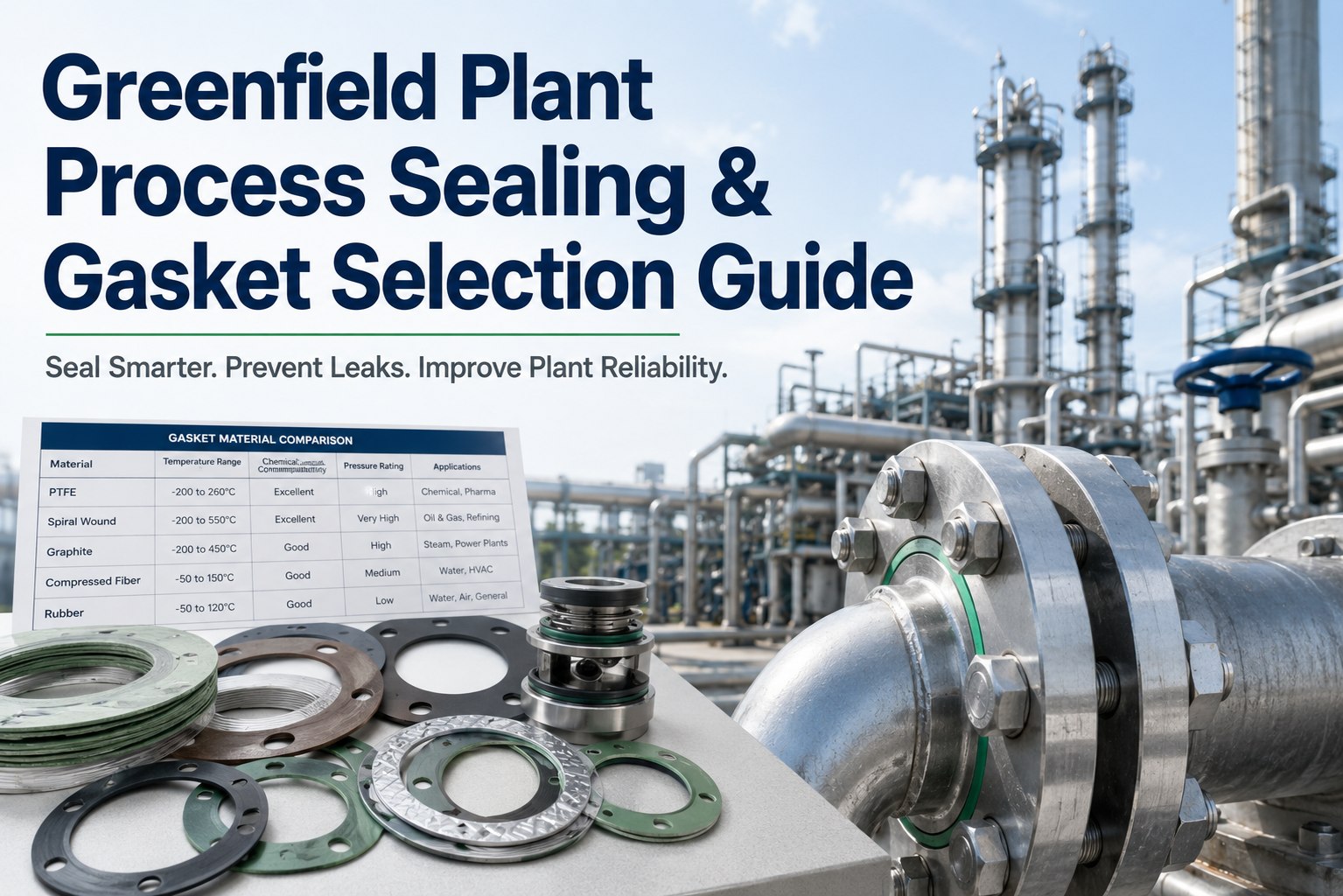
A process plant is held together by its seals. Thousands of flanged joints and hundreds of rotating shafts, each one a place where pressure, product, and emissions can escape — and each one sealed by a part that often costs a few dollars. A gasket is cheap until it leaks, and then it becomes the most expensive component in the plant: lost product, a safety event, a fugitive-emission violation, an unplanned shutdown. Most of those leaks trace back to choices made at design and assembly, not to bad luck. This guide covers how to select gaskets and seals for a greenfield plant, and how to keep them tight.
Specifying seals for a new plant? Book a 30-minute sealing and reliability consultation to get gasket and seal selection right from the flange schedule.
A Gasket Is the Cheapest Part Doing the Hardest Job
The whole joint depends on the right gasket, compressed by the right bolt load, against clean flange faces. Get any one of those wrong and the seam leaks — which is why most flange leaks are decided at selection and bolt-up.
Why Sealing Is a Reliability and Emissions Problem
Sealing rarely gets the attention of the big rotating equipment, yet it drives an outsized share of a plant's leaks, lost product, and emissions. A modern facility has thousands of flanged joints and hundreds of rotating seals, and each one is a potential fugitive-emission source that regulators now track. The encouraging part is that most leaks are designed and assembled in, not inevitable, so getting selection and bolt-up right up front is the cheapest reliability you will ever buy. If you want it scoped for your service conditions, you can map it with a reliability specialist.
of gasket failures trace to improper bolting — torque or sequence
of chemical-plant gasket failures come from the wrong material choice
pressure a metallic ring-type-joint gasket can seal at the extreme end
Static vs Dynamic: Two Sealing Problems
Process sealing divides cleanly in two, and the two halves use different parts, standards, and failure modes. A greenfield design has to plan for both.
Static Sealing — Gaskets
ASME B16.20 / B16.21Seal between two stationary surfaces — pipe flanges, vessel covers, heat exchangers — held by bolt load.
The leak risk is the joint itself: wrong gasket, wrong material, or wrong bolt-up.
Dynamic Sealing — Mechanical Seals
API 682Seal a rotating shaft on pumps, compressors, and agitators, with two lapped faces running against each other.
Mechanical-seal failure is the single leading cause of pump downtime in process plants.
Choosing the Right Gasket: Material to Duty
Gasket families climb in capability as pressure and temperature rise. The right choice starts from the flange face type and class, then matches material to the media and the duty.
Spiral-wound and ring-type-joint gaskets need the matching flange face — get the face type, class, and centering ring right, or even the correct material will leak.
Building a flange and seal schedule for your plant? Book a selection workshop and we will match gasket and seal type to every service.
Sealing for Low Emissions and Reliability
Selecting the right part is half the job; keeping it tight for years is the other half. Four practices, built in from the design, decide whether a plant stays leak-free and emissions-compliant.
Controlled Bolt-Up
The single biggest leak fix: correct torque, tightening sequence, and calibrated tools per ASME PCC-1, by trained technicians.
Low-Emission Sealing
Fugitive-emission-rated gaskets and valve packing, tested to API 622 and ISO 15848, to meet tightening leak-detection limits.
Mechanical Seal Reliability
The right seal arrangement, face materials, and flush plan to API 682 keep rotating equipment running leak-free for longer.
Predictive Leak Monitoring
Acoustic and gas sensing plus mechanical-seal condition data catch a developing leak before it becomes a release.
Want leak and seal monitoring designed in from day one? Book a reliability demo and see seal health and emissions on one screen.
Build a Plant That Stays Sealed
iFactory helps greenfield teams standardize gasket and seal selection, capture bolt-up and seal records, and monitor leaks and seal health continuously — so the reliability you design in is the reliability you keep, and emissions stay within limits.
Expert Perspective
The thing people underestimate about sealing is how little of it is about the gasket itself. You can spend on the best spiral-wound gasket money can buy, and it will still leak if it is the wrong size for the face, if the flange is warped, or if it is bolted up by hand without a torque sequence. The data bears this out — most failures come down to installation and material selection, not the part. On a greenfield plant you have the rare chance to standardize the right gaskets and seals against your service conditions, write the bolt-up procedures, and instrument the joints and shafts that matter most. Do that, and sealing stops being a recurring leak list and becomes a reliability advantage.
— Reliability Engineering Practice, iFactory Engineering Team
mechanical-seal failure is the top cause of pump downtime
the flange-assembly standard behind leak-free bolt-up
the mechanical-seal standard for process pumps
The Bottom Line
Sealing is a small line item that controls a large share of a plant's reliability, emissions, and safety. Choose the gasket family for the duty — soft non-metallic for moderate service, semi-metallic for high pressure and temperature, metallic ring-type-joint for the extremes — and match it to the flange face, the media, and the right mechanical seal for every rotating shaft. Then bolt it up properly, specify low-emission parts where regulations demand, and monitor the joints and seals that matter. A greenfield plant lets you make all of those decisions once, deliberately, before the first leak — which is exactly when sealing is cheapest to get right.
Design Sealing In, Not as a Repair List
From gasket and mechanical-seal selection and bolt-up standards to fugitive-emission control and predictive leak monitoring, iFactory helps greenfield teams build a plant that stays tight, compliant, and reliable from the first joint.
Frequently Asked Questions
How do I choose the right gasket for a flange?
Start from the flange face type and pressure class, then match the gasket family to the duty: soft non-metallic for low to moderate service, semi-metallic such as spiral wound for high pressure and temperature, and metallic ring-type-joint for the extremes. Confirm the gasket material is compatible with the process media and temperature, verify it meets the relevant ASME B16.20 or B16.21 dimensions, and make sure the centering and ring details suit the flange. The wrong face match or material will leak even when the family is right.
What's the difference between a gasket and a mechanical seal?
A gasket is a static seal that fills the gap between two stationary surfaces, like two pipe flanges, and is held in place by bolt load. A mechanical seal is a dynamic seal that contains fluid around a rotating shaft, such as a pump or compressor shaft, using two precisely lapped faces that run against each other. They solve different problems, follow different standards, and fail in different ways, so a plant needs a deliberate strategy for both.
Why do gaskets fail?
The leading cause is improper bolting — wrong torque or tightening sequence — which accounts for a large share of all gasket failures. Incompatible material selection is the next biggest, especially in chemical service, followed by creep relaxation at high temperature, thermal cycling and vibration, and chemical attack on the filler. A damaged or wrongly sized gasket will leak no matter how carefully it is installed, which is why selection and bolt-up matter most.
What are low-emission gaskets and why do they matter?
Low-emission gaskets and valve packing are sealing products tested to demonstrate very low leak rates of volatile compounds, helping plants meet fugitive-emission rules and leak-detection-and-repair programs. Standards like API 622 for valve packing and ISO 15848 define the testing. As emission limits tighten, facilities increasingly specify these parts on new joints and swap them in during turnarounds, since flanges and valves are among the largest fugitive-emission sources in a plant.
How does iFactory help with sealing reliability?
iFactory's greenfield advisory helps standardize gasket and seal selection against your service conditions and capture bolt-up and seal records, while its platform monitors leaks and mechanical-seal health to catch problems before they become releases. The same data supports fugitive-emission compliance and predictive maintenance across the plant. You can book a consultation to plan it for your facility.