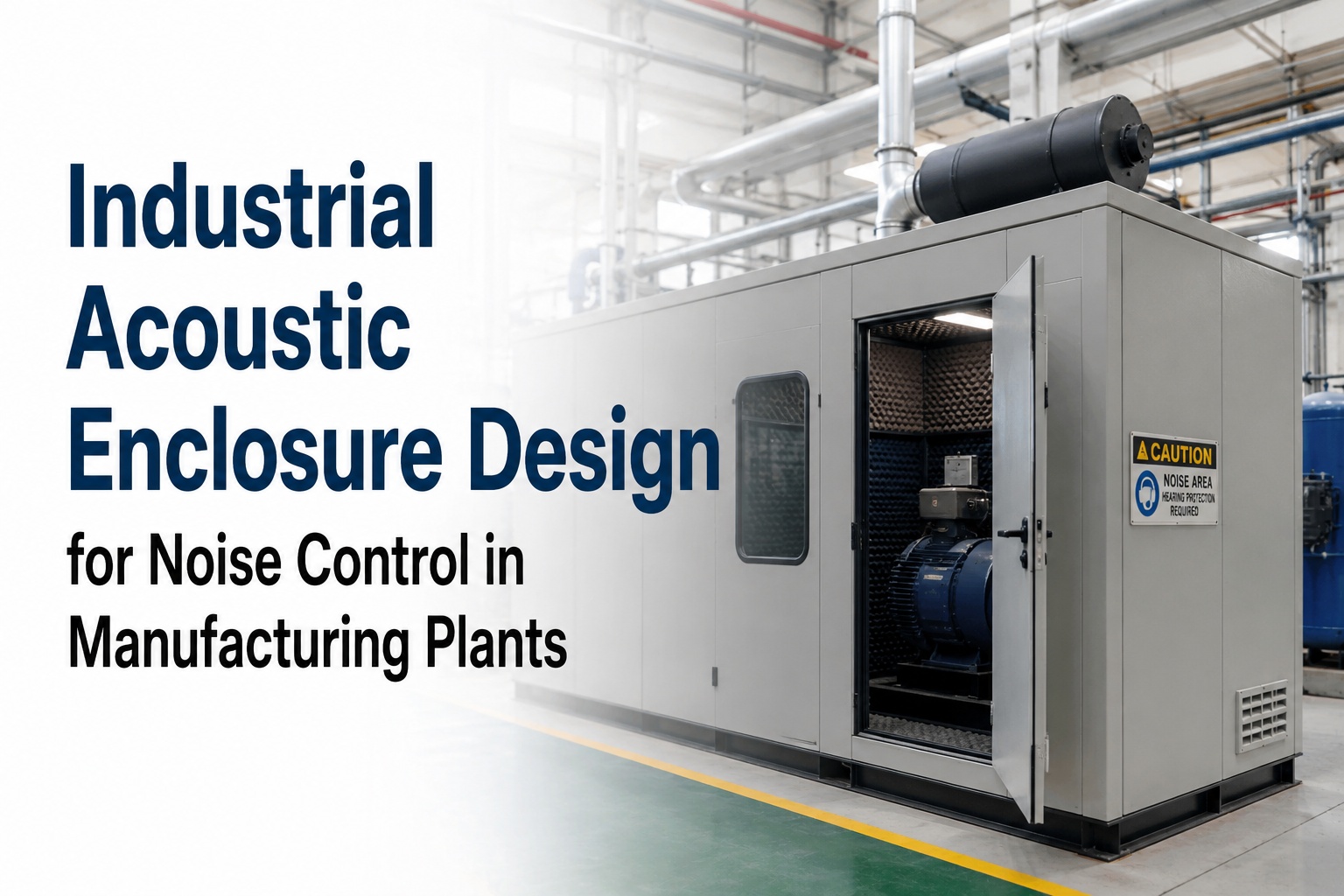
Industrial noise is the most pervasive occupational hazard in manufacturing facilities — and the most consistently underaddressed. OSHA requires hearing conservation programs the moment any worker is exposed to 85 dBA or higher over an eight-hour shift, and sets a permissible exposure limit of 90 dBA. A large industrial compressor typically emits 95–105 dBA at one meter. A diesel generator produces 100–105 dBA. An unenclosed stamping press can reach 110 dBA or higher. The gap between what industrial equipment generates and what OSHA permits is closed by one engineering discipline: acoustic enclosure design.
Design your facility's acoustic enclosure strategy with iFactory — we integrate noise mapping, enclosure specification, and OSHA compliance tracking into your plant layout from the FEED stage.
Acoustic Reference Scale
Industrial Noise Sources vs. OSHA Exposure Limits
Every dB above the action level compounds hearing damage risk — acoustic enclosures close the gap between source and compliance
-
Office / Control Room
-
Light Conveyor / Assembly
-
HVAC / Fan Room
-
Air Compressor (unenclosed)
-
Diesel Generator (open-frame)
-
Stamping Press / Impact Equipment
OSHA 29 CFR 1910.95: What Compliance Actually Requires
OSHA's occupational noise standard (29 CFR 1910.95) follows a two-threshold structure that many facility managers conflate. Understanding the distinction between the action level and the permissible exposure limit — and the different obligations each triggers — is the starting point for any acoustic enclosure design program.
Time-weighted average over 8 hours
- Hearing Conservation Program (HCP) must be established
- Audiometric testing program required for exposed workers
- Noise exposure monitoring and documentation
- Employee training on noise hazards and protection
Hearing protection is offered but not mandated at this level — engineering controls are the preferred first response.
8-hr TWA — 140 dB peak impulse
- Engineering or administrative controls are mandatory
- Hearing protection must be provided and used
- Violations can trigger citations and fines — up to $15,625 per violation
- Exposure duration halves for every 5 dBA increase above 90
At 95 dBA, maximum permissible exposure drops to 4 hours. At 100 dBA — 2 hours. At 110 dBA — 30 minutes.
typical insertion loss from a well-designed full acoustic enclosure — compressor from 100 dBA to 80 dBA
maximum insertion loss achievable with high-performance rigid panel enclosures for test cells and generators
sound level reduction for every doubling of distance from source — the inverse-square law in factory layouts
noise reduction achievable from a partial (3-sided) barrier wall for accessible equipment areas
Need to know which of your equipment requires enclosures under OSHA 29 CFR 1910.95? Book a compliance gap analysis with iFactory — we cross-reference your equipment noise data against OSHA thresholds and worker exposure durations.
Acoustic Enclosure Design: The Four-Layer Engineering Approach
Effective industrial noise control is not a single material decision. An enclosure that achieves 20 dB or more of insertion loss under real factory conditions requires four engineering layers working together — and it is the interaction between these layers (not any individual material) that determines actual performance. Enclosures that achieve lab-certified STC ratings but deliver only half that insertion loss on-site almost always have a failure in one of these four layers.
Mass Barrier Layer
Blocks airborne sound transmission
The primary noise barrier — dense material (steel, mass-loaded vinyl, composite panels) that resists sound transmission. Performance measured by Sound Transmission Class (STC). Every 6 dB increase in STC requires approximately doubling the panel surface mass. Low-frequency noise below 250 Hz (common in compressors and generators) requires heavy mass barriers; lightweight panels are ineffective at these frequencies.
- Metric: STC (Sound Transmission Class)
- Target: STC 30–50 depending on required IL
- Key failure mode: Gaps, penetrations, lightweight panels at low frequency
Absorptive Interior Lining
Reduces internal reverberation
Without internal absorption, hard-walled enclosures create reverberant fields that increase the sound pressure on the enclosure walls — reducing effective insertion loss by 5–10 dB compared to theoretical values. Absorptive materials (mineral fiber, foam composites, acoustic tiles with NRC 0.80–1.00) lining the interior walls reduce the reverberant buildup and protect the barrier layer's performance. Most effective above 500 Hz.
- Metric: NRC (Noise Reduction Coefficient)
- Target: NRC 0.80–1.00 for manufacturing spaces
- Key failure mode: Absorptive lining omitted to cut cost; hard internal surfaces
Vibration Isolation
Severs structure-borne transmission path
Equipment mounted on rigid floor connections transmits vibration energy structurally into surrounding floors and walls — where it re-radiates as airborne noise beyond the enclosure perimeter. Anti-vibration mounts (elastomeric pads, spring isolators, pneumatic isolators) interrupt this structure-borne path. Neglecting vibration isolation allows noise to bypass the airborne enclosure entirely, limiting effective insertion loss regardless of panel STC rating.
- Metric: Insertion Loss at dominant frequency
- Mount type: Matched to equipment weight and RPM
- Key failure mode: Rigid connections between machine and structure
Ventilation Acoustic Treatment
Maintains airflow without sound flanking
Compressors and generators produce significant heat — a large standby generator may require 20,000+ CFM of airflow. Every ventilation opening is a direct acoustic leak path that flanks the barrier layer. Acoustically treated louvers, baffled silencer channels, and duct-lined attenuators allow airflow while maintaining enclosure insertion loss. Correctly designed ventilation systems add only 1–3 dB penalty to enclosure performance versus an unventilated design.
- Method: Baffled silencer splitters or lined attenuator ducts
- Target: ≤3 dB IL penalty vs. unventilated design
- Key failure mode: Unlined duct connections; insufficient baffle depth
Need the four-layer enclosure approach applied to a specific piece of equipment? Book an enclosure design session with iFactory — we specify STC panel, NRC lining, vibration isolation type, and ventilation treatment for your compressor, generator, or press room in one session.
OSHA-Compliant Noise Control Designed Into Your Facility From Day One
iFactory integrates noise mapping, acoustic enclosure specifications, OSHA compliance tracking, and worker exposure monitoring into your greenfield facility design — so every noise source is controlled before your first employee enters the plant, not after your first OSHA inspection.
Noise Mapping: The Starting Point for Every Acoustic Design
No enclosure can be correctly specified without first knowing the noise source characteristics: the overall dBA level, the frequency spectrum (which determines whether mass barriers or absorptive treatment are the primary tool), the directional emission pattern, and the contribution of structure-borne transmission. Noise mapping provides this data for every equipment source in the facility and generates the acoustic model that drives enclosure specifications.
-
Source Identification & Frequency Analysis
Every significant noise source is identified, located, and characterized with a sound level meter or real-time analyzer measuring both overall dBA level and the octave-band spectrum from 63 Hz to 8,000 Hz. The frequency spectrum determines design priority: low-frequency noise (<250 Hz) requires mass-heavy barriers; mid-to-high frequency (>2,000 Hz) responds well to absorptive treatment.
Output: Frequency-resolved noise profile per source
-
Worker Exposure Dose Calculation
OSHA calculates exposure as a time-weighted average (TWA) combining noise level and duration. For each worker role, the actual time spent at each noise level is mapped to compute the 8-hour TWA. This determines which sources require enclosure (those contributing most to the TWA above 85 dBA) and which require administrative controls or relocation.
Output: Per-role TWA exposure map with compliance gap identification
-
3D Propagation Modeling
Sound propagates in three dimensions and interacts with reflective surfaces — floors, walls, machinery housings, and structural framing. A 3D acoustic model simulates how noise from each source travels through the facility, accounting for the inverse-square law decay, reflections, and the cumulative contribution from multiple sources at any given worker location. This model identifies the residual noise level at every workstation after proposed enclosures are applied.
Output: Noise heat map across facility floor plan before and after enclosures
-
Enclosure Specification & Verification
From the 3D model, the required insertion loss for each enclosure is calculated as: IL = Source Level − Target Level + Safety Margin (typically 3–5 dB). This IL value, combined with the frequency spectrum of the source, drives the STC and NRC specification for each enclosure. Post-installation verification measurements confirm that installed performance matches the design model — and flag any flanking paths (gaps, penetrations, rigid connections) that are degrading real-world insertion loss.
Output: Per-enclosure STC/NRC specification and post-installation verification protocol
Need a noise mapping assessment for your facility? Talk to iFactory's acoustic engineering team — we perform source identification, frequency analysis, and 3D propagation modeling using your equipment data and plant layout before any enclosure is specified.
Expert Perspective
The most common failure mode we see in industrial acoustic enclosures is not inadequate panel STC — it is a single flanking path that drops actual insertion loss from 25 dB to 12 dB. A one-centimeter gap around a pipe penetration. A rigid conduit connecting the machine structure to the wall. An unlined ventilation duct. The acoustic principle at work is the weakest link rule: a small area of high transmission loss surrounded by a small area of low transmission loss is dominated by the low performance. Building a $40,000 enclosure and then drilling an unlined hole in the wall is not a hypothetical scenario. We see it in every post-installation audit that underperforms its design.
insertion loss from custom transformer enclosures in documented utility deployment
OSHA action level that triggers mandatory Hearing Conservation Programs — often exceeded at unenclosed compressors
maximum insertion loss achievable with premium rigid-panel acoustic enclosures for engine test cells
From Noise Map to OSHA-Compliant Facility — Designed Before First Startup
iFactory's facility design service integrates acoustic noise mapping, enclosure specification (STC, NRC, vibration isolation, ventilation treatment), worker exposure dose calculation, and OSHA 29 CFR 1910.95 compliance verification into your greenfield plant design — so your facility is demonstrably compliant before a single worker enters the production floor.
Frequently Asked Questions
What is insertion loss and how is it different from STC for industrial enclosures?
Insertion Loss (IL) is a field measurement: the actual reduction in sound level at a specific point when an enclosure is installed around a noise source — measured in dBA under real operating conditions. Sound Transmission Class (STC) is a laboratory rating of a panel's ability to block sound transmission across a standard frequency range, following ASTM E90 test protocol. STC is determined in controlled lab conditions without the effects of gaps, penetrations, ventilation openings, vibration flanking, or reverberant field buildup inside the enclosure. In real industrial installations, actual insertion loss is typically 5–15 dB lower than the theoretical value calculated from the panel STC alone. The difference is caused by the flanking paths: unlined duct connections, gaps around pipes, rigid floor connections transmitting structure-borne noise, and internal reverberant fields. The IL specification is the correct design target; the STC specification drives the panel selection to achieve it.
How much noise reduction does an acoustic enclosure provide for a compressor or generator?
A well-designed full acoustic enclosure with mass barrier panels, absorptive interior lining, vibration isolation, and acoustically treated ventilation achieves 20–30 dB of insertion loss for compressors and generators in typical industrial installations. High-performance rigid panel enclosures for engine test cells or critical equipment can achieve 40–50 dB. A partial enclosure (3-sided barrier wall) provides 10–15 dB reduction. A single layer of mass-loaded vinyl acoustic blanket without a full enclosure provides 5–10 dB. For a compressor emitting 100 dBA, a 20 dB reduction brings the level to 80 dBA — below the OSHA 85 dBA action level — eliminating the Hearing Conservation Program requirement for workers in that area. For a generator at 105 dBA, a 20 dB enclosure achieves 85 dBA — at the action level threshold — which may still require HCP enrollment depending on worker exposure duration.
What is noise mapping and when is it required for manufacturing plants?
Noise mapping is a systematic measurement and modeling process that characterizes the sound level at every location in a facility, identifies which workers are exposed to what noise levels for how long, and calculates the time-weighted average (TWA) exposure for each worker role. OSHA requires initial noise monitoring when there is reason to believe any employee's noise exposure may equal or exceed 85 dBA TWA — which is the case for virtually any manufacturing facility with mechanical equipment. Noise mapping is required as the basis for establishing whether the action level or PEL applies to specific work areas. For greenfield plants, noise mapping is performed during the design phase using manufacturer equipment noise data and 3D acoustic propagation models — before any equipment is installed — so enclosure specifications, workstation locations, and administrative controls can be optimized in the design rather than retrofitted after construction.
How do you ventilate an acoustic enclosure without losing insertion loss?
Every ventilation opening in an acoustic enclosure is a direct acoustic flanking path that bypasses the barrier layer. The standard engineering solution is an acoustically treated attenuator or baffled silencer splitter integrated into the ventilation pathway. These devices consist of parallel baffles lined with sound-absorbing material that allow airflow through the channels while attenuating sound propagation along the same path. The attenuation per meter of baffle length depends on the baffle depth, spacing, and lining material — typically 5–15 dB/m at frequencies above 500 Hz. Correctly designed ventilation attenuators add only 1–3 dB penalty to the enclosure's overall insertion loss while maintaining the required airflow rate. The critical design constraint is pressure drop: every baffle adds resistance to airflow, so the ventilation system must be designed with sufficient static pressure to overcome the added resistance while delivering the required CFM to prevent equipment overheating.
What is the difference between sound absorption (NRC) and sound blocking (STC) in enclosure design?
Sound absorption and sound blocking address two different acoustic problems that both contribute to noise control performance. Sound blocking (characterized by STC) describes a material's ability to prevent sound from passing through it — dense, heavy materials block more sound because mass resists the pressure variations that transmit airborne noise. Sound absorption (characterized by NRC) describes a material's ability to convert incident sound energy into heat rather than reflecting it — soft, porous materials absorb sound because their open structure creates friction that dissipates acoustic energy. In an enclosure, both are needed. The outer barrier layer must block sound transmission to the outside (high STC). The inner lining must absorb sound inside the enclosure to prevent the reverberant field from building up and increasing the pressure on the barrier wall (high NRC, typically 0.80–1.00 for manufacturing environments). An enclosure with high STC panels but no interior absorption will underperform its theoretical insertion loss by 5–10 dB due to the reverberant buildup — one of the most common design oversights in industrial acoustic enclosures.