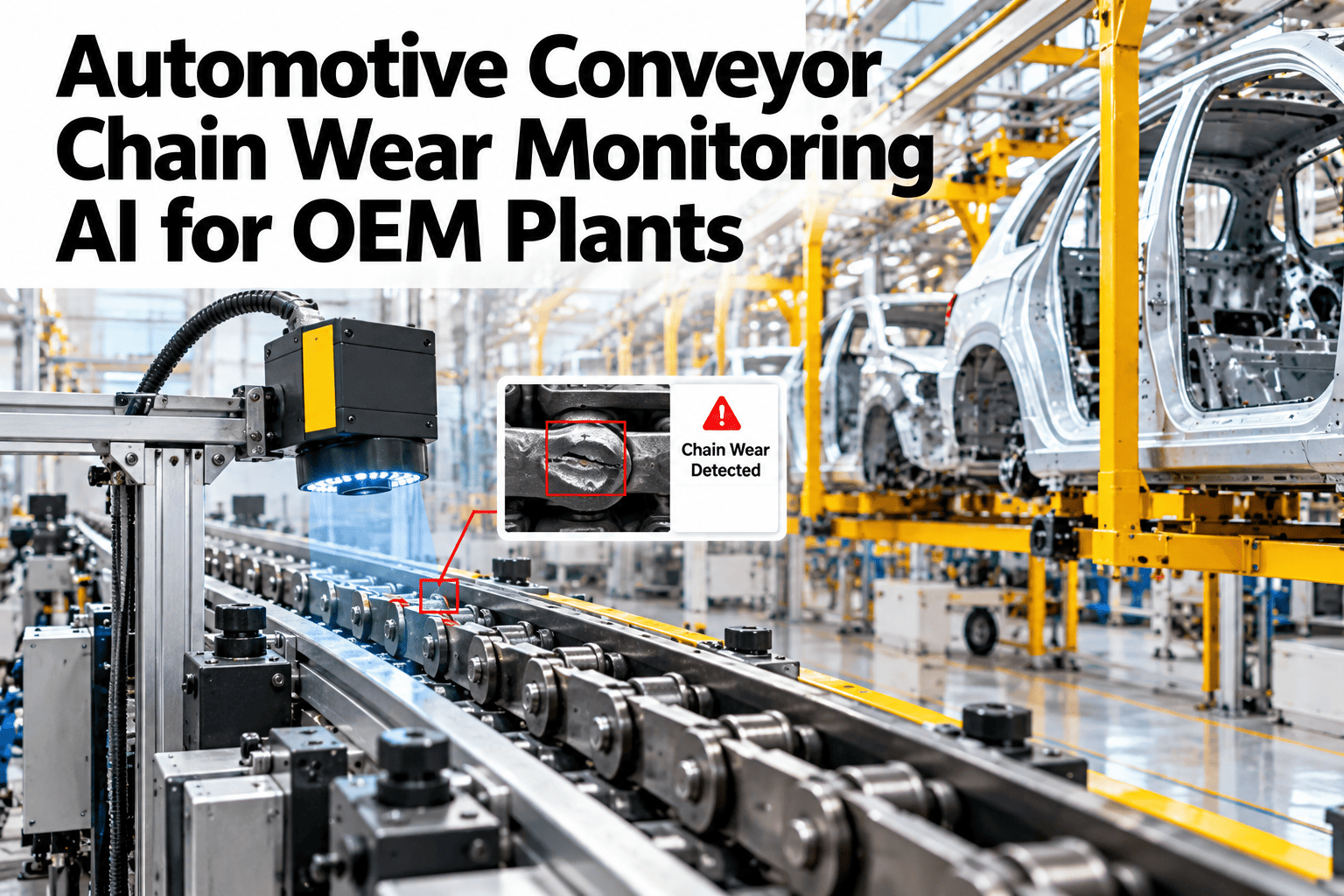
Conveyor chain wear in an automotive assembly plant is not a sudden event — it is a progressive accumulation of pin and bushing material loss that stretches the chain's effective pitch from its nominal value, millimeter by millimeter, across millions of operating cycles. The challenge is not whether the chain will wear; it will. The challenge is knowing how fast it is wearing, how much wear remains before replacement is necessary, and whether any specific chain segment is elongating faster than the rest — indicating a lubrication failure, misalignment, or sprocket damage that will accelerate the wear rate on the chain that follows. iFactory AI's chain wear monitoring AI answers all three questions continuously, without interrupting production. See how AI chain wear monitoring works on your OEM plant's conveyor system.
Know Your Chain Wear Rate Before It Knows Your Production Schedule
Pitch elongation tracking, wear-rate estimation, and change-out planning for high-cycle automotive assembly conveyor chains — so replacement is planned, never emergency.
How Chain Wear Destroys Conveyors Without Warning
A chain that has elongated beyond its serviceable limit does not fail cleanly — it fails in ways that damage equipment far beyond the chain itself.
How iFactory AI Monitors Chain Wear Continuously
AI-based chain wear monitoring replaces periodic manual chain measurement — which catches wear only at measurement intervals — with continuous automated tracking that detects wear-rate changes as they develop.
Chain Wear Limits and Monitoring Thresholds
Replacement limits vary by chain standard and application. These are the reference values for common automotive assembly conveyor chain types.
| Chain Standard | Nominal Pitch | Monitoring Alert (1%) | Replacement Limit (2–3%) | Typical OEM Replacement |
|---|---|---|---|---|
| DIN 8187 (European) | Various (12.7 to 101.6 mm) | +1% elongation | +2% (general), +1.5% (precision) | At 1.5–2% for body conveyors |
| ANSI (North America) | #60 to #240 (19.05 to 76.2 mm) | +1% elongation | +3% maximum | At 2% for production conveyors |
| Floor conveyor chain | Application-specific | +0.5% in tight sections | +1.5–2% | Typically every 2–3 years |
| Overhead trolley chain | 152.4 or 228.6 mm pitch | Tracking change before elongation limit | +2% or tracking error | Condition-based with AI monitoring |
Frequently Asked Questions
Can the system detect differential elongation between the two parallel chains on a body conveyor?
Yes. Sensors on both parallel chains measure elongation independently, and iFactory AI tracks the difference between the two — flagging when the differential exceeds a threshold that will begin to produce carrier twist or lateral tracking errors. Differential elongation monitoring is one of the most valuable early-warning capabilities for body conveyors where parallel chain imbalance is a common root cause of carrier problems. Ask about differential elongation monitoring configuration for your conveyor type.
How does AI monitoring handle the speed variation that occurs when a conveyor changes product mix or slows for maintenance?
iFactory AI's pitch measurement is speed-compensated — the sensor measures time between successive pins and calculates pitch from the simultaneously recorded conveyor speed, so elongation readings remain accurate across any speed range including slow crawl during maintenance. The wear rate calculation also normalizes for operating hours and cycle count rather than calendar time, so production schedule changes do not distort the wear projection. Walk through the speed-compensation methodology in a live demonstration.
How many sensor positions are needed for effective chain wear monitoring across a full plant conveyor?
Minimum coverage requires one sensor per conveyor section between drive and take-up points to measure overall elongation. Full segment-level monitoring that detects localized wear typically uses three to five sensor positions per conveyor, creating segments between each pair of positions. A body conveyor spanning 200 meters with five sensors delivers segment-level tracking at 40-meter intervals — sufficient to identify problem zones without excessive sensor density. The exact configuration is designed during the scoping phase based on the conveyor layout.
What happens to the wear model when a chain section is replaced but the rest of the chain continues running?
When a segment is replaced, iFactory AI resets the elongation baseline and wear rate for that segment to the new-chain state while preserving the history for the unchanged segments. The wear rate for the new segment is initially estimated from the conveyor's fleet average until its own measurement history accumulates. The change-out event is logged as a maintenance record, and the new segment's projected replacement date is calculated from its own measurements as they develop.
Can chain wear monitoring integrate with lubrication system data to identify whether lubrication is contributing to accelerated wear?
Yes. When lubrication system data — lube point dispensing records, lubricant consumption, or auto-lube system alarm history — is available, iFactory AI correlates it with segment-level wear rate data to identify whether wear acceleration on a specific segment correlates with lubrication gap events. This is one of the most common findings in chain wear investigations, and the data linkage converts it from a hypothesis to a documented root cause. See the lubrication and wear rate correlation view in a live session.
Replace Chain When the Data Says — Not When It Breaks
iFactory AI monitors pitch elongation by segment, calculates wear rate and remaining life, and generates planned change-out work orders for your OEM plant's conveyor chains. Book a walkthrough to see the monitoring framework on your system.