A functional safety audit under ISO 26262 doesn't ask whether your airbag deployment logic works — it asks whether you can prove, with a documented and unbroken evidence chain, that every safety requirement traces forward to a specific design decision, a specific implementation, and a specific verified test result. That chain is the safety case, and it's the actual deliverable an assessor is evaluating, not the software itself in isolation. Building and maintaining that evidence chain manually across a multi-year, multi-supplier development program is where most functional safety programs lose the most time — not in the engineering, but in proving the engineering happened the way the standard requires. The engineering teams rarely fail an assessment on technical merit; the programs that struggle are the ones that can't produce the documented linkage fast enough, or find the linkage was never actually complete to begin with. See how iFactory captures and links the process evidence ISO 26262 traceability audits require, automatically, as the work actually happens.
Quality, Traceability & Compliance · ISO 26262
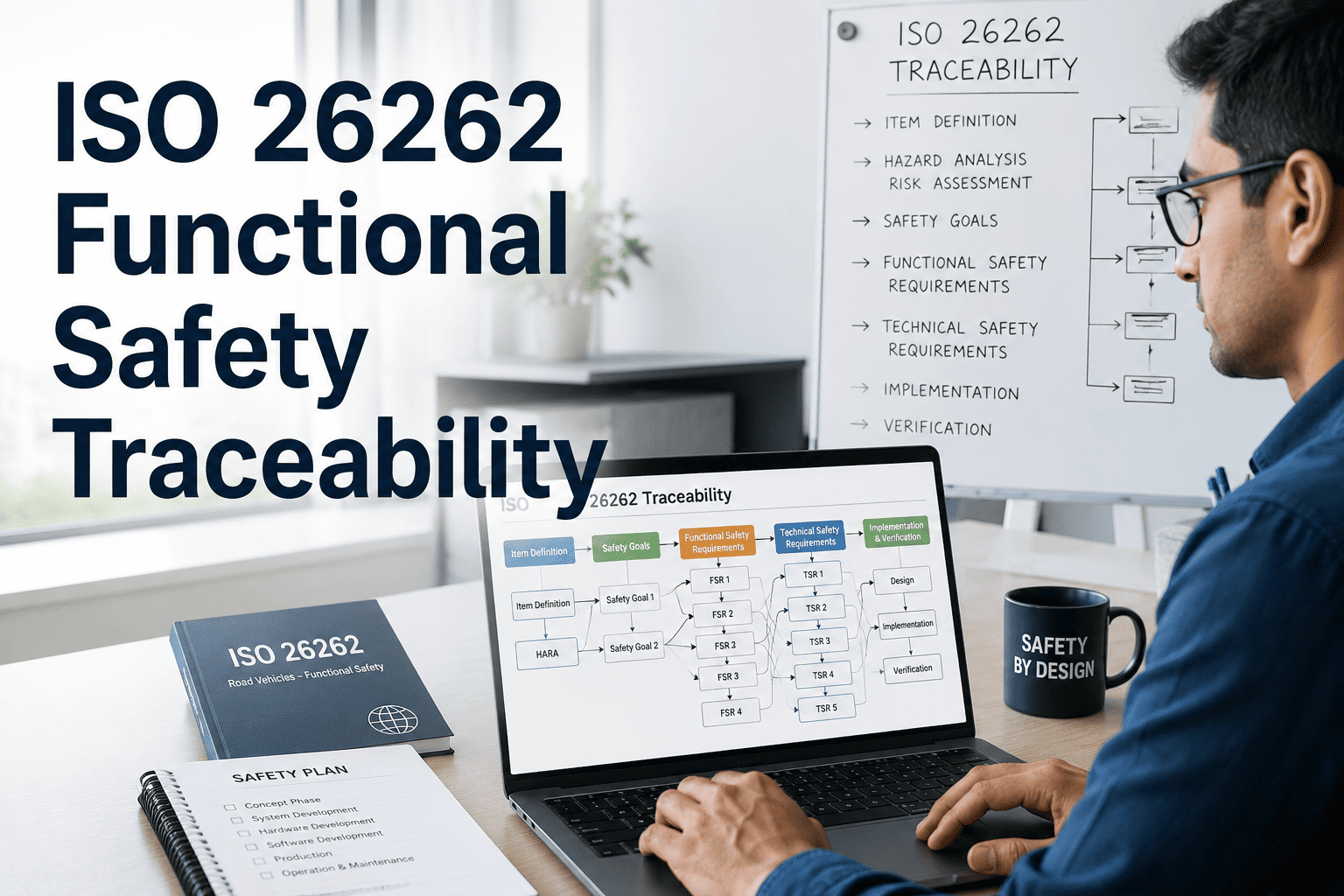
ISO 26262 Functional Safety Traceability
Safety-critical builds demand provable process control. Bidirectional traceability linking requirements, design, implementation, and test results — the evidence chain an ISO 26262 audit is actually evaluating.
D covers the highest-risk functions — autonomous braking, airbag deployment — and demands the most rigorous traceability evidence.
What "Traceability" Actually Means
Bidirectional, Not Just Documented
ISO 26262 — formally "Road Vehicles, Functional Safety" — spans 12 parts and organizes safety work around Automotive Safety Integrity Levels, assigned per safety function based on a Hazard Analysis and Risk Assessment. Every safety goal derived from that analysis inherits its ASIL, and every requirement, design element, and test case that traces to that goal needs to demonstrate rigor appropriate to that level. The standard's second edition, published in 2018, extended coverage that originated in 2011, adapting the general functional-safety logic of IEC 61508 specifically for automotive electrical and electronic systems.
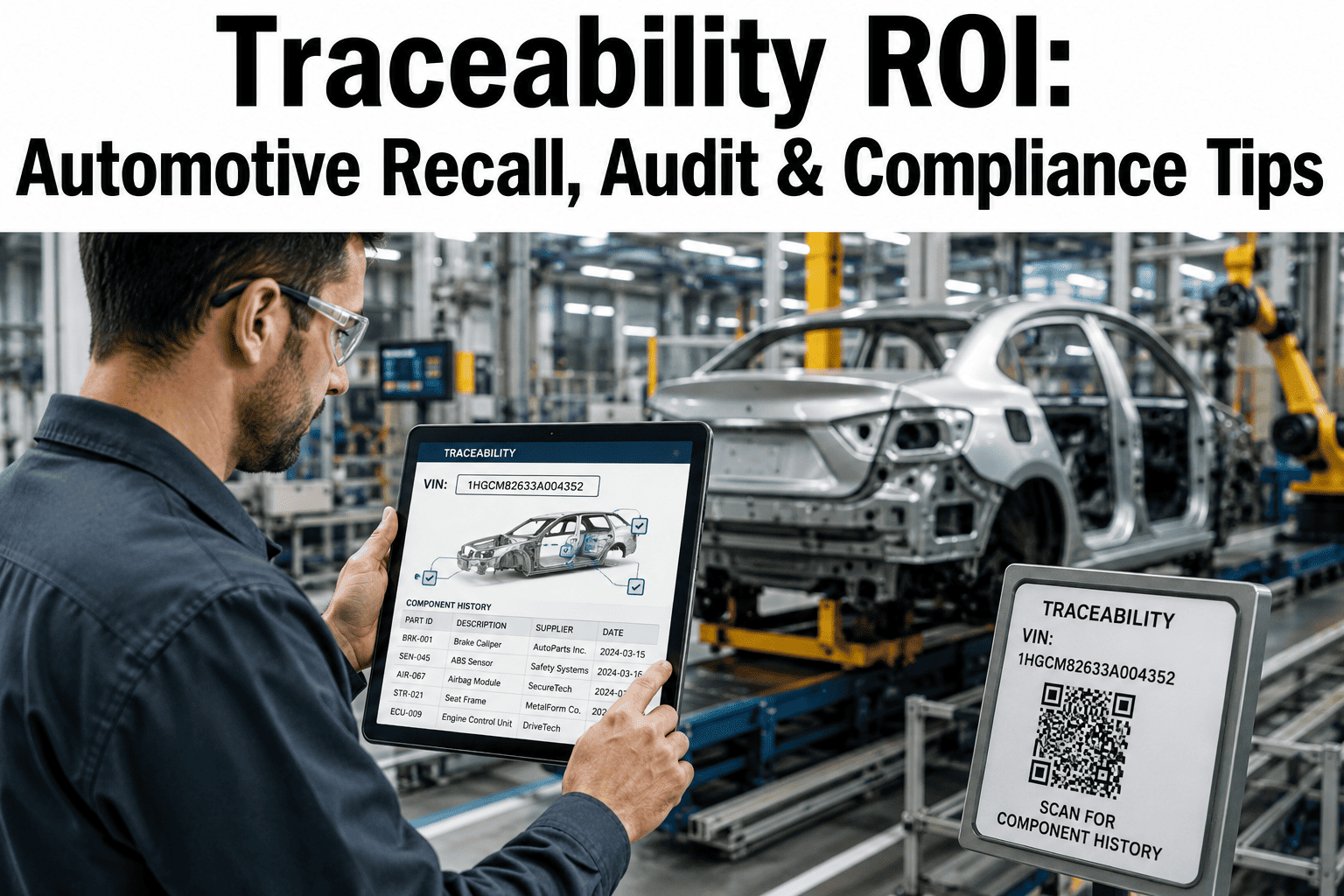
"Traceability" in this context means something specific: bidirectional linkage between requirements, design, implementation, and test results. Forward traceability shows a requirement was actually built and verified. Backward traceability shows every implemented feature and test case can be traced back to a requirement that justified it — nothing unaccounted for, nothing built without a documented reason rooted in a safety goal. A chain that only satisfies one direction is not a complete traceability chain, even if it looks complete from a casual review.
Every one of the five links in this chain needs to hold independently, and an assessor will test them independently rather than assuming that a well-organized requirements document implies the rest of the chain is equally solid. A requirement can be beautifully documented and still fail traceability if the test case that supposedly verifies it doesn't actually exist, was executed against an earlier version of the requirement, or produced a result nobody recorded. The chain is only as strong as its weakest link, and the weakest link is rarely the one a team expects going in.
The Chain Is the Deliverable
An Assessor Isn't Auditing Your Code. They're Auditing Whether You Can Prove the Chain.
iFactory links requirements, design artifacts, implementation, and test results automatically as work happens — so the evidence chain exists continuously, not reconstructed under deadline before an audit.
Traceability Depth Scales With Risk, Not Uniformly
A single traceability standard applied uniformly across ASIL A and ASIL D functions is either under-rigorous for the highest-risk systems or needlessly burdensome for the lowest-risk ones. The rigor is meant to scale with the assigned ASIL, and understanding that scaling is what lets a program allocate its limited traceability effort efficiently rather than applying maximum rigor everywhere by default.
ASIL
Typical Application
Traceability Expectation
A
Lower-risk functions — comfort systems with limited safety consequence
Basic requirement-to-test linkage, documented but less exhaustive verification depth
B
Moderate-risk functions with some potential for harm under failure
Structured traceability with independent review of key safety requirements
C
Higher-risk functions — significant injury potential under failure
Rigorous bidirectional traceability, tool qualification considerations begin to matter more
Full bidirectional traceability, independent verification, qualified toolchains, exhaustive evidence depth
The Safety Case, Specifically
What Assessors Are Actually Evaluating
The safety case is a structured, evidence-based argument that a given E/E system is acceptably safe for its intended use, and it spans every phase of the development lifecycle — requirements engineering, design, implementation, verification, validation, and configuration management. It is not a single document; it's the sum of every linked artifact across that lifecycle, presented in a way that lets an assessor follow the argument from hazard to mitigation to verified evidence without gaps.
This framing matters because it reorients what "compliance work" actually is. A team can complete every required engineering activity — hazard analysis, requirement derivation, design review, testing — and still fail to produce a defensible safety case if those activities aren't linked into a coherent, traceable argument. The safety case is the deliverable; the underlying engineering work is necessary but not sufficient on its own.
Where Traceability Breaks Down
The Recurring Gaps Assessors Actually Find
These four patterns account for the large majority of traceability findings in real assessments, and recognizing them ahead of time is far cheaper than discovering them during the audit itself.
Supplier Boundary Gaps
Evidence chains frequently break precisely at OEM-supplier handoffs, where a requirement passed to a Tier-1 supplier loses its documented link back to the originating safety goal, or the supplier's verification evidence never makes it back into the OEM's consolidated safety case.
Toolchain Fragmentation
Requirements living in one tool, design in another, and test results in a third — each individually well-documented, but with no automated linkage between them — forces manual reconciliation that's both slow and a common source of undetected gaps.
Late-Cycle Requirement Changes
A safety requirement modified after design and test artifacts already exist requires every downstream link to be re-verified, and this re-traceability step is frequently where manual processes silently fall behind as a program approaches a deadline.
Evidence Reconstruction Under Deadline
Teams that maintain traceability as a periodic documentation exercise rather than a continuous byproduct of the actual engineering work frequently find themselves reconstructing months of evidence links in the weeks before a scheduled assessment.
Readiness Checklist
Before Your Next Functional Safety Assessment
These four checks address the specific gap categories most commonly cited in real assessment findings, and are worth confirming well ahead of a scheduled audit rather than during preparation for it.
01
Confirm Every Safety Goal Has a Documented ASIL Assignment
Trace back to the HARA that produced it — an ASIL assignment without a documented, defensible hazard analysis behind it is itself a finding an assessor will raise.
02
Verify Bidirectional Links, Not Just Forward Documentation
Confirm every implemented feature and every executed test case traces back to a specific requirement — backward traceability gaps, where something exists with no documented justification, are as significant a finding as a missing forward link.
03
Check Supplier Evidence Handoffs Specifically
Where a requirement crosses an OEM-supplier boundary, confirm the evidence chain actually crosses with it — this is one of the most commonly cited failure points in multi-tier automotive development programs.
04
Confirm Re-Traceability After Any Late Requirement Change
A modified safety requirement needs every downstream link re-verified, not just the immediately affected artifact — audit for orphaned test cases and design elements tied to a requirement version that no longer exists.
Field Perspective
“
The programs that struggle with an ISO 26262 assessment are almost never the ones with bad engineering. They're the ones where the engineering was sound but the proof of it lives in four disconnected tools and a shared drive full of spreadsheets nobody's updated consistently. An assessor doesn't take your word that a requirement was tested — they want to see the specific test case, the specific result, and the specific requirement it traces back to, linked, not cross-referenced by memory during the audit. Building that linkage as a byproduct of the actual work, rather than a separate documentation exercise bolted on afterward, is the single biggest difference between a smooth assessment and a stressful one — and it's usually the difference between a program that finishes on schedule and one that doesn't.
Wilhelmina Osei-Draganov
Functional Safety Lead · 13 years in automotive E/E functional safety across ASIL B through D programs
Common Questions
Frequently Asked Questions
What does "bidirectional traceability" actually mean under ISO 26262?
Bidirectional traceability means the evidence chain works in both directions: forward traceability confirms a specific requirement was actually implemented and verified through a specific test with a documented result, while backward traceability confirms every implemented feature and every executed test case can be traced back to a requirement that justified its existence. A chain that only works forward can miss undocumented, unjustified functionality in the system; a chain that only works backward can miss requirements that were never actually implemented or tested. Both directions need to hold for the evidence chain to genuinely support the safety case an assessor is evaluating, and confirming both directions independently — not assuming one implies the other — is a specific check worth building into any internal readiness review. Book a traceability readiness review to assess whether your current evidence chain holds in both directions.
Does every component in a vehicle need the same level of traceability rigor?
No — ASIL levels are assigned per safety function based on a Hazard Analysis and Risk Assessment, not applied uniformly across an entire vehicle or system, and traceability rigor is meant to scale with the assigned ASIL. A comfort feature with limited safety consequence assigned ASIL A warrants a different evidentiary depth than an autonomous emergency braking function assigned ASIL D, which typically demands full bidirectional traceability, independent verification, and often qualified toolchains. Applying ASIL D-level rigor uniformly across lower-risk functions is possible but generally an inefficient use of engineering resources relative to what the standard actually requires.
Why do traceability gaps so often appear specifically at OEM-supplier handoffs?
A requirement passed from an OEM to a Tier-1 supplier crosses an organizational and, frequently, a toolchain boundary simultaneously — the supplier may track requirements, design, and test evidence in entirely different systems than the OEM uses, and reconciling those systems into one consolidated safety case is a manual, error-prone process unless it's deliberately automated. This is a widely recognized coordination challenge in multi-tier automotive development, and it's specifically worth auditing separately from internal traceability, since a program can have excellent internal evidence discipline and still have significant gaps precisely at the points where responsibility for a requirement changes hands. Talk to solutions engineering about maintaining evidence chain continuity across supplier boundaries.
What happens to existing traceability evidence when a safety requirement changes late in development?
A modified safety requirement invalidates the traceability assumptions of everything already linked to its prior version — the design elements, implementation, and test cases that traced to the old requirement need re-verification against the new one, not just an update to the requirement document itself. This re-traceability step is one of the areas most likely to fall behind schedule in manually maintained evidence chains, since it requires actively hunting down every downstream artifact rather than simply documenting the change and moving on, which is exactly the kind of gap an assessor is trained to look for.
Is ISO 26262 compliance legally mandated for vehicle homologation?
ISO 26262 compliance is generally not a direct legal requirement for vehicle homologation in most jurisdictions, but OEMs almost universally treat it as a contractual gate to market — suppliers are typically required to demonstrate compliance as a condition of doing business with an OEM on safety-related E/E systems, which makes it a practical necessity even where it isn't a statutory one. This distinction matters for how a program prioritizes compliance work: it's driven by commercial and contractual necessity rather than regulatory enforcement, but the practical consequence of failing an assessment — losing a contract or a program — is often just as significant as a regulatory penalty would be.
Prove the Chain, Not Just the Engineering
Continuous Evidence Linkage, Not a Pre-Audit Scramble
iFactory captures and links requirements, design artifacts, implementation, and test results as your team's actual work happens — so the ISO 26262 evidence chain exists continuously across your program, including at supplier boundaries.