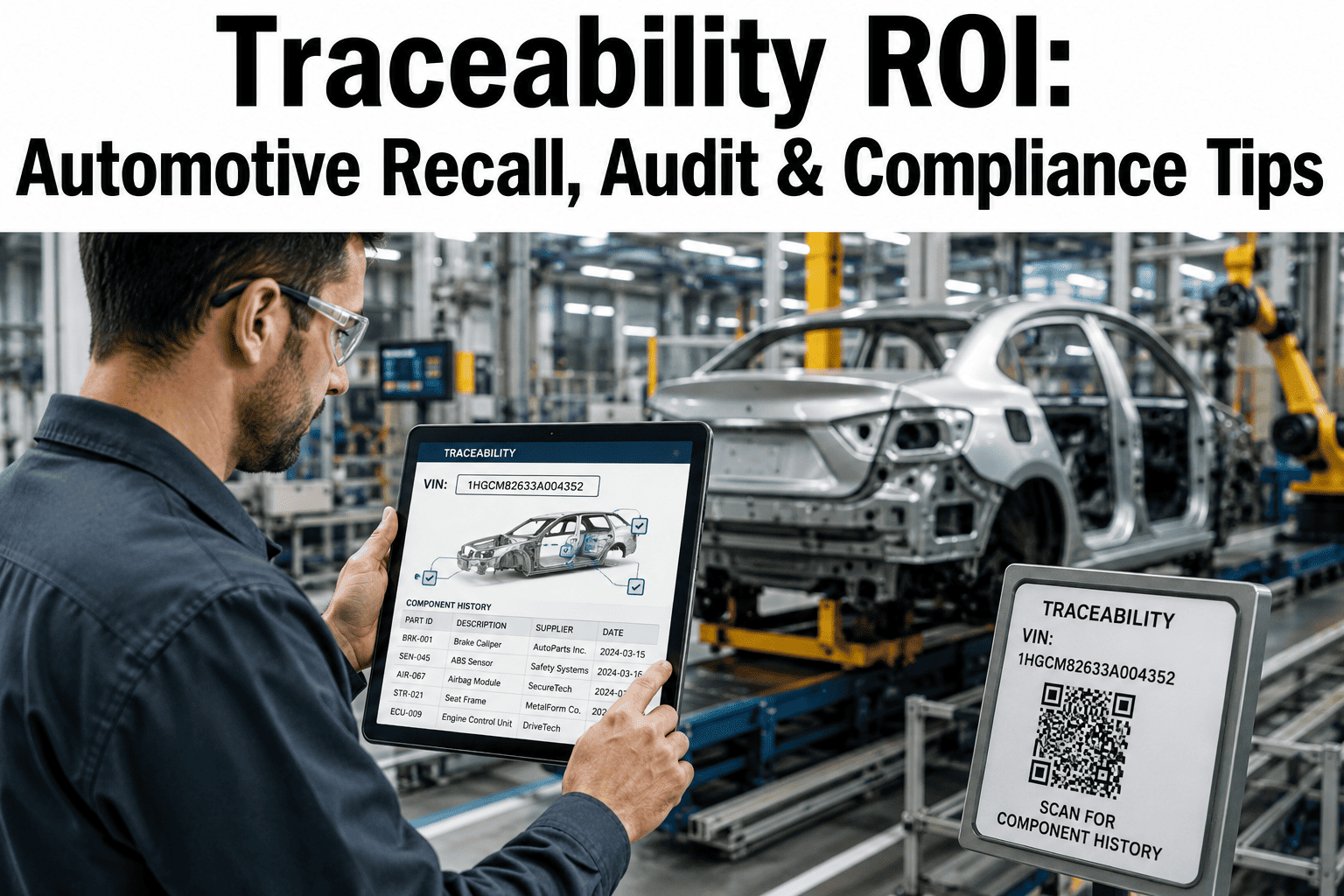
Justifying a traceability system investment to finance rarely fails because the technology doesn't work, it fails because the business case is built on vague claims about "better visibility" instead of a specific number tied to recall scope, audit hours or compliance risk. A traceability system's ROI comes from three measurable places: how much smaller a recall gets when genealogy is precise, how many audit hours disappear when records assemble automatically, and how much compliance risk shrinks when every component is accounted for. Book a demo to build a traceability ROI case using your own recall and audit history.
Traceability ROI for Automotive
Turn Traceability From a Cost Center Into a Number Finance Approves
iFactory quantifies recall scope reduction, audit efficiency gains and compliance cost savings against your own plant's history, so the investment case is built on your numbers, not an industry average.
The Three Places Traceability ROI Actually Comes From
Most traceability business cases stall because they try to quantify "risk reduction" in the abstract. The stronger case breaks ROI into three specific, measurable components that finance can independently verify. Ask support how each component is calculated from your plant's records.
01
Recall Scope Reduction
Precise genealogy narrows a recall to the exact affected lot or serial range instead of over-recalling out of caution, cutting the direct cost of replacement, shipping and customer disruption per incident.
02
Audit Efficiency Gains
Automatically assembled traceability records eliminate the manual compilation work that consumes days of staff time ahead of every customer and regulatory audit cycle.
03
Compliance Cost Avoidance
Complete component-level records reduce the risk of compliance findings, penalties and the cost of remediation programs triggered by traceability gaps.
Traceability Maturity: Where Most Plants Start vs. Where ROI Shows Up
| Factor | Manual / Partial Traceability | iFactory Full Genealogy Traceability |
|---|
| Recall Scoping | Broad recalls issued out of caution when exact affected units are unclear. | Recall narrowed precisely to the affected lot or serial range. |
| Audit Preparation | 20-40 hours per audit cycle manually compiling records from multiple systems. | Records assemble automatically, prep time cut 60-75%. |
| Component-Level Data | Partial genealogy, often missing supplier-level component detail. | Full forward and backward genealogy including supplier component data. |
| Compliance Findings Risk | Elevated risk from data gaps discovered during regulatory or customer audits. | Reduced risk from complete, consistently available records. |
| Cost Visibility | Recall and audit cost treated as a fixed, unavoidable operating expense. | Cost tracked per incident, giving a clear before-and-after ROI trend. |
Get a Traceability ROI Estimate Built From Your Own Data
iFactory reviews your recent recall and audit history to calculate a specific ROI case rather than relying on generic industry figures.
Building the Investment Case, Stage by Stage
1
Historical Data Review
Recent recall scope, audit hours and any compliance findings tied to traceability gaps are reviewed to establish a baseline.
2
Genealogy Gap Assessment
Current traceability depth is compared against full forward and backward genealogy to identify the specific gaps driving cost.
3
ROI Model Built
Recall scope, audit efficiency and compliance risk components are calculated against your baseline to produce a specific ROI projection.
4
Pilot Validation
A pilot deployment validates genealogy accuracy and audit time reduction against the projected model before full rollout.
Results From Plants Running Full Genealogy Traceability
Automotive Component Supplier
Recall Scope Reduced From Full Model Year to Single Production Week
A component supplier with partial lot-level traceability previously issued recalls covering an entire model year of production due to imprecise genealogy. After deploying full forward and backward traceability, a subsequent recall was scoped to a single production week, cutting replacement and logistics cost dramatically compared to the prior recall's scope.
98%
Reduction in recall scope
68%
Audit prep time reduction
1 wk
Precise recall scope achieved
What Compliance and Quality Leaders Say
Finance approved the project the moment we showed them what our last recall actually cost versus what precise genealogy would have limited it to. The number spoke for itself.
VP of Quality
Component Supplier, Michigan
Audit prep used to be a full week of pulling records from five different systems. Now it's a report we generate in an afternoon.
Compliance Director
Tier-One Automotive Supplier, Ohio
Frequently Asked Questions
How is recall scope reduction actually calculated for the ROI case?
The calculation compares your historical average recall scope, meaning how many units were affected per incident, against the scope precise genealogy would have limited that same incident to, then multiplies the difference by your per-unit recall cost including replacement, logistics and customer disruption. This is done using your own recall history rather than an industry average, which is why the projection tends to be far more convincing to finance stakeholders.
What counts as a compliance cost that traceability can help avoid?
This includes the cost of remediation programs triggered by data gaps found during regulatory or customer audits, penalties tied to incomplete component records, and the indirect cost of losing customer confidence after a traceability finding. The exact figure is weighted against your specific historical finding rate and gap closure achieved after deployment rather than a generic industry penalty estimate.
Do we need a full plant-wide deployment to see ROI, or can a pilot show results?
A pilot on one line or product family typically validates genealogy accuracy and audit time reduction well before a full rollout, giving you real data to refine the ROI model rather than relying solely on the initial projection. Most plants use pilot results to secure budget for the remaining rollout rather than committing to the full investment upfront.
How long does it take before audit prep time actually drops?
Audit prep time reduction is typically visible starting with the first audit cycle after go-live, since automatically assembled records replace the manual compilation step immediately rather than requiring months of accumulated data.
Talk to support about your specific audit cycle timing.
Can the ROI model account for supplier-level component data, not just our own production?
Yes, full genealogy traceability extends to supplier-level component data where that data is available, which is often the specific gap driving recall scope beyond what a plant's own internal traceability alone can resolve.
Book a demo to see supplier-level genealogy included in your ROI model.
Build a Traceability Investment Case Finance Will Actually Approve
iFactory quantifies recall scope reduction, audit efficiency and compliance cost avoidance using your own plant's history, turning traceability from an abstract risk argument into a specific number.
ROI calculated from your own recall and audit data
Full forward and backward component genealogy
60-75% reduction in audit preparation time
Pilot validation before full plant rollout