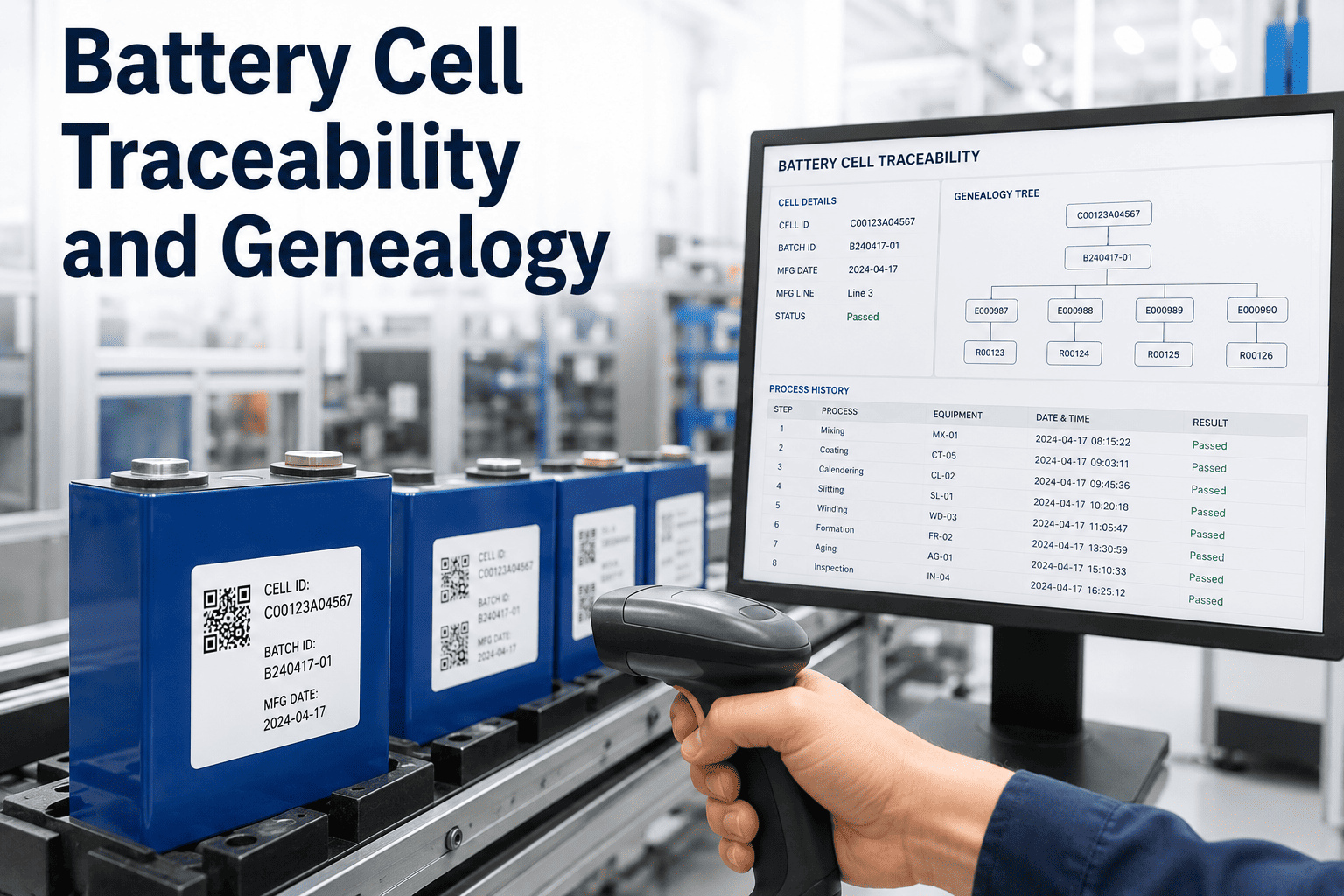
When a battery recall notice goes out, the first question from regulators and customers alike is the same one: which cells, from which batch, ended up in which packs and which vehicles. A plant that cannot answer that within minutes is forced into a blunt, expensive choice — recall broadly to be safe, or investigate for weeks while exposure grows. Neither option is acceptable at gigafactory scale, where a single production day can touch tens of thousands of cells across multiple lines and shifts. The plants that handle this well are not lucky, they simply built cell-to-pack genealogy into the process from day one instead of trying to reconstruct it after the fact. iFactory's traceability platform is built to make that lineage available in minutes, not weeks.
Battery Cell Traceability
Cell-to-Pack Genealogy That Answers a Recall Question in Minutes
Every cell carries a history — raw material lot, process parameters, formation results, and final pack destination. See how connected genealogy turns that history into fast, defensible answers.
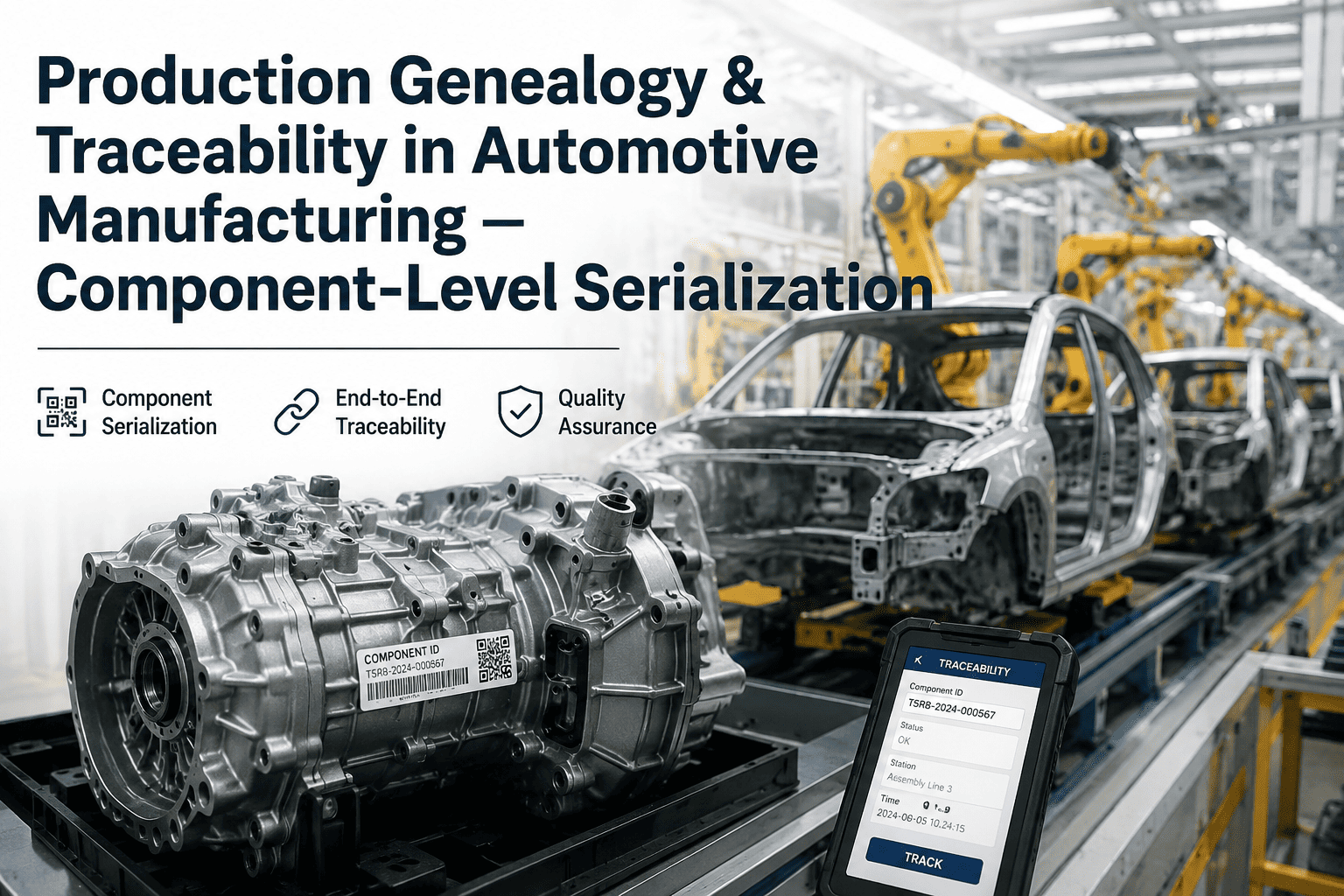
Why Cell Genealogy Is Harder Than Automotive Part Traceability
Traditional automotive parts traceability tracks a single serialized component through assembly. Battery cells are different — each cell inherits characteristics from an entire chain of upstream events: the electrode material lot, the coating run, the calendering pass, the formation cycle, and finally the module and pack it lands in. A gap anywhere in that chain breaks the genealogy, which is exactly why so many recall investigations take far longer than anyone wants.
Material Lot
Coating Run
Calendering Pass
Cell (Formation ID)
Vehicle VIN
Each link in this chain has to stay connected from raw material through to the vehicle for genealogy to be queryable in a recall event.
What Breaks the Chain in Most Plants Today
Batch-Level, Not Cell-Level
Many plants track genealogy at the batch level, which forces overly broad recalls when only a subset of cells is actually affected.
Disconnected Systems
MES, formation test systems, and pack assembly records often live in separate databases with no shared cell ID linking them.
Manual Pack Mapping
The link between which cells went into which pack is sometimes recorded manually, introducing transcription errors under time pressure.
Short Data Retention
Process data gets archived or purged before the vehicle's warranty period ends, leaving gaps for older field failures.
From Raw Material to VIN: What Full Genealogy Captures
A complete genealogy record does not stop at the cell. It carries process history forward through module assembly, pack build, and final vehicle integration, so that a query can run in either direction — from a raw material lot forward to every affected vehicle, or from a single VIN backward to the exact formation cycle its cells went through.
| Genealogy Layer | Data Captured | Why It Matters in a Recall |
|---|
| Raw material | Supplier lot, receipt date, certificate of analysis | Isolates supplier-driven quality issues |
| Cell process | Coating, calendering, formation parameters | Links defects to a specific process window |
| Module / pack | Which cells assembled into which module and pack | Narrows recall scope to affected packs only |
| Vehicle | Pack serial to VIN mapping | Enables precise, minimal-scope field action |
Want to see what your current genealogy gap looks like end to end? Talk to our team about a traceability audit.
How AI Closes the Genealogy Gap
Building full genealogy is less about adding new sensors and more about linking data that already exists across separate systems. AI plays the connective role — matching cell IDs across MES, formation testers, and pack assembly logs even when those systems were never designed to talk to each other.
1
Ingest
Pull cell IDs and process data from MES, formation testers, and pack build systems
2
Link
Match records across systems even where ID formats or timestamps differ
3
Query
Search forward from a material lot or backward from a VIN in seconds, not weeks
4
Contain
Scope any field action to only the cells and vehicles actually affected
What Full Genealogy Changes for the Business
Narrower
Recall scope tied to actual affected cells, not full batches
Faster
Investigation response time when a field issue is reported
Stronger
Warranty defense with process evidence tied to each pack
Who Relies on Genealogy Data Day to Day
01
Quality Engineering
Uses genealogy to trace a field failure back to the exact process conditions the affected cells experienced.
02
Warranty Teams
Defend or validate claims using process evidence tied directly to the specific cells in a customer's pack.
03
Regulatory and Compliance
Answer safety authority requests for traceability evidence within the timelines regulators expect.
04
Plant Leadership
Scope any containment action precisely enough to avoid unnecessary production or field disruption.
Frequently Asked Questions
What's the difference between batch traceability and cell-level genealogy?
Batch traceability tells you which production run a defect came from, while cell-level genealogy tells you exactly which individual cells, in which specific packs and vehicles, were affected. That distinction is what determines whether a field issue triggers a recall covering thousands of vehicles or a targeted action covering only the cells actually at risk.
Our team can help assess which level your current systems actually support.
How long does it take to trace a cell back to its raw material lot?
With connected genealogy data, this is typically a query that returns in seconds rather than an investigation that takes days or weeks of manually cross-referencing spreadsheets across departments. The speed difference matters most in exactly the moment it counts — when a safety authority or a customer is waiting on an answer.
Does this require replacing our existing MES or formation test systems?
No, in most deployments the genealogy layer sits alongside existing systems and links their data rather than replacing any of them. The core requirement is a consistent cell ID that can be matched across systems, which is usually achievable with the data those systems are already generating.
How far back does genealogy data typically need to be retained?
Retention needs to comfortably outlast the vehicle's warranty period and any applicable regulatory retention requirement, which for automotive battery packs often means retaining process data for a decade or more. Plants that purge data too early lose the ability to answer questions about vehicles that are still well within their service life.
Where should a plant start if genealogy tracking is currently incomplete?
Start by mapping which systems currently generate cell-level data and where the ID linkage between them already exists versus where it breaks — that map shows exactly which connections need to be built first for the most immediate genealogy improvement.
Book a demo to see how that mapping process typically works.
A Recall Question Shouldn't Take Weeks to Answer.
Build Cell-to-Pack Genealogy That Answers in Minutes
Bring your current MES, formation, and pack build data. We'll show you where the genealogy chain is already connected and where the gaps sit.