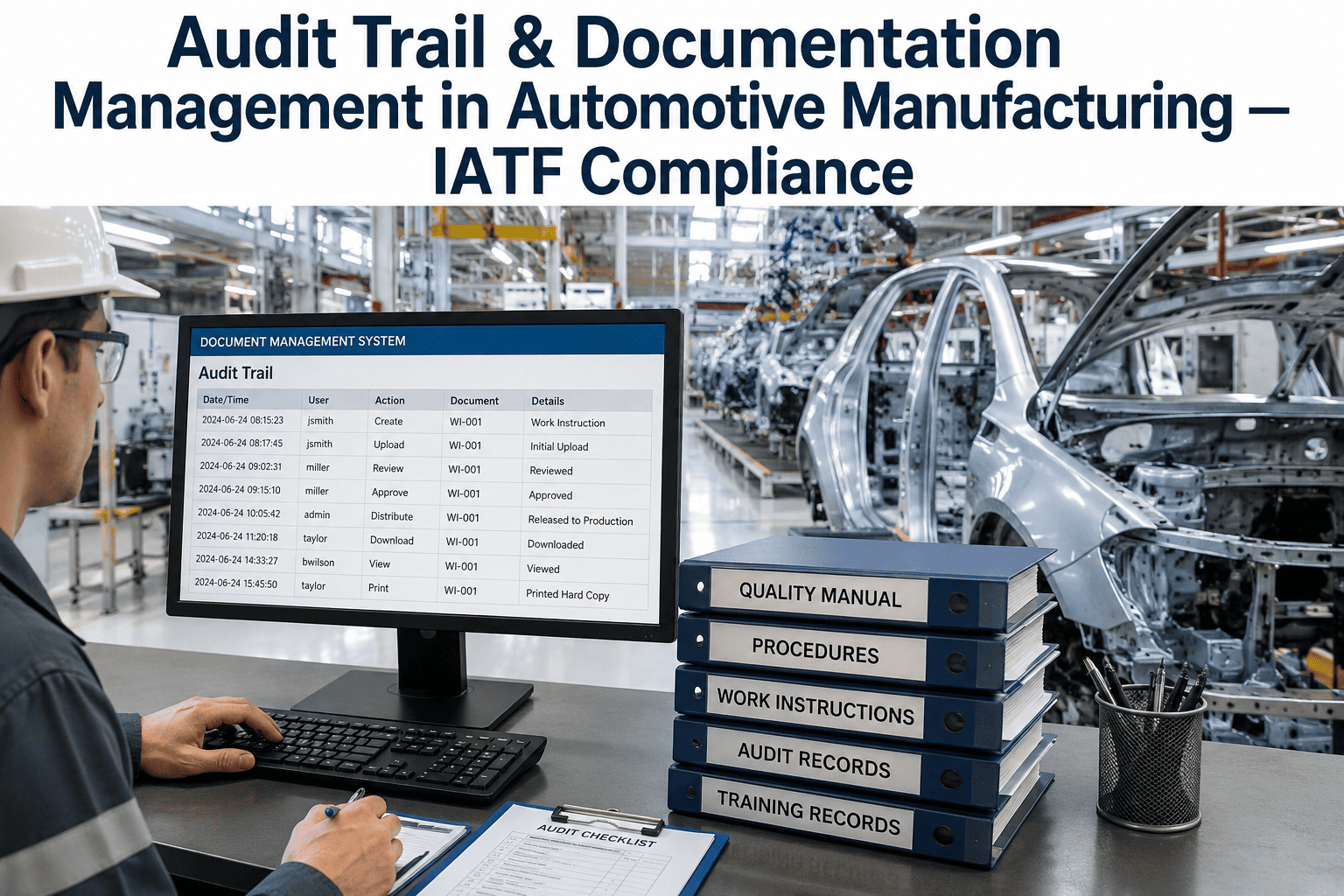
An IATF 16949 auditor rarely finds a plant's biggest documentation gap by asking to see the quality manual, that document is always polished and ready. The real exposure shows up when the auditor asks to trace a specific approved deviation back through every version, approval signature, and effective date, and the paper trail has a gap, a missing signature, or a document that was edited after the fact without a recorded change history. Automotive quality records carry legal and contractual weight, and a broken audit trail on even one record can cast doubt on the reliability of everything else in the quality system during a supplier audit.
Build an Audit Trail That Survives IATF 16949 Scrutiny Without a Paper Chase
AI-powered document control automatically version-locks approvals, tracks change history, and produces a defensible audit trail for every quality record across your plant.
Why Manual Document Control Fails Under Audit Pressure
Most quality documentation systems work fine day to day, a control plan gets updated, someone emails the new version around, and everyone eventually starts using it. The failure only becomes visible under audit pressure, when an assessor asks to see proof of exactly who approved a specific revision, on what date, and what the document looked like before that change. Shared drive folders and emailed PDFs cannot answer that question reliably, because nothing prevents someone from editing a file after approval, saving over an old version, or losing track of which copy is actually the controlled master.
IATF 16949 and the broader quality management frameworks that automotive suppliers operate under place explicit requirements on document control, approval workflows, and record retention specifically because this gap is common and consequential. A single non-conformance finding on document control during a certification audit can jeopardize supplier status with an OEM, regardless of how well the actual manufacturing process is running on the floor.
iFactory locks every approved document version, tracks the complete change history, and generates audit-ready records automatically, no manual reconciliation required.
Six Elements of a Defensible Audit Trail
Every document version is timestamped and permanently linked to the person who created or modified it, with no ability to retroactively edit a locked approved version.
Approval workflows require the correct authorized role to sign off before a document becomes effective, and that approval is recorded automatically, not tracked in a separate spreadsheet.
Superseded versions remain retrievable rather than being deleted or overwritten, so an auditor can see the complete revision history of any controlled document on request.
Effective dates are enforced automatically, meaning the system prevents a superseded document from being used on the floor after its replacement becomes active.
Access logs record who viewed or downloaded a controlled document and when, providing evidence that the correct current version was actually in use during production.
Retention periods are enforced according to the applicable quality standard, with records neither deleted early nor allowed to accumulate indefinitely without a defined policy.
Document Types Most Frequently Cited in Automotive Audits
| Document Type | Common Audit Finding | Root Cause |
|---|---|---|
| Control plans | Floor copy does not match latest approved revision | No automated distribution or effective-date enforcement |
| Work instructions | Missing approval signature on file | Manual sign-off tracked outside the document system |
| Deviation approvals | Incomplete change history | Edits made after approval without version tracking |
| Calibration records | Gaps in retention or missing records | Paper records lost or retention policy not enforced |
| Training records | Cannot confirm operator trained on current revision | Training completion not linked to document version |
From Reactive Cleanup to Continuous Audit Readiness
Most plants approach audit preparation as a periodic scramble, someone is assigned to pull together the last two years of records a few weeks before the scheduled assessment, and gaps discovered during that scramble get patched retroactively in ways that can themselves look suspicious to an experienced auditor. This approach treats documentation compliance as a project rather than a continuous operating state, which means the underlying gap causing the finding never actually gets fixed, it simply gets covered for the next audit cycle.
A continuously enforced document control system flips this dynamic entirely. Because approval workflows, version locking, and effective-date enforcement happen automatically as part of the normal document lifecycle, there is no separate audit preparation phase required, the system is always in the state an auditor expects to find it. This also frees up the quality team's time that would otherwise go into periodic manual reconciliation, redirecting it toward actual process improvement work instead.
Move from periodic audit scrambles to continuous compliance. See how iFactory keeps your document control audit-ready every single day.
Frequently Asked Questions
What happens to our existing document library during migration?
Existing controlled documents are imported with their current version and approval status preserved as the starting baseline, and going forward all new revisions, approvals, and changes are tracked automatically within the system. Historical paper records that predate digital storage can be scanned and attached to the relevant document family so the full history remains retrievable, even though granular version tracking naturally begins from the point of digital migration onward. Our support team can walk through the specific migration approach for your document library.
Does this satisfy IATF 16949 document control requirements specifically?
The system is built around the core document control expectations found in IATF 16949 and related automotive quality frameworks, including controlled approval workflows, version history, effective-date enforcement, and retention management. Final certification decisions rest with your accredited certification body during an actual audit, so this should be treated as a strong operational foundation for meeting those requirements rather than a substitute for your own internal quality management review process.
Can operators on the floor still access documents easily, or does this slow things down?
Operators access the current effective version through the same simple lookup they use today, typically by scanning a station or part identifier, and the system's version control runs invisibly in the background. If anything, floor access becomes faster and more reliable because operators are automatically shown the correct current revision rather than needing to manually confirm they are looking at the latest printed copy posted at the workstation.
How are approval workflows configured for different document types?
Approval routing is configured per document category, so a control plan revision might require sign-off from quality and process engineering, while a work instruction update might only require a single department approval, matching whatever authority matrix your plant's quality management system already defines. This flexibility means the system enforces your existing approval policy rather than forcing a one-size-fits-all workflow onto every document type.
What is a realistic timeline to get audit-ready with this approach?
Plants typically see their most audit-critical document families, control plans, deviation approvals, and calibration records, fully migrated and enforcing version control within a few weeks, with the broader document library following over the subsequent months. The exact timeline depends on how many document families exist and how clean the current version history is going into migration. Book a demo to get a specific estimate based on your current documentation volume.
Stop patching audit gaps after they are found. Book a demo and see continuous document compliance in action on your own record types.