Not every bolt on a vehicle carries the same consequence if it fails, and treating them all with identical verification rigor either wastes resources on low-risk fasteners or, more dangerously, under-verifies the ones where a failure could actually hurt someone. A trim panel screw and a steering knuckle bolt should never sit on the same verification standard, yet without a formal classification system, plants often default to either verifying everything at maximum rigor, which is expensive and slows the line unnecessarily, or applying a single lighter standard across the board, which leaves safety-critical joints under-protected. A clear bolt classification strategy solves this by matching verification depth to actual risk. See what a proper bolt classification strategy looks like for your specific vehicle platform.
Not Every Bolt Deserves the Same Verification Standard
A steering bolt and a trim screw carry entirely different consequences if they fail. Classifying fasteners by risk level is what lets verification effort go where it actually matters most.
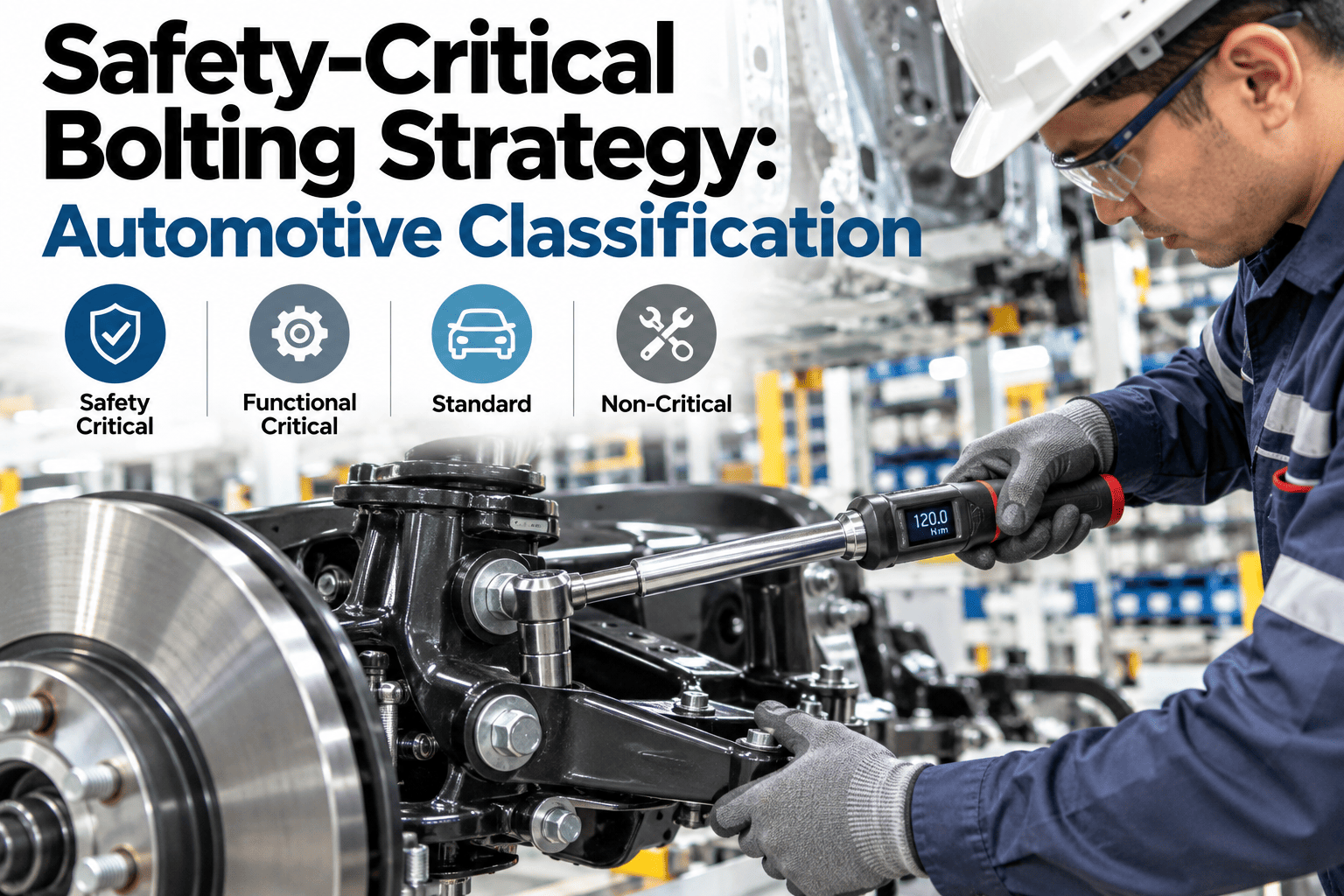
the typical classification structure separating safety-critical, function-critical, and general fasteners on a vehicle platform
of total fasteners on a typical vehicle that fall into the highest safety-critical classification requiring full verification
verification coverage required on every safety-critical fastener, with no sampling gap tolerated at this classification level
The Bolt Classification Structure
Verification rigor scales inversely with fastener count — the fewest bolts carry the strictest requirement, while the largest population needs a lighter, still-disciplined standard.
Safety-Critical
Steering, suspension, braking, and restraint system fasteners. Full torque, angle, and cycle verification on 100% of events, with no sampling.
Function-Critical
Engine mounts, drivetrain, and body structural fasteners. Torque and angle verification on every event, with cycle monitoring on higher-risk joints.
General Assembly
Trim, interior, and non-structural fasteners. Torque verification with statistical sampling, calibrated tools, and periodic audit checks.
Build a Classification Strategy for Your Platform
iFactory reviews your fastener inventory to show exactly how your current verification coverage maps against a proper safety-based classification.
Classification, Risk, and Verification Requirement
Each classification level carries a specific verification requirement matched to the actual consequence of a fastening failure at that level.
Building a Classification Program From Scratch
A defensible classification system needs to be built systematically, not assigned informally station by station.
Map every fastener against its failure consequence
Engineering and safety teams jointly review each fastening point against what actually happens if it fails, rather than defaulting to a generic assumption based on component type alone.
Assign verification requirements by class, not by station
The classification, not the physical location on the line, determines verification depth, ensuring a safety-critical bolt gets full coverage regardless of which station happens to install it.
Audit classification decisions periodically
Design changes can shift a fastener's actual risk profile over a vehicle's production life, so classifications need periodic review rather than being set once and left unchanged indefinitely.
What Changes When Classification Drives Verification
Figures reflect typical outcomes within the first year after implementing a formal three-tier bolt classification and verification strategy.
A Safety Engineer's View on Bolt Classification
Before we formalized classification, verification depth basically depended on which engineer had set up that particular station years earlier, so we had some cosmetic trim fasteners getting full torque-angle-cycle checks while a couple of genuinely safety-relevant joints only had a basic torque click. Building an actual classification matrix and matching verification to real risk fixed both problems at once — less unnecessary overhead in some places, real coverage gaps closed in others.
The Bottom Line on Safety-Critical Bolting Strategy
Applying the same verification standard to every fastener on a vehicle is inefficient at best and dangerous at worst, since it either drowns the line in unnecessary checks on low-risk hardware or leaves genuinely safety-critical joints under-verified. A formal classification structure matches verification depth to actual failure consequence, concentrating full torque, angle, and cycle coverage exactly where a mistake could genuinely hurt someone, while keeping general assembly fasteners on an appropriately lighter, still-disciplined standard.
Frequently Asked Questions
Who typically decides which class a specific fastener belongs to?
Classification decisions are usually made jointly by design engineering and safety teams, since the determination depends on understanding both the component's function and the actual consequence of a failure, which requires input from both technical disciplines rather than a decision made by manufacturing alone. Book a review to see how this classification process would work for your platform.
Can a fastener's classification change over a vehicle's production life?
Yes — a design change, a supplier component change, or a field issue discovered after launch can all shift a fastener's actual risk profile, which is exactly why classification needs periodic review rather than being locked in permanently at initial vehicle launch.
Is sampled verification for Class C fasteners actually safe, or should everything just be fully verified?
Sampled verification combined with calibrated tools and periodic audits is generally considered appropriate for genuinely low-consequence fasteners, since full verification on every single general assembly fastener would add significant line time and cost without a proportional safety benefit — the goal is matching rigor to actual risk, not eliminating all sampling everywhere.
How does this classification system relate to industry standards like IATF 16949?
Formal fastener classification and risk-based verification strategies align closely with the special characteristic and risk management principles found in IATF 16949 and related automotive quality standards, and a documented classification system typically strengthens audit readiness against those standards rather than existing as a separate parallel requirement.
What happens if a fastener's classification is disputed between engineering and manufacturing?
Most plants resolve classification disputes by defaulting to the more conservative classification until a formal review confirms otherwise, since the cost of over-verifying a borderline fastener is far lower than the cost of under-verifying one that turns out to be genuinely safety-relevant. Talk to a specialist about setting up a formal classification review process for your plant.
Match Verification Rigor to Actual Fastener Risk
Book a 30-minute assessment. iFactory reviews your fastener population and shows exactly where classification and verification coverage need to align.