An SPC chart that lives in its own disconnected application is a quality record with no way to actually stop a bad part from shipping. The chart can show a clear out-of-control signal, the engineer can see it, and the part can still move to the next station and onto a truck because the SPC system and the MES that controls production flow have never been told to talk to each other. Integration is what turns a statistical observation into an enforced quality gate — connecting SPC directly into MES, ERP, and the broader quality management system so a violation can actually hold a part, trigger a work order, and update a genealogy record automatically. If your SPC data still lives in a system nobody else's software can see, book a demo to see connected quality gates in action.
A Quality Signal That Can't Stop a Part Isn't a Quality Gate
iFactory connects SPC directly into your MES, ERP, and quality management system, so an out-of-control signal can automatically hold production, trigger a corrective action work order, and update part genealogy — not just sit on a chart waiting to be noticed.
The Real Cost of a Disconnected SPC System
SPC platforms deployed as a standalone tool, separate from the systems that actually run production and manage quality records, create a specific and expensive gap: the software knows something is wrong, but nothing downstream is listening. This is not a hypothetical risk — it is the default state of most legacy SPC deployments purchased years before MES and ERP integration was treated as a core requirement.
An out-of-control signal that doesn't automatically communicate to MES cannot physically stop a part from continuing down the line, relying entirely on a human noticing and acting.
Quality engineers manually re-key SPC findings into a separate QMS or ERP ticketing system, introducing transcription errors and wasted time on every event.
Without a connected data flow, tracing which specific serial numbers were affected by a measurement anomaly requires manually cross-referencing timestamps across disconnected systems.
A finding that has to be manually transferred into a separate corrective action system adds hours or days of delay before the formal resolution process even begins.
What a Connected Quality Data Flow Actually Looks Like
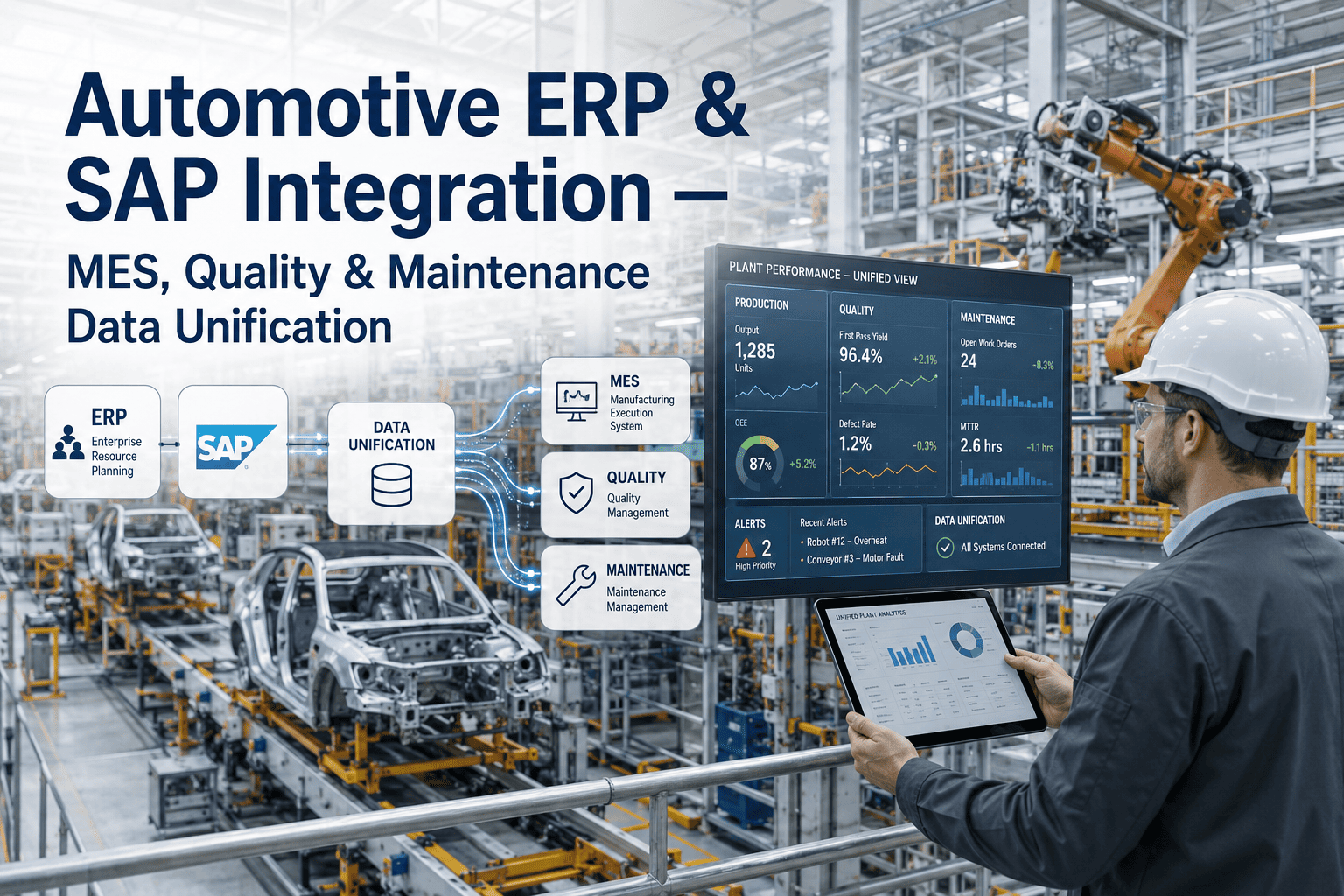
Integration is not about replacing your MES, ERP, or QMS — it is about making sure a single quality event flows automatically across all three, each system doing the part of the job it already does well.
Measurement Captured in SPC
A gauge, torque wrench, or vision system sends the measurement into the SPC engine, tagged with the part serial number and station identifier.
Rule Evaluation and Signal
The SPC engine evaluates the measurement against active control rules in real time and classifies any violation by severity.
MES Quality Gate Triggered
A critical violation sends an automatic hold instruction to MES, physically preventing the affected part or lot from advancing to the next operation.
QMS Corrective Action Created
The violation automatically opens a corrective action record in the quality management system, pre-populated with the measurement data and affected part range.
ERP Genealogy Update
Affected serial numbers and lot data are pushed to ERP for genealogy tracking, ensuring downstream shipping, warranty, and recall processes have accurate traceability.
See Your Own MES and QMS Connected to Live SPC Data
Bring your current system stack and we'll walk through exactly what a connected quality gate would look like on your production line.
What Each System Contributes to a Connected Quality Flow
Integration works best when each system continues doing what it already does well, simply sharing data instead of operating in isolation.
| System | What It Contributes | What It Receives From SPC |
|---|---|---|
| MES | Production flow control, station routing, line-stop authority | Real-time hold instructions on out-of-control parts or lots |
| ERP | Lot and serial genealogy, inventory status, shipping control | Affected part ranges for genealogy and shipment hold |
| QMS | Corrective action workflow, audit documentation, CAPA tracking | Pre-populated findings with measurement evidence attached |
| SPC Engine | Statistical rule evaluation, capability analysis, trend detection | Part context, station data, and prior corrective action history |
Building a Quality Gate That Actually Holds Parts
Not every SPC violation should trigger a hard production stop — the gate logic needs to match severity and characteristic criticality, the same way a well-designed alarm system does.
Safety or regulatory characteristic violation automatically holds the specific part or lot in MES until an engineer disposition decision is logged.
Functional characteristic violation flags the lot for review without a hard stop, notifying quality while production continues under close monitoring.
Lower-severity or cosmetic characteristic violations are logged and visible in the dashboard without any production flow interruption.
Where a Connected Gate Prevented a Shipping Escape
A driveline component supplier had SPC charting in place for years, running on a standalone system with no MES connection. During a torque anomaly on a critical fastener, the SPC chart correctly flagged the violation, but the affected lot continued through final packaging and shipped before the quality team reviewed the chart the next morning. The customer caught the issue during incoming inspection, triggering a formal containment and a supplier corrective action request that cost weeks of engineering time and damaged the customer relationship.
After integrating SPC directly with MES, the same category of violation now automatically places an MES hold on the affected lot the moment the rule fires, before the parts can advance past the current station. The corrective action record opens automatically in the QMS with the measurement evidence already attached, and genealogy data updates in ERP in real time. The statistical detection capability had not changed at all — only the connection between detection and enforced action had, and that connection was the entire difference between an internal catch and a customer-facing escape.
Frequently Asked Questions
Does SPC-to-MES integration require replacing our existing MES platform?
No — integration is designed to work with the MES platform you already run, connecting through standard API or middleware rather than requiring a platform replacement. iFactory's integration layer is built to communicate with the major automotive MES platforms already in wide use across supplier plants, exchanging hold instructions, part context, and station data without disrupting existing production flow logic your MES already manages well. The goal is adding a quality signal channel into your existing infrastructure, not displacing it. To review compatibility with your specific MES platform, contact our support team.
How do we decide which violations should trigger a hard MES hold versus a soft flag?
Gate severity should map directly to characteristic criticality as defined in your control plan and FMEA — safety and regulatory characteristics generally warrant a hard hold that stops the specific part or lot until an engineer logs a disposition decision, while lower-risk functional or cosmetic characteristics may only need a soft flag or advisory notification without interrupting production flow. Setting every violation to a hard stop creates unnecessary line disruption and pushback from operations, while setting nothing to a hard stop defeats the purpose of connecting SPC to MES at all. Our engineering team can help map your specific control plan to gate severity levels — book a demo to review it together.
What happens to genealogy data when a hold is triggered on a lot that has already partially shipped?
A connected system pushes the affected serial number range to ERP in real time as soon as the violation is detected, so genealogy tracking reflects the exact scope of potentially affected parts even if some units in the lot have already moved downstream. This allows a much more precise containment scope than a manual timestamp-based investigation, often narrowing what would otherwise be a full-lot recall down to a specific, smaller serial number range. For details on how genealogy scoping works with your specific ERP setup, reach out to support.
Does connecting SPC to our QMS eliminate the need for manual corrective action documentation?
Integration eliminates the manual re-entry of measurement data and finding details into the QMS, since the corrective action record is automatically pre-populated with the violation's evidence, timestamp, and affected part range the moment it fires. Engineering judgment on root cause, corrective action selection, and verification of effectiveness still requires human review and sign-off — integration removes the administrative overhead, not the engineering decision-making. This typically shortens the time from detection to a properly documented corrective action from hours to minutes. See the full workflow on a live demo — book a session here.
How long does a typical SPC-to-MES-to-ERP integration project take?
Timeline depends heavily on the specific MES, ERP, and QMS platforms already in place and how well-documented their existing API or integration layer is, but most single-line integration projects complete within six to ten weeks, including gate severity mapping, testing hold instructions against a non-production environment, and validating genealogy data flow before going live. Plants with modern, API-accessible MES and ERP platforms tend toward the faster end of that range, while older systems requiring custom middleware development take longer. For a specific estimate based on your current system stack, contact our support team.
Turn Every SPC Signal Into an Enforced Action
A chart that only shows a problem is half the job. See how iFactory connects SPC directly into your MES, ERP, and QMS so a violation actually stops a bad part.