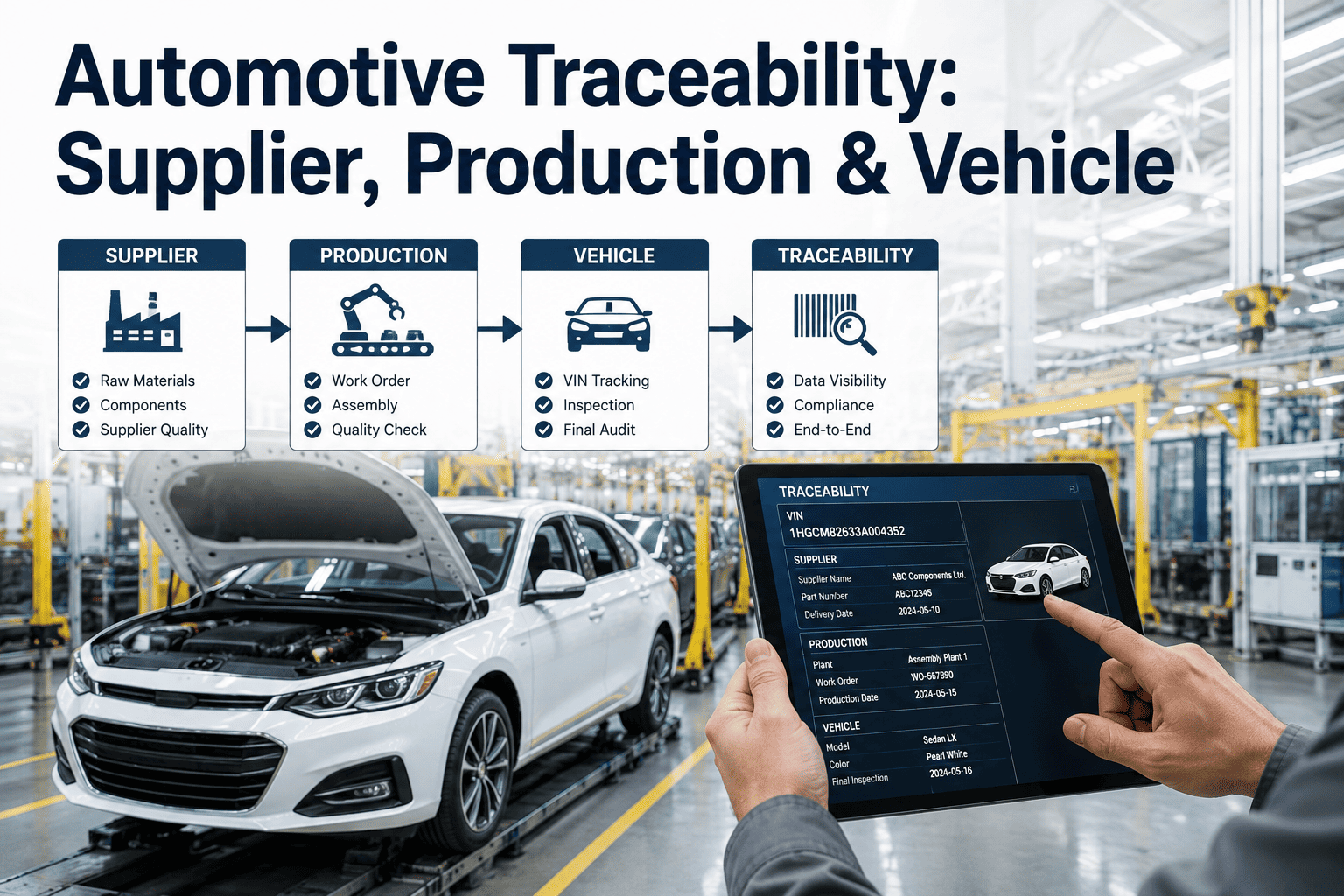
When a supplier notifies an automotive plant of a material lot issue, the question that actually matters isn't whether the plant received that lot — it's which specific vehicles it ended up in, and whether any of them have already shipped. Answering that question in minutes instead of days depends entirely on whether traceability data connects supplier lots through production process steps all the way to finished vehicles, which is precisely the chain iFactory's traceability platform is built to hold together.
A Recall Question Is Really a Traceability Question. Most Plants Answer It Slower Than They Think.
Supplier lot, production process data, and finished vehicle identity have to be linked as one continuous chain — a gap anywhere in that chain turns a targeted recall into a broad one.
The Three Links a Traceability Chain Can't Skip
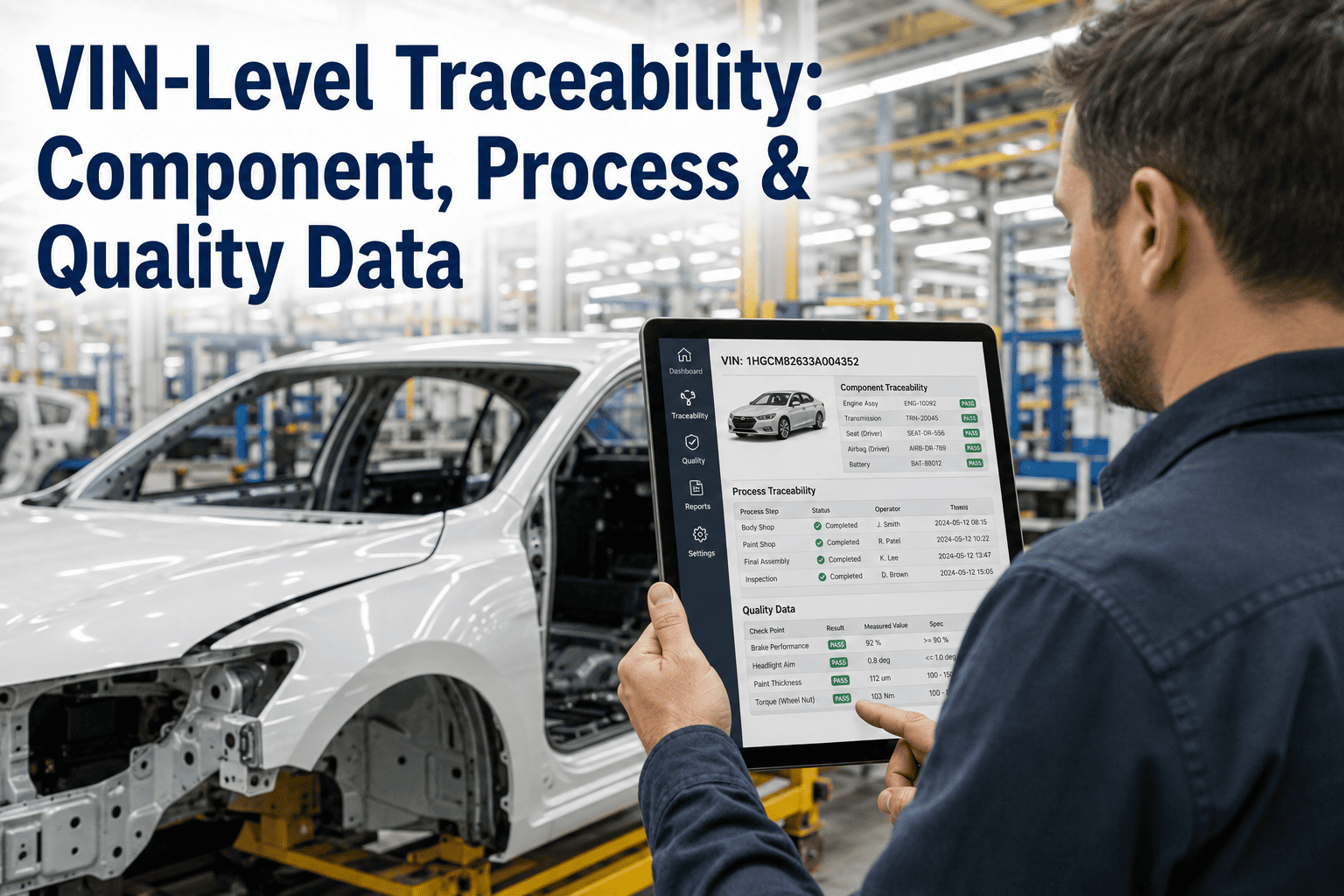
Automotive traceability is often described as one capability, but it actually depends on three separate systems staying connected to each other: supplier-side lot and shipment records, production-side process and quality data captured at each station, and vehicle-side assembly records that tie everything together under a single vehicle identity. A gap at any one of these links breaks the chain for every vehicle downstream of it.
Supplier Traceability
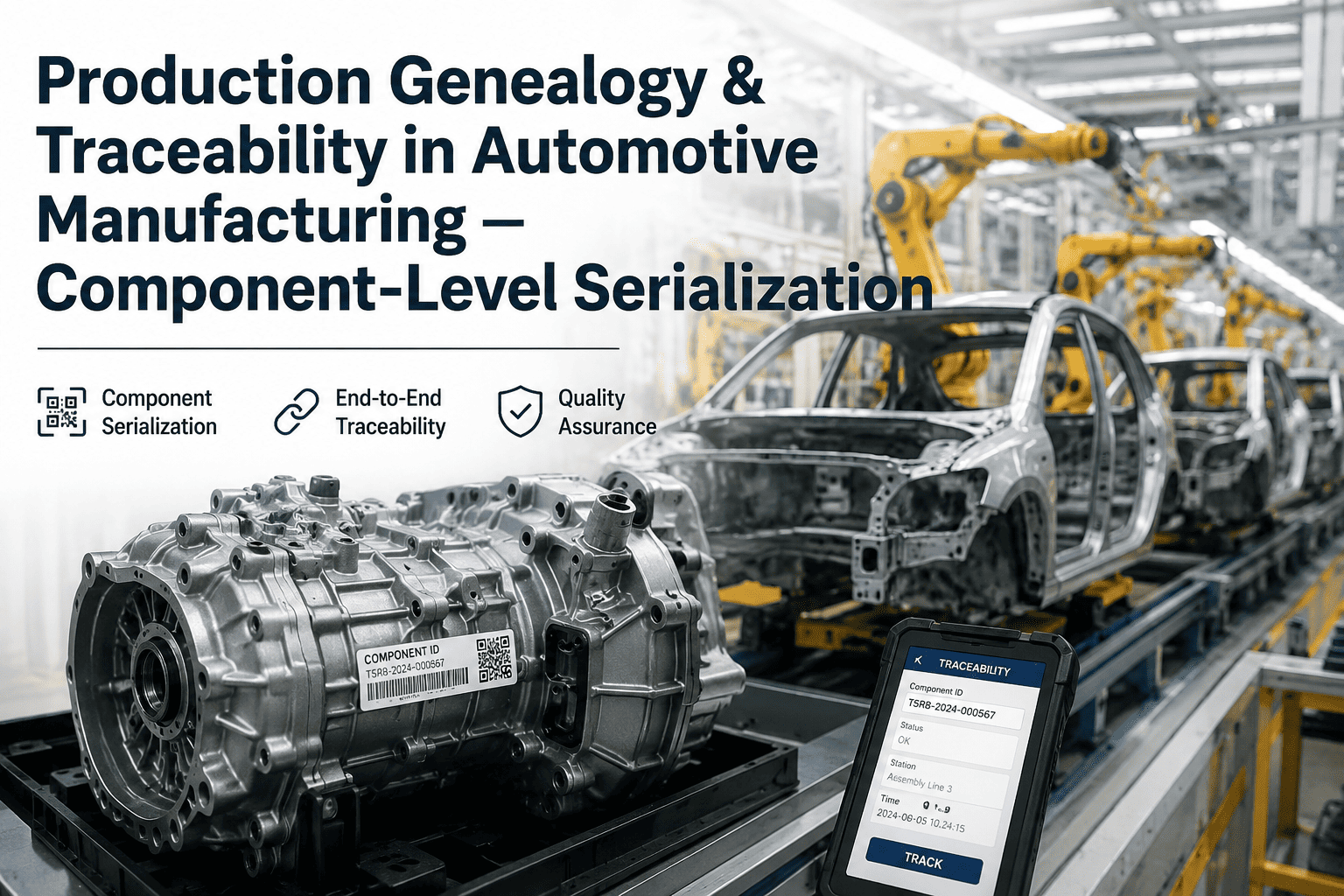
Links incoming components and raw materials to their originating supplier lot, batch, or heat number — the starting point for any investigation that begins with a supplier notification.
Production Traceability
Captures which process parameters, equipment, and operators touched a specific unit at each station, connecting component genealogy to what actually happened during assembly.
Vehicle Traceability
Ties the full component and process history together under a single vehicle identity, usually anchored to VIN, so the complete build record can be retrieved from one reference point.
Quality Linking
Associates inspection results and test outcomes at each stage with the same component and vehicle identity, so a quality issue can be traced back to its source as easily as a component can be traced forward.
Why Disconnected Systems Turn a Targeted Recall Into a Broad One
When supplier, production, and vehicle data live in separate systems that don't share a common identifier, answering a lot-level question requires manually cross-referencing spreadsheets or system exports — a process that's slow enough that plants frequently default to a wider recall scope than necessary, simply because narrowing it down with confidence would take longer than the response window allows.
| Traceability Maturity | Disconnected Systems | Connected End-to-End Chain |
|---|---|---|
| Lot-to-Vehicle Lookup Time | Hours to days of manual cross-referencing | Minutes, via a single query |
| Recall Scope Precision | Often broadened to stay safe under time pressure | Narrowed precisely to affected units |
| Process Data Association | Frequently missing or incomplete | Captured automatically at each station |
| Audit Response Time | Extended, dependent on manual data pulls | Rapid, since the chain is already connected |
Recall scope precision is worth dwelling on, because it's the line item that translates most directly into cost. A recall scoped to 4,000 vehicles instead of 40,000 because the affected lot could be traced precisely isn't just faster to execute — it's an order of magnitude cheaper, and it preserves customer trust in a way that an unnecessarily broad recall doesn't.
Close the Gaps Between Supplier, Production, and Vehicle Data
iFactory connects supplier lot records, production process data, and vehicle build history into one traceable chain, so a lot-level question gets answered in minutes.
Building the Chain: Where to Start
Standardize the identifier used at every link
Agree on a consistent component and lot identifier that carries through supplier receiving, production, and final vehicle records rather than being translated or dropped between systems.
Capture process data at the point of occurrence
Record which process parameters, equipment, and operators touched each unit automatically at the station itself, rather than reconstructing it later from paper travelers or shift logs.
Anchor everything to a single vehicle identity
Tie component genealogy and process history to the vehicle's own identifier as early in the build as possible, so the full record is retrievable from one reference point later.
Test the chain before you need it
Run a mock lot-to-vehicle lookup periodically to confirm the chain is actually intact, rather than discovering a gap for the first time during a real supplier notification.
A Composite Scenario: The Fastener Lot That Took Four Days to Trace
A Tier 1 automotive supplier received notice from its own fastener supplier of a heat-treatment inconsistency affecting a specific lot range. The plant's incoming inspection system recorded which lots had been received, but the assembly line's process data — which specific units had actually consumed fasteners from that lot range — lived in a separate system that wasn't linked to the receiving records by a shared identifier. Tracing the affected lot to specific finished units required manually cross-referencing receiving logs against approximate production date ranges, since the systems didn't share a common reference point.
The investigation took four days to narrow down with confidence, during which several thousand additional units shipped that couldn't be ruled out without a broader containment action. The plant's response afterward was to implement a shared lot identifier that carried through from receiving into the production system automatically, specifically so that a future lot-level question could be answered by a direct query instead of a multi-day manual reconciliation — a change that turned what had been a four-day investigation into something closer to a same-day lookup on the next occurrence.
Don't Wait for a Recall to Find Out Your Chain Has a Gap
iFactory links supplier, production, and vehicle data under a shared identifier from day one, so lot-level traceability is ready before you ever need it under time pressure.
Frequently Asked Questions
What's the difference between component traceability and vehicle traceability?
Component traceability tracks a single part or material from its supplier lot through production, while vehicle traceability ties every component and process record together under one vehicle identity, so a complete build history can be retrieved from a single reference point rather than reconstructed component by component. Visit support to see how the two layers connect in practice.
How quickly should a plant be able to answer a lot-level recall question?
With a fully connected traceability chain, a lot-to-vehicle lookup should take minutes rather than days, since the identifier carries through from supplier receiving to production to finished vehicle without requiring manual cross-referencing between disconnected systems.
Why do traceability gaps usually happen between systems rather than within one system?
Most individual systems — an ERP, an MES, a quality system — track their own data well, but the gap opens at the handoff between them when there's no shared identifier carrying through, which is exactly where a lot number or component ID can get lost or translated inconsistently. Book a demo to see how a shared identifier closes that handoff gap.
Does full traceability require replacing existing plant systems?
Not necessarily — the more common approach connects existing supplier, production, and quality systems through a shared identifier and a unifying platform layer, rather than replacing systems that are already working well individually.
How does traceability maturity affect recall cost?
A precisely scoped recall based on confirmed lot-to-vehicle traceability affects only the units actually impacted, while a broadly scoped recall driven by an inability to trace precisely can affect an order of magnitude more vehicles, with proportionally higher cost and customer impact. Contact support to evaluate your current traceability chain for gaps before they matter.