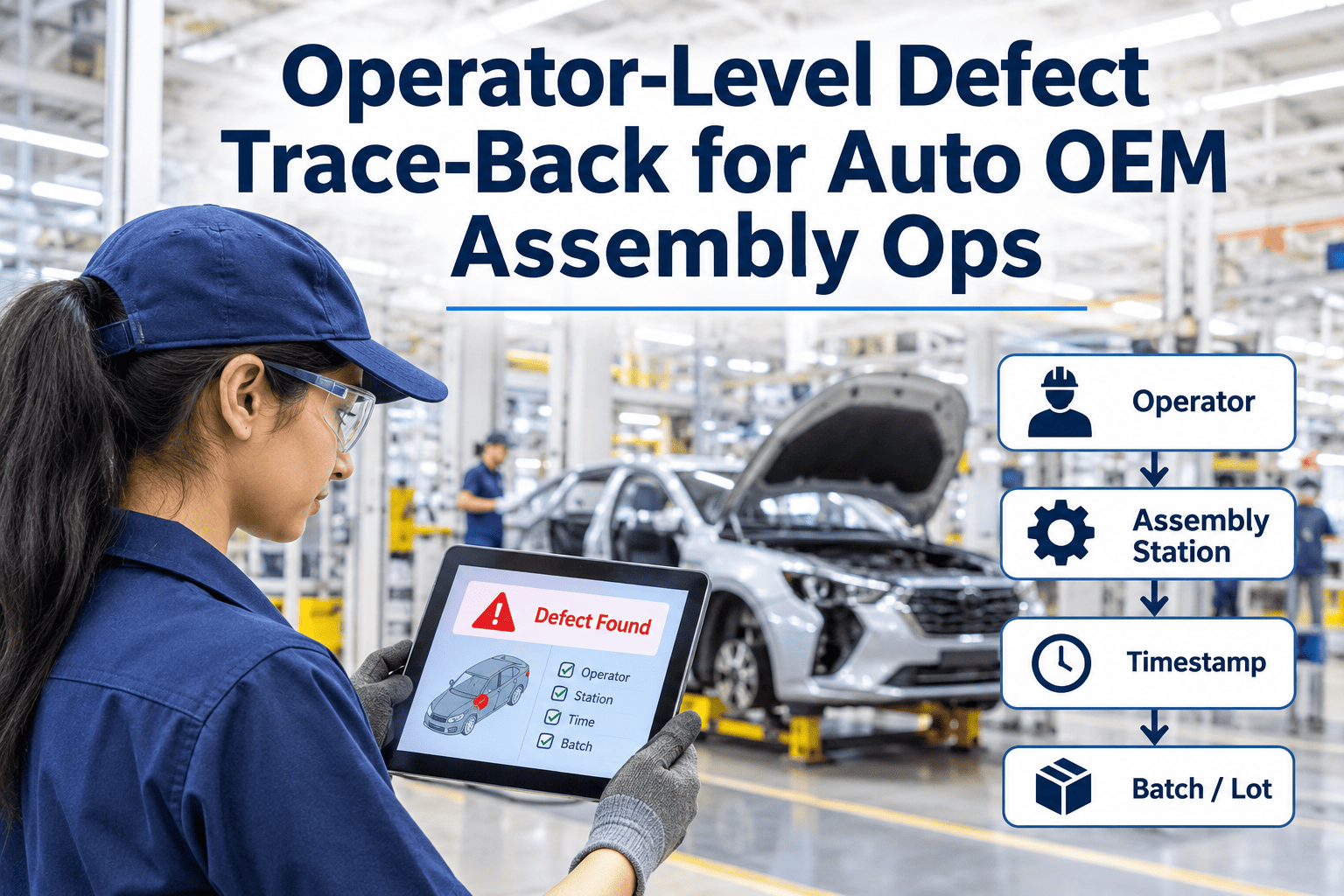
Operator-level data is the layer of traceability most plants are nervous to build, because the fastest way to make it useless is to treat it as a blame record instead of a pattern signal. Badge-scan capture, training-record linkage and shift-correlation analytics exist to answer a different question than "whose fault was this": they answer whether a defect pattern tracks with a training gap, a shift handover issue, or neither. iFactory AI's automotive quality team can review how operator-level data could be captured constructively on your line before adding this layer to your traceability system.
The Point Isn't "Who Did It" — It's "What Pattern Repeats"
Badge-scan capture, training-record linkage and shift-correlation analytics turn operator data into a constructive signal for training gaps and handover issues, not a blame log.
Why Operator Data Gets Skipped, and What That Costs
Many quality teams avoid operator-level capture entirely out of fear it will be misused, which is a reasonable concern but leaves a real blind spot: training gaps, handover issues and station-specific skill requirements all leave signatures in defect data that only operator context can reveal. The fix isn't to skip the layer, it's to build it so the output is a pattern across many shifts and many operators, never a single-incident report naming one person.
A defect type clustering around recently trained operators points to a curriculum issue.
Defects concentrated near shift change often point to a handover process gap.
A station with a defect rate correlated to tenure, not individual skill.
Without context, a correlation can be misread as blame if handled carelessly.
Building a Constructive Capture Model
The design choices made before capturing any data determine whether this layer helps the team or damages trust in it. Our team can walk through a non-punitive design for your assembly ops.
Station assignment logged automatically, removing manual reporting bias.
The correlation is with training completion dates, not performance reviews.
Report findings as "new-hire defect rate elevated for 30 days," not by name.
A confirmed pattern becomes a curriculum fix, not an individual consequence.
What Shift-Correlation Analytics Can and Can't Tell You
| Pattern Observed | What It Suggests | What It Doesn't Prove |
|---|---|---|
| Defects rise in first 30 days post-training | Training content or pacing gap | Which specific trainer or session was weak |
| Defects cluster near shift change | Handover process gap | Which shift is individually at fault |
| Defects correlate with a specific station only | Station difficulty or ergonomics issue | Operator competence at that station |
Find Your Training and Handover Patterns Without Naming Names
Review how pattern-level shift and training correlation could surface real process gaps on your line.
A Composite Scenario: The Defect That Wasn't About Any One Person
Picture an assembly line where a specific fastener defect kept recurring, with initial review tempted to flag it as an individual performance issue on the shift where it most often appeared.
Correlating against training records showed the defect rate was elevated for every operator in their first month at that specific station, regardless of shift, which reframed the issue entirely from an individual problem to a training curriculum gap for that station. Revising the training module for that station closed the pattern across all shifts. The scenario illustrates why pattern-level framing matters; actual causes vary by line.
Where iFactory AI Fits
iFactory AI captures station assignment through badge-scan data automatically, links it to training completion records, and surfaces correlation findings at the pattern level, so the output informs training and process decisions rather than individual performance reviews.
Badge-scan logging replaces manual reporting and its built-in bias.
Defect patterns connect to training dates, not personnel evaluations.
Findings surface as trends across groups, never a single-name report.
Frequently Asked Questions
Framing matters from the start — involve operator representatives in the design, report findings only at the pattern level, and explicitly route confirmed patterns to training fixes rather than individual consequences, which builds trust that the data serves the team. Discuss a rollout communication plan for your workforce.
A few months of defect data tagged with station, badge-scan timestamp and training completion date is usually enough to see whether new-hire defect rates are elevated relative to tenured operators at the same station. Review your current data readiness for this analysis.
For process improvement purposes, no — the value is in the aggregate pattern, and most plants keep individual-level data accessible only for legitimate purposes like training record-keeping, separate from any defect trend analysis shared with the broader team. Review access and reporting boundaries for this data.
Yes, a defect rate that spikes specifically in the window around shift change, regardless of which two shifts are involved, points to the handover process itself rather than either shift's individual performance. Ask how handover patterns are detected.
It's one layer alongside asset, tool, batch and parameter linkage, and its main value is ruling operator-related causes in or out during an investigation, rather than serving as a standalone system. See how it connects to your full matrix.
Turn Operator Data Into a Training Fix, Not a Blame Log
iFactory AI captures badge-scan and training data automatically and reports findings at the pattern level, so this layer helps the team instead of worrying it.