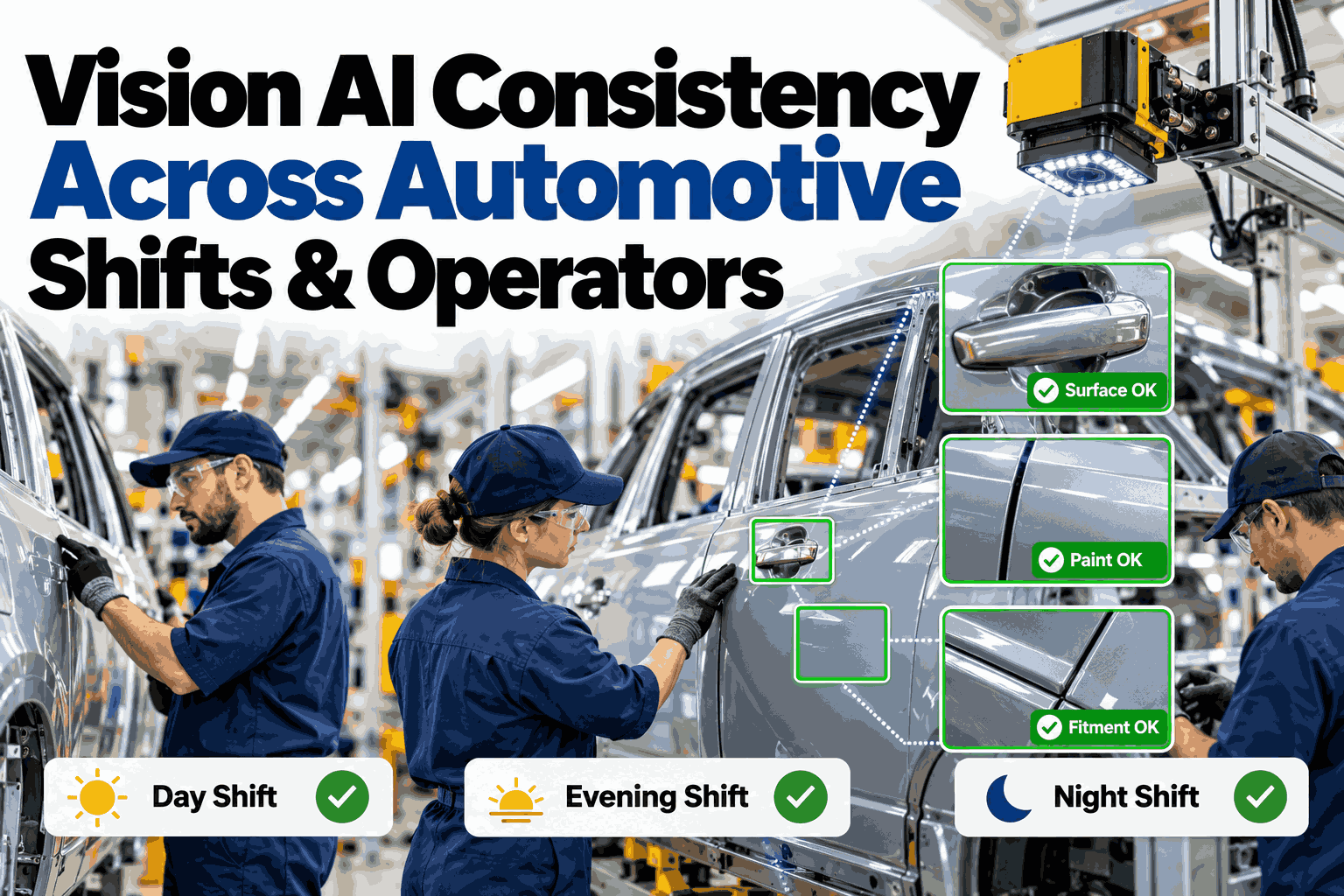
On many automotive lines, the same door panel can pass on the day shift and be held on the night shift, not because the part changed but because the people and conditions around it did. That gap creates disputes with customers, unpredictable rework and audit findings that are hard to explain. Vision AI closes it by applying one set of inspection criteria to every part, at every station, around the clock, and recording each result automatically. To see how this would look on your own stations, you can compare shift-by-shift results in a live walkthrough with our team.
Same Part, Same Verdict, Whatever the Shift or the Operator
iFactory AI standardizes automotive inspection criteria, scores every part without operator bias and logs each decision so quality stays consistent from first shift to last.
When the Verdict Depends on Who Is Standing at the Station
Manual inspection relies on judgment, and judgment shifts with experience, fatigue, lighting and line pressure. Two skilled inspectors can look at a borderline paint flaw and disagree.
This is not a people problem. It is a method problem, and a consistent method can be built.
Four Sources of Shift-to-Shift Drift
Before fixing the spread, it helps to see where it starts. This split is an illustrative example of how a typical visual check can break down.
Find Out How Much Your Shifts Disagree
Share sample parts and see how iFactory AI scores them against a single standard, then compare the result with your current shift data.
Turn a Vague Standard Into a Visual Rule Everyone Shares
The first step is not software. It is agreeing on what accept, marginal and reject look like, then encoding those limits so every station applies them identically.
Each defect type, such as paint dirt, weld spatter, gap and flush, scratches or missing parts, gets its own limits by zone and model. The limits above are an example of the structure, not a real specification.
How a Part Moves From Camera to Decision Without Opinion
Every part follows the same four-stage path, so no step depends on who is on shift.
Operators are not removed. They move from repeating the same judgment thousands of times to resolving the few cases where judgment truly adds value.
Every Decision Leaves a Record You Can Compare Across Shifts
Because results are logged the same way every time, shift comparisons become simple filters instead of paper searches. This sample log shows the idea.
| Time | Station | Part ID | Shift | Result | Reason logged |
|---|---|---|---|---|---|
| 06:12 | Paint check 2 | P-10482 | Day | Pass | All zones within limit |
| 15:47 | Weld check 1 | P-20931 | Evening | Review | Spatter near edge limit |
| 22:05 | Gap and flush 3 | P-30718 | Night | Reject | Gap above zone limit |
| 02:30 | Paint check 2 | P-10977 | Night | Pass | All zones within limit |
When a customer asks why a part was shipped or held, the answer is one lookup away. To learn how these logs can feed your quality reports, ask our team about reporting options.
Shrink the Gap Between Your Best and Worst Shift
The clearest proof of consistency is the spread between shifts. This illustrative view shows the range of defect call rates before and after standardizing.
A narrow range does not guarantee every call is right, so track accuracy against confirmed defects as well. Consistency and correctness must both improve.
A Calibration Rhythm That Prevents Drift Over Time
Consistency is maintained, not installed once. A simple rhythm keeps cameras, lighting and limits aligned.
What Automotive Quality Teams Ask About Consistency
See Operator-Independent Inspection Working on Your Line
Book a session with iFactory AI to review your inspection criteria, compare shift results and see how automotive vision software can deliver consistent, fully logged quality decisions.
.png)