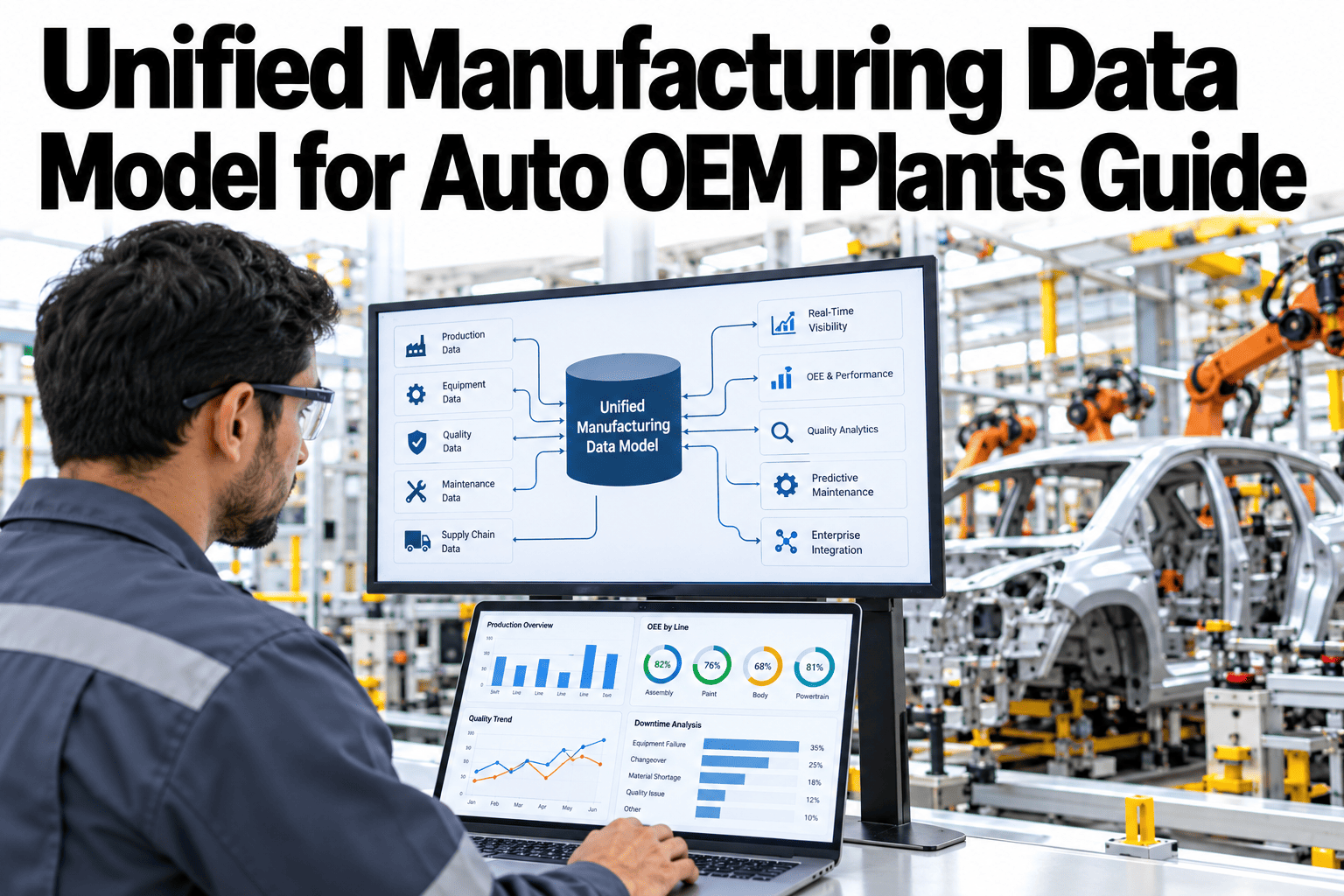
Most auto plants did not set out to build a tangle of incompatible data models. It happened gradually, one system at a time, each added to solve an immediate problem without a shared blueprint for how it should fit with everything already in place. A unified manufacturing data model is that missing blueprint, built once and used as the anchor for every system added afterward. Teams ready to put one entity model behind their analytics can book a demo with the iFactory AI team.
Unified Manufacturing Data Model for Auto OEM Plants Guide
An ISA-95 aligned entity model, a shared event schema and a versioning strategy, built once, anchor every system a plant connects afterward, instead of each new tool inventing its own structure.
Why ISA-95 Alignment Matters
ISA-95 is not a product, it is a shared language for describing manufacturing structure, from enterprise down to equipment. Aligning a plant's entity model to it means new systems, and new vendors, have a known structure to connect to rather than a custom one invented from scratch.
| ISA-95 Level | Plant Example |
|---|---|
| Enterprise | The automaker as a whole |
| Site | One assembly plant |
| Area | Body shop, paint shop, final assembly |
| Line and cell | A specific line, down to an individual station or robot |
The Core Entities
Underneath the ISA-95 levels sit the actual entities every analytics question depends on: assets, events and the KPIs calculated from them. Each needs a clear, stable definition before anything is built on top.
Asset
Anything physical the plant tracks, from a whole line down to a single robot arm, placed in the asset hierarchy.
Event
Anything that happens at a point in time, a downtime, a defect, a work order, tagged to an asset and a timestamp.
KPI
A calculated value derived from events, using a written definition that every system agrees to use.
Event Schema Consistency
An event schema is the specific set of fields every event record carries, regardless of which system generated it. Without a shared schema, each system's events look different enough that joining them becomes error-prone guesswork.
Inconsistent fields
One system's event has a station field, another calls it a location, a third omits it, making automated joins unreliable.
Consistent fields
Every event, regardless of source system, carries the same core fields, named the same way, ready to be joined automatically.
Anchor Every System to One Data Model
iFactory AI helps build an ISA-95 aligned entity model and event schema for your auto OEM plant. Book a 30-minute walkthrough.
Versioning the Model as the Plant Changes
A plant is never static. New lines get added, stations get renumbered, equipment gets replaced. A data model without a versioning strategy either breaks every time this happens or quietly accumulates inconsistency as old and new naming mix together.
Plain-Language Glossary
A shared vocabulary keeps IT, engineering and analytics teams reading the same data model the same way.
Expert Review
Data architects who have built unified models across auto OEM plants keep returning to the same two notes.
Don't skip versioning
Teams that build the entity model but skip a versioning strategy tend to see the model quietly degrade within a year, as the first line rebalance or renumbering breaks historical continuity.
Keep the schema minimal at first
A smaller, well-adopted event schema beats a comprehensive one nobody fully implements. Start with the fields every system can realistically provide, then expand.
Frequently Asked Questions
Do we need to adopt ISA-95 exactly as written?
No, most plants adapt it to their own structure while keeping the core levels consistent, since full literal compliance matters less than internal consistency. Book a demo to see an adapted ISA-95 model.
How big should the initial event schema be?
Smaller than most teams expect. A handful of core fields that every system can reliably provide outperforms a long list nobody fully implements.
What happens to historical data when the model changes?
A versioning strategy keeps historical records linked to their original identifiers, so past reports stay accurate even after a plant change. Ask support how versioning handles a specific plant change.
Can this model support multiple plants across our network?
Yes, a shared model is especially valuable across a plant network, since it is what allows performance to be compared consistently between sites. Book a demo to see a multi-plant data model.
Who should own the data model long term?
A joint ownership between IT architecture and plant engineering works well, since one understands system constraints and the other understands the floor.
Build the Blueprint Before the Next System
iFactory AI helps build a unified, versioned data model that anchors every system your auto OEM plant connects. Book a walkthrough built around your own architecture.