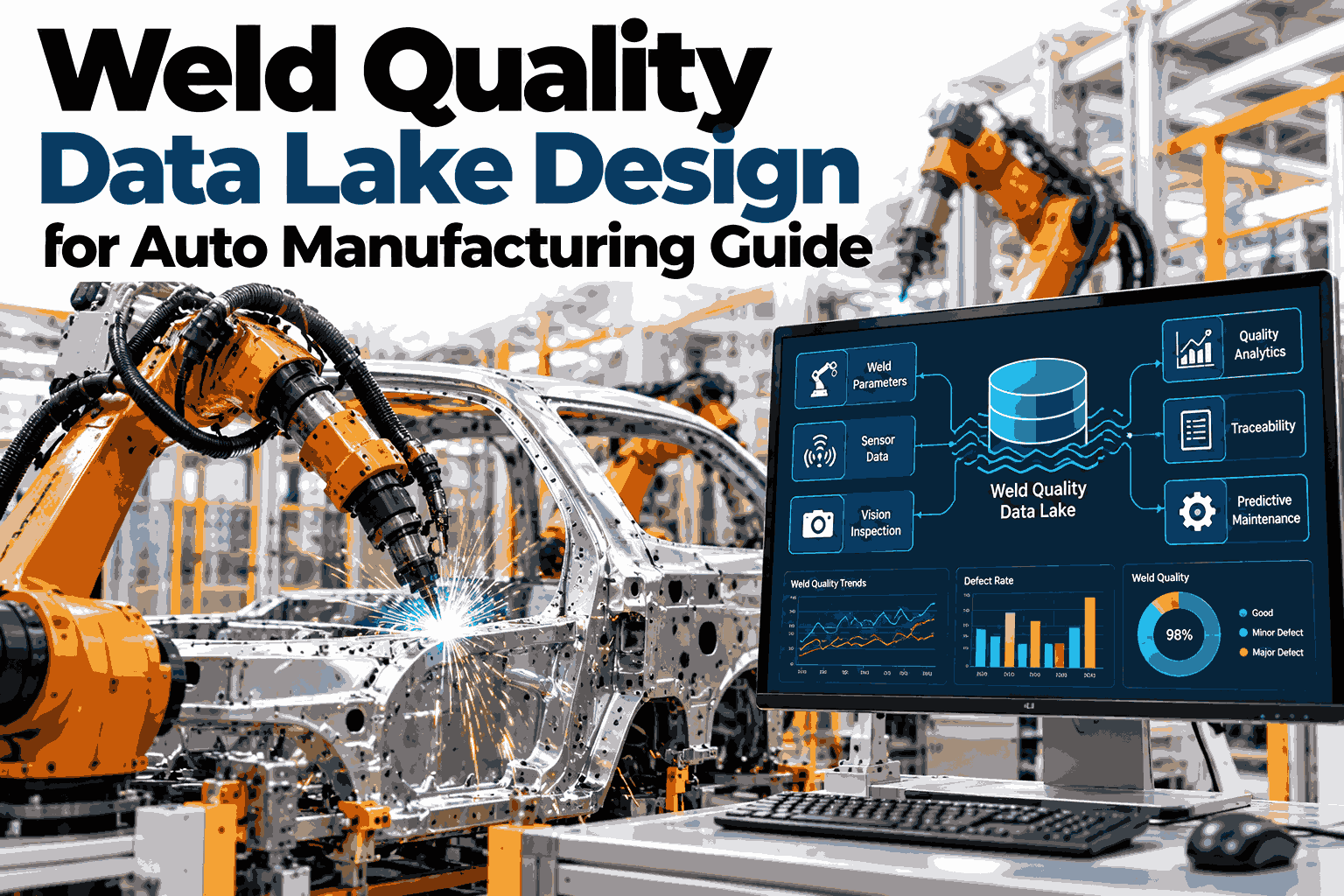
Most body shops already produce the raw material for weld analytics: thousands of waveforms per vehicle, every shift, every gun. The trouble is what happens next. Signals get summarized to a pass or fail flag, raw curves are overwritten within days, and a year later nobody can ask why one model year welded differently from another. A well-designed weld data lake keeps the evidence, organizes it for learning and stays affordable. Plant data teams can sketch a lake layout around their own controllers and MES in a working session before committing to storage.
Keep Every Weld Waveform. Learn From All of Them.
iFactory Automotive Weld AI designs the storage, curation and training layers that turn years of weld signals into predictions your quality team can use.
What Gets Lost When Only Summaries Survive
A pass flag answers today's question. A stored waveform answers questions nobody has thought to ask yet.
You cannot create a waveform later. Whatever you fail to store today is gone for every future model.
Three Zones, One Direction of Travel
Good lakes are organized as zones. Data moves forward through them and gets cleaner and more useful at each step.
Immutable, timestamped and never edited. It is the source of truth for audits and reprocessing.
Units standardized, welds matched to VIN, station, program and tip condition. Bad records are flagged.
Engineered features and labeled examples, versioned so any model can be reproduced later.
Storing Waveforms Without Drowning in Them
Waveforms are dense, and storing them naively gets expensive. The format you pick decides cost, speed and what analysts can do.
| Option | Strength | Watch Out For |
|---|---|---|
| Full-rate raw arrays | Maximum fidelity for research | Highest storage cost, slower scans |
| Columnar files by date and station | Fast filtering and strong compression | Needs disciplined partitioning |
| Downsampled curves plus features | Cheap and quick for dashboards | Loses fine detail for new questions |
| Time-series database only | Great for live trending | Poor fit for long-horizon training sets |
Size a Lake for Your Own Weld Volume
Share your gun count and weld points per body. We will outline a storage design and what each tier would hold.
Hot, Warm and Cold: Matching Cost to Value
Not every weld needs to be instantly searchable forever. Tiering keeps recent data fast and old data cheap, while still retrievable.
From Stored Signals to a Trained Model
The training pipeline is where storage design pays off. Clean lineage makes models trustworthy and repeatable.
Labels are the scarce asset. Linking a few destructive test results to their exact waveforms is worth more than millions of unlabeled welds.
Questions Only a Long Horizon Can Answer
Short retention limits you to today's problems. A lake that spans model years lets you ask bigger questions.
Did the new coating change our weld window?
Compare curves before and after the supplier switch on the same guns.
Is this station degrading slowly?
Trend months of signals instead of reacting to one bad shift.
Which launch behaved best?
Benchmark ramp-up stability across programs and plants.
Which vehicles share a risky condition?
Search history by pattern when an issue appears late.
Design Mistakes That Are Costly to Reverse
Most regrets come from early decisions that seemed minor. Check these before the first byte is written.
A Phased Build That Shows Value Early
Start narrow and prove usefulness before scaling storage.
Frequently Asked Questions
How much weld data will we actually generate?
It depends on weld points per body, sampling rate and production volume. Full-rate waveforms can grow quickly, which is why tiering and compression matter. Estimate your own yearly volume with our team using real station counts.
Should we build on cloud, on premises or both?
Many plants keep hot data close to the line for speed and push older data to cheaper cloud or archive storage. Security policy and OEM data rules often decide the split. The design should allow either without rework.
Do we need machine learning to benefit?
No. A curated lake already supports trending, audits and faster investigations. Models become the next step once labels exist. Decide which use case should come first in a short planning call.
How do we handle different controller brands?
Each brand's output is mapped once into a common schema in the curated zone. Raw data stays untouched, so the mapping can be corrected and rerun later without losing history.
Can the lake support traceability and recalls too?
Yes, since the same keyed, timestamped records serve both. A VIN search becomes a query against the curated zone. See one dataset serve analytics and traceability together on your own data.
Start Storing Weld Data Your Future Models Can Use
Bring your controller list and one pilot cell. We will outline a lake design, a tiering plan and a first model use case.