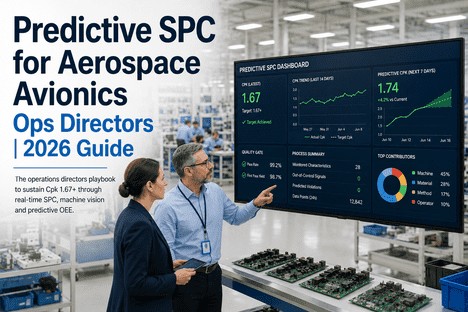
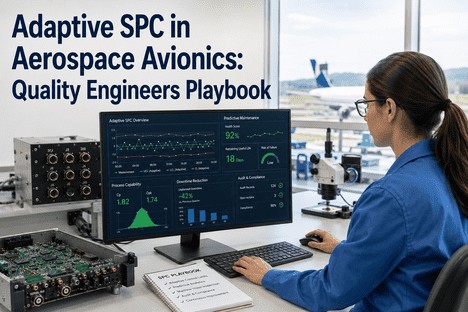
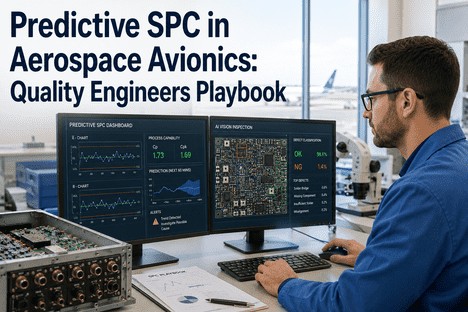
OEE in avionics assembly is not a number to report at shift handover — it is a diagnostic that tells the shift supervisor exactly where the line is losing time. When availability drops, something stopped production. When performance drops, something slowed it down. When quality drops, something produced defects that need sorting or rework. The insight that separates a top-quartile avionics operation from the rest is not the ability to calculate OEE after the fact — it is the ability to predict which component of OEE will drop next and intervene before the loss compounds. Predictive SPC gives shift supervisors that foresight: real-time control charts that catch process drift before it becomes a quality event, adaptive limits that eliminate false alarm noise, and ML-driven forecasts that flag tomorrow's OEE risk on today's dashboard. This is how avionics supervisors use Predictive SPC to lift OEE by 10 to 20 points — and why best-in-class avionics SMT lines have already made the transition.
Real-Time Control Charts · Adaptive Limits · ML Forecasts · AS9100 Records
Avionics Supervisors Are Lifting OEE 10-20 Points With Predictive SPC — Not Shift-End Reports.
iFactory's Predictive SPC platform gives shift supervisors real-time control charts on every parameter, adaptive UCL/LCL boundaries that eliminate false alarm desensitisation, and ML-driven OEE forecasts that identify tomorrow's loss events on today's dashboard — all in one quality intelligence layer built for aerospace electronics.
OEE point improvement achievable in avionics lines when Predictive SPC replaces retrospective control charts with real-time process monitoring and ML-driven forecasting
42%
Of aerospace OEE losses attributed to inspection pauses — the single largest loss category that digital SPC and real-time quality monitoring directly eliminate from the availability calculation
50-70%
False alarm reduction when adaptive control limits replace static UCL/LCL thresholds — restoring operator response rates and eliminating the quality-loss events that false alarms miss
82%
OEE achievable by best-in-class avionics SMT lines using Predictive SPC — a 17-plus point gain over the 65% median that most aerospace electronics operations currently report
The Three OEE Levers: How Predictive SPC Moves Each One
OEE is the product of three factors — Availability, Performance, and Quality — and each factor responds to a different dimension of Predictive SPC capability. Shift supervisors who understand which lever each Predictive SPC capability addresses can deploy the system to move the specific OEE components that matter most on their line.
Availability
Reducing Inspection Pauses and Micro-Stops
Current OEE Contribution42% of total loss
Inspection pauses account for 42% of all OEE losses in aerospace manufacturing — the single largest loss category. Each first-article inspection, each AOI verification hold, each manual microscope review stops the line while quality data is collected and transcribed. Predictive SPC eliminates the latency by embedding real-time quality measurement into the production flow: control charts update with every board, adaptive limits flag deviations immediately, and the supervisor sees quality status without stopping the line for a manual check. The inspection pause that used to cost 30 minutes of availability per occurrence becomes a glance at the dashboard.
Target: +5 to 8 Availability points
Performance
Eliminating Speed Loss From Rework Loops
Current OEE Contribution28% of total loss
Performance loss in avionics assembly is driven primarily by rework loops and documentation waits — boards that complete the production pass but cannot proceed because an inspection hold has not been released, or boards that must be pulled from the flow for defect review and rework. Predictive SPC reduces performance loss by identifying defect risk before the board enters the rework queue. When the system forecasts a solder paste volume drift that will produce marginal joints, the supervisor adjusts the printer parameters on the next board — not after 30 boards have been produced and 15 require rework at end-of-line.
Target: +3 to 6 Performance points
Quality
Catching Defects Before They Reach End-of-Line
Current OEE Contribution30% of total loss
Quality loss is the most visible OEE component — scrap boards, reworked assemblies, customer escapes, and the containment actions each defect triggers. Predictive SPC addresses quality loss at the source rather than at the inspection gate. Real-time control charts on solder paste deposition, reflow profile parameters, and placement accuracy catch process drift at the individual board level. When four of five consecutive boards show a placement offset trending toward the spec limit, the Western Electric Rule 3 alert fires — and the supervisor adjusts the pick-and-place nozzle before a nonconforming board is produced.
Target: +4 to 7 Quality points
Six Predictive SPC Capabilities That Drive OEE From the Supervisor's Console
Predictive SPC is not a single feature — it is a connected set of capabilities that together convert raw process data into OEE-improving actions. Each capability addresses a specific loss category and each one is accessible from the supervisor's dashboard without requiring data analysis skills or quality engineering support.
01
Real-Time Control Charts on Every Parameter
Every monitored process variable — solder paste height, reflow zone temperature, placement force, conveyor speed — displays on a live Shewhart control chart that updates with every new data point. The supervisor sees which parameters are in control, which are trending, and which have triggered a Western Electric rule pattern — without opening a spreadsheet or waiting for a quality report.
OEE impact: Eliminates the 30-minute inspection pause for chart review. Availability gain on every shift.
02
Adaptive UCL/LCL That Track Process Regime Changes
Control limits that recalibrate automatically when the process mean shifts — product changeovers, reflow profile adjustments, new solder paste batches. The supervisor does not manually recalculate limits. The system suppresses false alarms during transitions and re-establishes accurate boundaries once the new regime is stable.
OEE impact: 50-70% false alarm reduction. Operator response credibility restored. Quality alerts acted on, not ignored.
03
All Eight Western Electric Rules — Every Second
Not just Rule 1 (point beyond 3-sigma). Rules 2 through 8 evaluate pattern-based drift — trends, runs, stratification, alternation, and mixture — on every parameter every second. The supervisor catches the gradual solder paste volume decline that Rule 5 (trend) flags before it crosses the spec limit that would trigger a quality event.
OEE impact: Catches drift at the trend stage, before it becomes a quality loss event. 4-7 quality points recovered.
04
ML-Driven OEE Loss Forecasting
The predictive ML model ingests control chart trends, process parameter streams, and shift context data (shift hour, operator team, product type) and outputs a shift-level OEE forecast. The supervisor sees not just what OEE was last shift, but what OEE is projected for the current shift and which loss category is most likely to degrade it.
OEE impact: Proactive loss prevention. Supervisor intervenes on the forecasted OEE risk before it materialises.
05
Live Cpk Trending Against the 1.67 Target
Cpk calculated continuously for every quality characteristic and displayed as a live trend line against the AS9100 minimum of 1.67. The supervisor sees capability moving in real time — not as a batch report at the end of shift. A Cpk trend declining toward 1.33 triggers an alert before the process produces nonconforming boards.
OEE impact: Quality loss prevented at the process level. Cpk stays above target; scrap rate stays below threshold.
06
One-Click AS9100 Audit Documentation
Every control chart data point, every limit recalculation, every Western Electric rule alert, every Cpk value, and every supervisor action is logged automatically with timestamp and product context. Audit documentation — control limit histories, defect event logs, Cpk trend exports — is generated for any date range with a single click.
OEE impact: AS9100 audit prep drops from days to minutes. Documentation is never the reason for a line stop.
The OEE Improvement Journey: From Baseline to Best-in-Class
The progression from typical avionics OEE to best-in-class follows a predictable path — each stage characterised by a specific capability deployment that unlocks the next tier of OEE performance. Shift supervisors leading this progression move from reactive loss accounting to predictive loss prevention in three stages.
Stage 1
Baseline
Paper SPC, Manual Charts, End-of-Line Inspection
Control charts updated by hand or reviewed at shift handover. Inspection data transcribed from paper to digital after the fact. OEE calculated from shift-end tallies. False alarms from static limits ignored because most are noise.
55-65%
Stage 2
Digital SPC
Real-Time Charts, Adaptive Limits, Digital Records
Control charts live on every parameter. Adaptive limits eliminate false alarms. All eight Western Electric rules run continuously. Inspection pauses drop as quality status is visible in real time. AS9100 records generate automatically.
70-78%
Stage 3
Predictive
ML Forecasts, OEE Prediction, Preventive Intervention
ML models forecast OEE for the current shift. The supervisor sees which loss category will degrade and intervenes before the loss compounds. Cpk trends predict quality risk 24 hours ahead. Best-in-class OEE sustained across product mix changes.
78-84%
"
We deployed Predictive SPC on our primary avionics SMT line in February 2026. Within 90 days, OEE moved from 62% to 79%. The biggest single gain came from eliminating inspection pauses — our operators had been stopping the line for 20 minutes every two hours to record SPC data on paper and transcribe it into the quality system. With real-time control charts on the dashboard, that 20-minute pause disappeared. The operators saw quality status live and never had to stop to check a chart. The second gain came from the false alarm reduction. Our static limits were generating 30-plus alarms per shift during product changeovers. The operators had learned to ignore them. When adaptive limits brought that down to two or three genuine alerts per shift, they started responding again — and the quality loss events that the false alarms were masking became visible and actionable.
OEE in avionics assembly has been stuck at 55 to 65% for most operations not because the equipment cannot run faster or the workforce cannot produce more — but because the quality detection architecture forces the line to stop more than it needs to, wait more than it should, and rework more than it must. Inspection pauses consume 42% of available time. Static control limits generate false alarms that desensitise operators to genuine drift signals. End-of-line inspection catches defects that could have been prevented at the process level with a control loop that operated fast enough for human intervention.
Predictive SPC addresses each of these loss categories at their structural source rather than their symptom level. Real-time control charts eliminate the inspection pause by putting quality status on the dashboard rather than on paper at the end of the line. Adaptive limits restore alert credibility by reflecting current process conditions rather than the conditions of the last capability study. All eight Western Electric rules running continuously on every parameter catch drift at the trend stage — before a single nonconforming board is produced. ML-driven OEE forecasting gives the supervisor the one capability that separates best-in-class operations from the rest: the ability to see tomorrow's loss event on today's dashboard and intervene before it compounds.
iFactory's Predictive SPC platform is built for avionics shift supervisors who need to lift OEE by 10 to 20 points without adding headcount, replacing equipment, or waiting for the next quality programme cycle. Book a Demo to see the Predictive SPC dashboard configured for your avionics line and product mix, or talk to an expert about a free OEE assessment for your avionics operation.
Frequently Asked Questions
Inspection pauses in avionics assembly fall into two categories: scheduled quality checks (first-article inspection, SPC data collection, control chart review) and unscheduled holds triggered by a quality finding at end-of-line inspection. Predictive SPC addresses both. For scheduled checks, real-time control charts on the supervisor's dashboard eliminate the need to stop the line for manual data collection and chart review — the chart is live, the data is current, and the quality status is visible without stopping. For unscheduled holds, the predictive capability identifies defect risk at the process level before the board reaches end-of-line inspection, so the supervisor can adjust process parameters and prevent the defect from forming — which eliminates the hold event entirely. The combination typically recovers 30 to 50% of the inspection pause time in the first 30 days of deployment, contributing 4 to 6 points of Availability improvement. Talk to an expert about estimating inspection pause recovery for your specific line configuration.
A standard OEE calculation is a retrospective metric — it tells the supervisor what the OEE was for the completed shift or production run. The ML-driven OEE forecast is a predictive metric: it ingests current process variable data, control chart trends, Western Electric rule activity, and shift context information, then projects what the OEE will be at the end of the current shift if no intervention occurs. The forecast is expressed as a specific OEE percentage with the primary loss category driving the projection. For example, the forecast might show "Projected OEE: 71% — primary risk: Performance loss from rework queue accumulation on Line 3." This gives the supervisor a specific, actionable intervention target rather than a general awareness that OEE might decline. The ML model improves its forecast accuracy over time as it learns the specific loss patterns of the line — typically reaching 90%+ accuracy within 4 to 6 weeks of deployment. Book a Demo to see the OEE forecast configured for an avionics production line.
Yes. The platform maintains separate OEE baselines, control limit profiles, and Cpk targets for each product type registered in the system. When the line changeover occurs and the new product type is scanned, the adaptive limits, control chart configurations, and OEE baseline all transition automatically to the correct profile for the new product. The supervisor sees the OEE trend for the current product type, not a blended number that mixes different product baselines. Historical OEE data is segmented by product type, shift, and operator team — giving the supervisor the ability to compare performance across products on the same line. This multi-profile architecture is essential for high-mix avionics operations where a single SMT line may run 8 to 12 different board types in a week, each with different complexity levels, component densities, and quality specifications. Book a Demo to see multi-product OEE tracking configured for a high-mix avionics production programme.
iFactory connects to existing MES and OEE systems through standard industrial integration protocols — OPC-UA, REST APIs, and SQL-based connectors. The platform reads production data (run counts, downtime events, cycle times) from the MES and enriches it with quality data from the Predictive SPC engine (control chart status, Western Electric rule alerts, Cpk values). The combined data stream feeds both the Predictive SPC dashboard and the existing OEE system, so the supervisor has a single source of truth for both quality and OEE metrics without duplicating data entry. For operations using paper-based OEE tracking, the platform provides direct data entry interfaces that capture OEE data at the source and eliminate the transcription step. In either case, the OEE calculation uses verified production data paired with verified quality data — not estimates, not manual tallies, and not data from separate systems that never reconcile at the end of the shift. Talk to an expert about integrating Predictive SPC with your existing MES and OEE infrastructure.
42% of Your OEE Losses Come From Inspection Pauses — and Predictive SPC Eliminates the Structural Reason for Them. Get a Free OEE Improvement Assessment.
iFactory's Predictive SPC platform for avionics shift supervisors — real-time control charts on every parameter, adaptive UCL/LCL that eliminate false alarm noise, all eight Western Electric rules live, and ML-driven OEE forecasting that converts reactive loss tracking into preventive loss elimination.